

(UroToday.com) The American Urologic Association (AUA) 2025 Annual Meeting, held in Las Vegas, NV, was host to a bladder cancer epidemiology and evaluation moderated poster session. Dr. Christopher Filson presented a study assessing the clinical utility of a urinary biomarker, CxBladder Triage, compared to standard of care for the evaluation of microscopic hematuria in a large independent delivery network.
Hematuria remains a costly and burdensome condition for patients and physicians due to the patient volume and invasive nature of testing (e.g., cystoscopy, CT). Cxbladder Triage is a urine test that uses mRNA biomarkers and clinical information to classify a patient’s risk of having bladder cancer. The standard of care (SOC) evaluation for microscopic hematuria patients within Kaiser Permanente – Southern California (KP-SCAL) relies on a validated Hematuria Risk Index to guide the use of cystoscopy and type of imaging modality.
The objective was to evaluate the real-world utility of adding the Cxbladder Triage test to the standard KP-SCAL microscopic hematuria diagnostic workflow. The study inclusion criteria were as follows:
- Urinalysis with microscopic hematuria (>3-50 RBC/HPF)
- Encounter with urologist (September 2021 – September 2024)
- Patient ages 35–88 years
- Six months of KP membership before and after encounter
The exclusion criteria were as follows:
- Gross hematuria within 6 months prior to encounter
- Prior diagnosis of bladder cancer
The study investigators identified patients who received the Cxbladder Triage test and created a 1:1 matched cohort of non-tested patients (e.g., SOC) based on date of encounter and hematuria risk index. The patients were divided into two groups, based on Cxbladder Triage result:
- Low probability of bladder cancer (<4.00)
- Physician-directed protocol (≥4.00)
The study outcomes were:
- Cystoscopy within 6 months
- CT urography within 6 months
- Bladder cancer diagnosis (ICD C67.x) within 6 months and 1 year
The baseline patient characteristics are summarized below:

Of 5,242 patients who received the Cxbladder Triage test, 3,353 (64%) were included for analysis and matched 1:1 with SOC patients. 80% of Cxbladder Triage tests showed low probability of bladder cancer.
The use of cystoscopy was as follows:
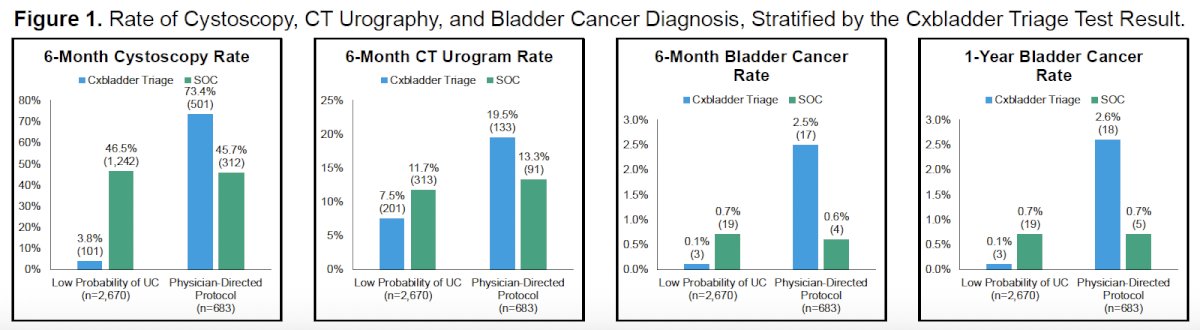
- Low-probability Cxbladder result: 3.8% vs 46.5% without a test (p<0.01)
- Physician-directed protocol: 73.4% vs 45.7% without a test (p<0.01)
Cxbladder Triage testing significantly decreased CT urogram use among low-risk microscopic hematuria patients (7.5% vs 11.7%), while simultaneously increasing use among higher-risk patients (19.5% vs 13.3%).
At 6 months, the overall cancer detection rates were similar between those who received the Cxbladder Triage test (0.6%) and their matched cohort (0.7%; p=0.654).
Dr. Filson concluded as follows:
- This study population avoided 952 cystoscopies (284 per 1,000 referrals for hematuria) and 70 CTs (21 per 1,000 referrals).
- Cxbladder Triage testing significantly decreased cystoscopy and imaging utilization among low-risk microscopic hematuria patients, while simultaneously increasing use among higher-risk patients.
- Further population-level evaluations of the Cxbladder Triage test are warranted to reduce the burden of unnecessary cystoscopy.
Presented by: Christopher Filson, MD, Kaiser Permanente, Los Angeles, CA
Written by: Rashid K. Sayyid, MD, MSc – Robotic Urologic Oncology Fellow at The University of Southern California, @rksayyid on Twitter during the 2025 American Urological Association (AUA) annual meeting held in Las Vegas, NV, Saturday, April 26 - Tuesday, April 29, 2025
Related Content: Advancing Microhematuria Evaluation: The Impact of Urinary Biomarkers and Updated Guidelines - Jay D. Raman & Yair Lotan
Real-World Implementation of Biomarkers for Microhematuria Workup - Ronald Loo & Christopher Filson