

(UroToday.com) The American Urologic Association (AUA) 2025 Annual Meeting, held in Las Vegas, NV, was host to a non-invasive bladder cancer podium session. Dr. Yijun Shen presented the preliminary efficacy and safety results from a prospective, open-label, single center study evaluating disitamab vedotin combined with BCG for the treatment of high-risk, non-muscle invasive bladder cancer (NMIBC) patients with HER2 expression.
The current treatment for high-risk NMIBC involves BCG therapy or radical cystectomy, especially for patients with very-high-risk features. However, 40–60% of high-risk NMIBC patients will relapse after BCG treatment. Moreover, there is a high incidence of postoperative complications and a negative impact on health-related quality of life after radical cystectomy.
Disitamab vedotin is a novel antibody drug conjugate that targets the HER2 protein; however, its efficacy and safety in high-risk NMIBC remain relatively unknown. As such, Dr. Shen and colleagues conducted a prospective, open label, single-center study to evaluate the efficacy and safety of disitamab vedotin combined with BCG in high-risk NMIBC patients.
In this study, two cohorts of BCG-naive patients with very-high-risk features who refused to undergo radical cystectomy or did not meet the requirements of radical cystectomy with HER2 expression (IHC 1+/2+/3+) were enrolled in two cohorts:
- Cohort A: patients were unable to undergo complete tumor resection or had CIS
- Cohort B: patients underwent complete tumor resection
All patients were planned for eight cycles of disitamab vedotin injected intravenously (2mg/kg, once every three weeks) and at least one year of BCG intravesical instillation.
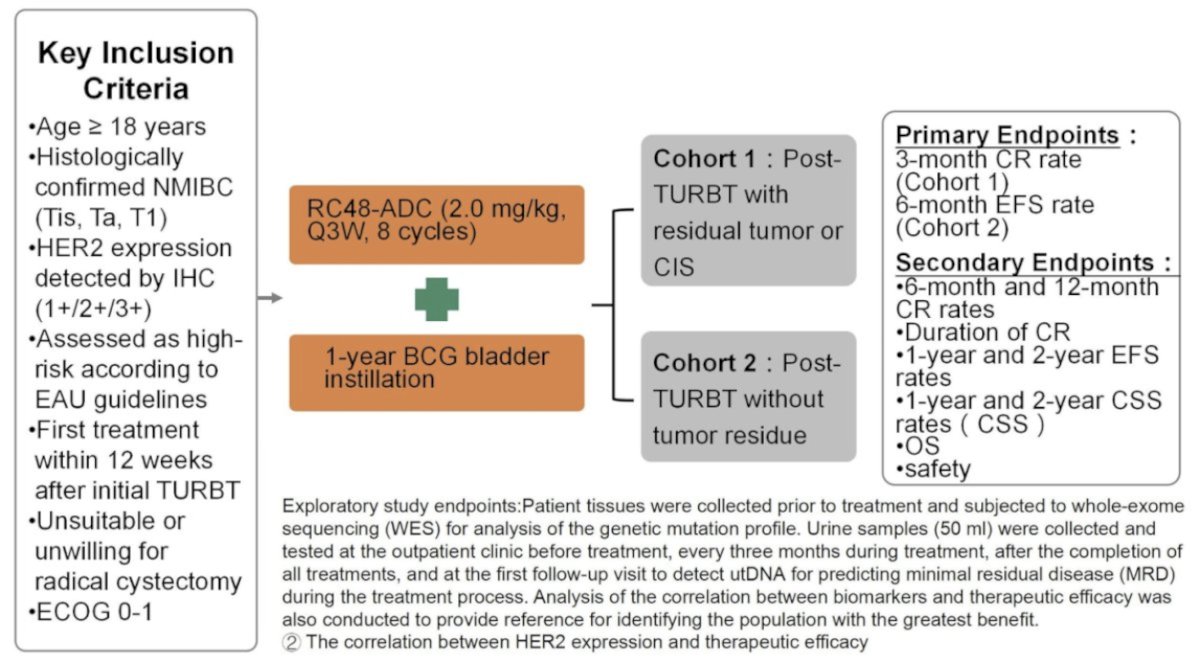
The primary endpoints included the 3-month clinical complete response rate in Cohort A and the 6-month event free survival rate in Cohort B. The secondary endpoints were additional efficacy and safety endpoints.
From December 2023 to August 2024, 20 eligible patients (16 male; 4 female) were enrolled, with 15 patients in Cohort A and 5 patients in Cohort B. Overall, 17 patients had HER2 high expression (2+ or 3+), and 3 had HER2 low expression (1+).
At the cut-off date (September 12, 2024), the clinical complete response rates at 3 months and 6 months were both 100% in 11 and 5 patients, respectively, from Cohort A. The 6-months event-free survival rate in the 3 evaluable patients in Cohort B was also 100%.
Thirteen of 20 patients (65%) experienced treatment-related adverse events. The most common treatment-related adverse events were:
- AST/ALT increase: 40% (8/20)
- Alopecia: 45% (9/20)
- Peripheral sensory neuropathy: 35% (7/20)
- Anorexia: 10% (2/20)
- Rash: 5% (1/20)
Grade 3 treatment-related adverse events occurred in 10% (2/20) of patients, with one peripheral sensory neuropathy caused by disitamab vedotin and one hematuria caused by BCG. BCG-related adverse events were reported in 12/20 (60%) patients, including bladder irritation, fever, arthralgia, conjunctivitis, and hematuria.
Dr. Shen concluded this presentation discussing a prospective, open label, single-center study assessing the preliminary efficacy and safety of disitamab vedotin combined with BCG in the treatment of high-risk NMIBC with HER2 expression, with the following take-home points:
- This was the first study to evaluate disitamab vedotin in combination with BCG in the treatment for high-risk NMIBC
- Preliminary results showed the combination had promising efficacy with a manageable safety profile
- This may potentially provide a new bladder-sparing therapy for very high-risk NMIBC patients with HER2 expression who refused radical cystectomy or did not meet the requirements of radical cystectomy
Presented by: Yijun Shen, MD, Department of Urology, Fudan University Shanghai Cancer Center, Shanghai, China
Written by: Rashid K. Sayyid, MD, MSc – Robotic Urologic Oncology Fellow at The University of Southern California, @rksayyid on Twitter during the 2025 American Urological Association (AUA) annual meeting held in Las Vegas, NV, Saturday, April 26 - Tuesday, April 29, 2025