

(UroToday.com) During the 2023 American Urological Association’s Late Breaking Abstract II - Cancer session, Dr. Paulo Lages provided a presentation exploring the effect of learning curve on the performance of PSMA-PET scans based on an analysis of detection rate according to Gleason score and PSA.
Dr. Lages began his presentation by reviewing that over the past several years, PSMA PET-CT scans have been increasingly utilized in staging men with localized high-risk prostate cancer and biochemically recurrent disease after treatment, often resulting in changes in management. Prior studies have noted that PSMA-PET positivity rate is correlated with both PSA level, as well as Gleason grading.
The authors objective in this study was to analyze the association of combined PSA and Gleason score with PSMA-PET detection rates. Using a large institutional database of patients with biochemical recurrence (BCR) who underwent PSMA-PET scan between October 2015 and July 2022). Patients were stratified based on the timing of the exam, and a retrospective review was performed.
From 2015 to 2019, the authors identified 351 exams, with 303 being performed for recurrent disease. From 2021 to 2022, the authors identified 351 exams, with 303 being performed for recurrent disease. Dr. Lages pointed out the increase in PSMA-PET utility in the latter timeframe. Specifically, PSMA PET scans were performed at lower PSA levels, with higher detection rates at lower PSA levels noted in the latter timeframe.
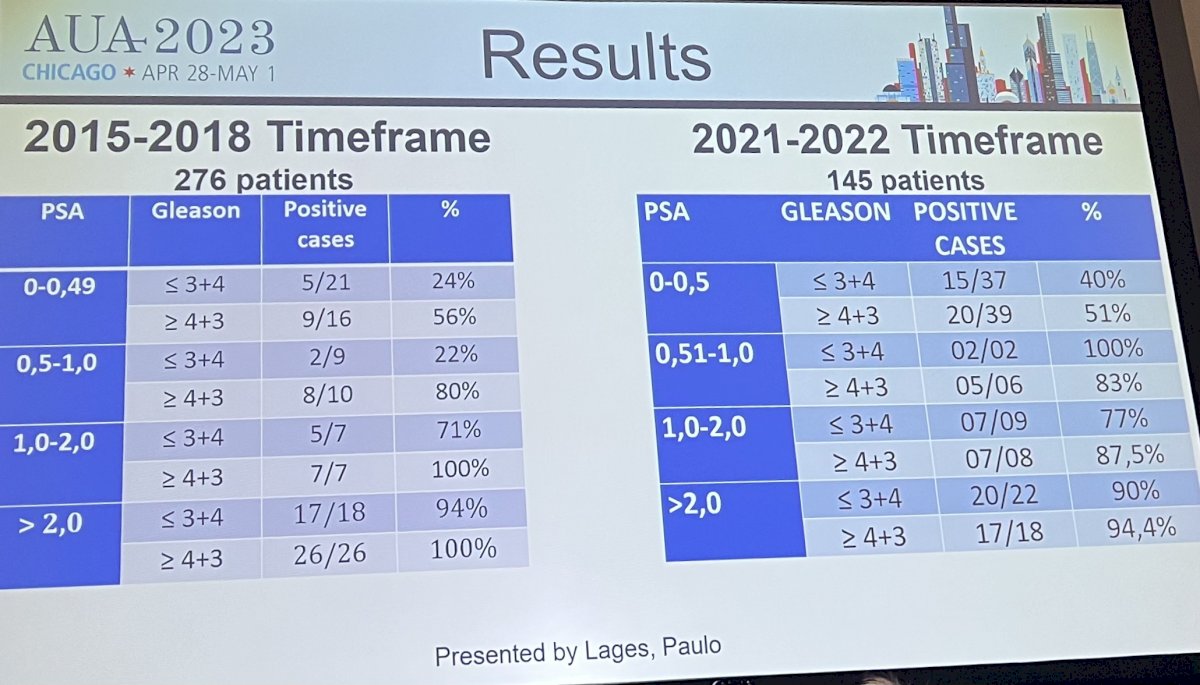
Dr. Lages hypothesized that this difference may be due to the learning curve associated with accurate PSMA-PET interpretation.
He concluded the presentation as follows:
- There was a clinically relevant increase in the detection rate for patients with PSA levels between 0 and 0.5, and Gleason Score ≤ 3+4.
- A similar detection rate was noted among other clinicopathologic characteristics.
- This data supports team training during the adoption phase of PSMA-PET scan to ensure accurate analysis of results
Presented by: Paulo Lages, MD, GU Oncology, Oncoclinicas, DF
Written by: Ruchika Talwar, MD, Urologic Oncology Fellow, Vanderbilt University Medical Center, during the 2023 American Urological Association (AUA) Annual Meeting, Chicago, IL, April 27 – May 1, 2023
References:- Hofman MS, et al. Prostate-specific membrane antigen PET-CT in patients with high-risk prostate cancer before curative-intent surgery or radiotherapy (proPSMA): a prospective, randomised, multicentre study. Lancet 2020
- Fendler WP, et al. Assessment of 68Ga-PSMA-11 PET Accuracy in Localizing Recurrent Prostate Cancer: A Prospective Single-Arm Clinical Trial. JAMA Oncol. 2019