

(UroToday.com) The 2025 ASTRO annual meeting featured a biomarker breakthroughs in prostate cancer session and a presentation by Kylie Morgan discussing the influence of HSD3B1 genotype on prostate cancer outcomes following definitive radiation therapy with ADT.
The adrenal-permissive HSD3B1(1245C) allele has been associated with resistance to ADT leading to poorer outcomes in men with advanced prostate cancer. However, whether HSD3B1 genotype affects curative therapy outcomes for men undergoing radiotherapy with ADT is unknown: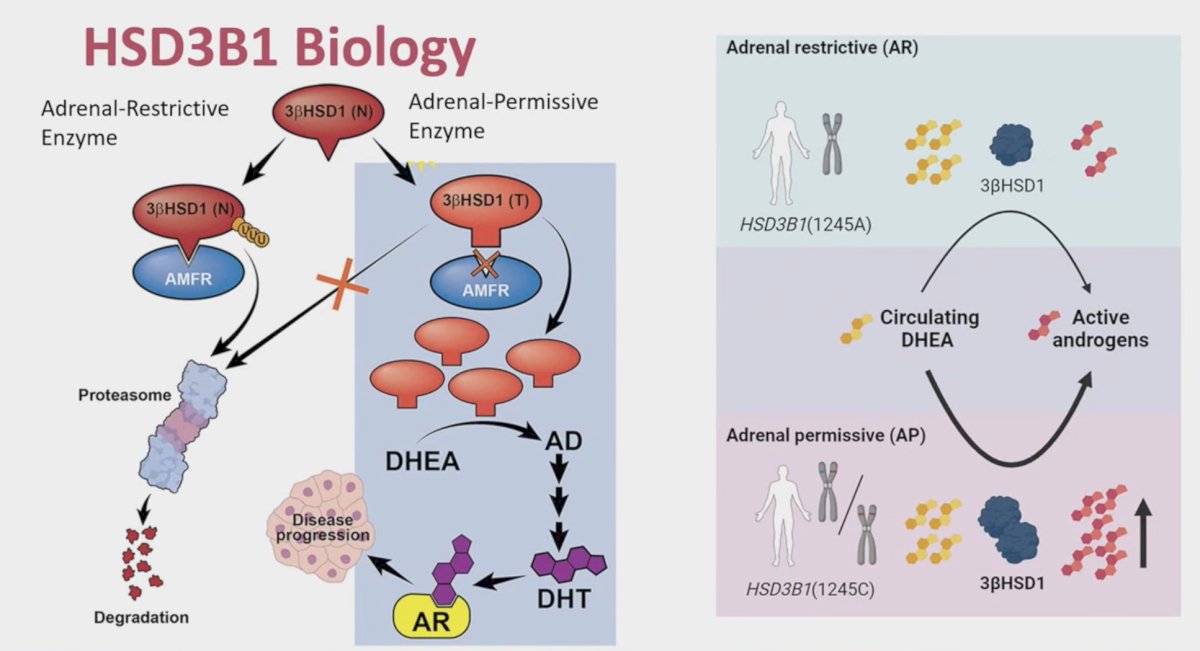
As such, the investigators tested the hypothesis that men with an adrenal permissive HSD3B1 genotype will have poorer outcomes when undergoing ADT.
This study analyzed patients from the Million Veterans Program within the Veterans Health Administration (VHA) database utilizing Veterans Informatics and Computing Infrastructure (VINCI). Eligible patients were diagnosed with localized prostate cancer after Million Veterans Program enrollment and received definitive radiation therapy with ADT. HSD3B1 genotype status was categorized as homozygous adrenal-restrictive, heterozygous adrenal-restrictive, or homozygous adrenal-permissive. The primary outcomes of interest included biochemical recurrence, metastatic castration-resistant prostate cancer (mCRPC), and cancer-specific mortality, identified using the National Death Index (NDI). NDI data was available through December 31, 2021, after which all patients with continued follow-up were censored for the cancer-specific mortality analysis. Cox proportional hazard models were applied to examine the associations between HSD3B1 genotype and outcomes of interest, adjusting for relevant clinical factors, including cancer staging, demographic characteristics, and treatment details. Time-to-event analyses were performed from the date of prostate cancer diagnosis to the outcome of interest.
Of the 3,170 participants included in the study, 209 (6.6 %) had the homozygous adrenal-permissive genotype, 1,105 (34.9 %) had the heterozygous adrenal-permissive genotype, and 1,856 (58.5 %) had the homozygous adrenal-restrictive genotype: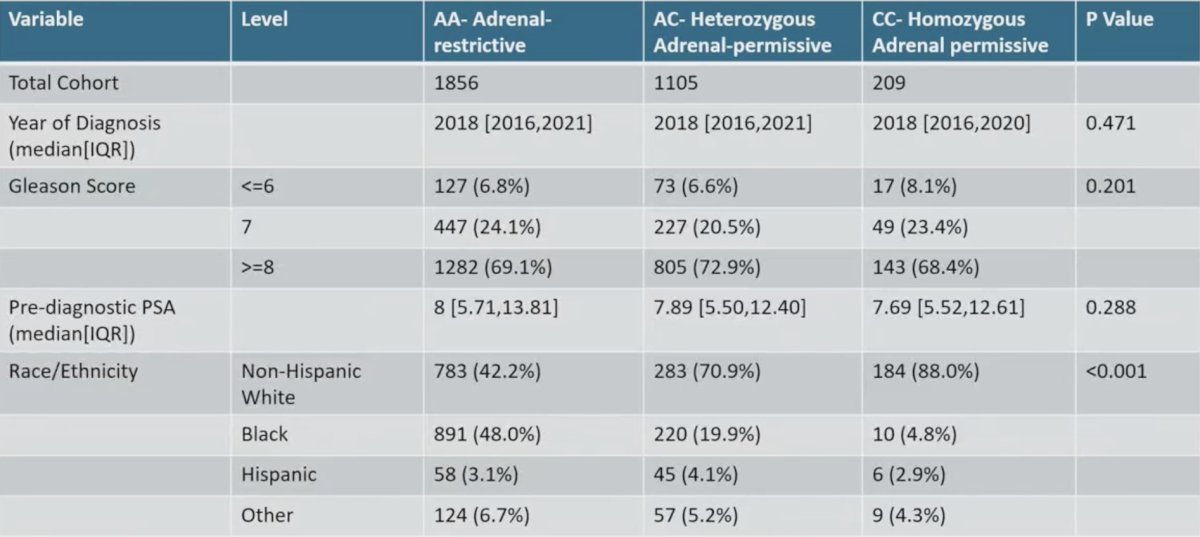
Patients with the homozygous adrenal-permissive genotype demonstrated an increased risk of biochemical recurrence (HR 1.48, 95% CI 1.08-2.05; p = 0.016) and time to metastases (HR 1.43, 95% CI 1.00-2.03; p = 0.05) compared to those with the heterozygous adrenal-permissive/homozygous adrenal-restrictive genotypes: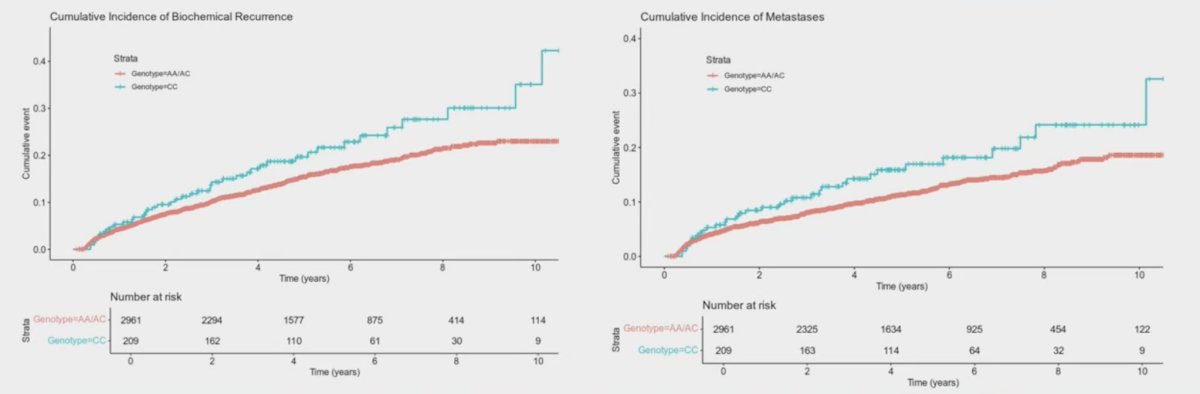
Additionally, the homozygous adrenal-permissive genotype also demonstrated an increased risk of time to mCRPC (HR 1.98, 95% CI 1.12-3.41, p = 0.018), but not time to prostate cancer-specific mortality (HR 1.80, 95% CI 0.88-3.71, p = 0.109) compared to the heterozygous adrenal-permissive/homozygous adrenal-restrictive genotypes: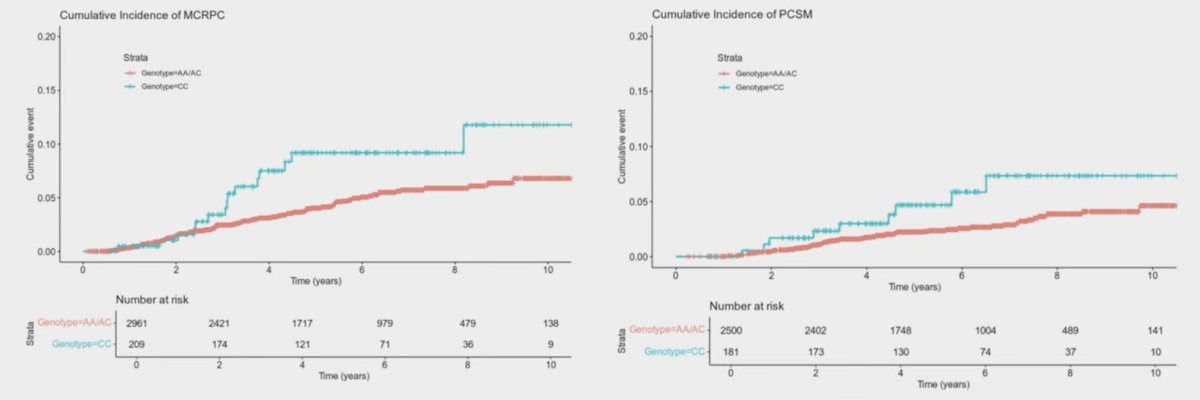
Kylie Morgan concluded her presentation discussing the influence of HSD3B1 genotype on prostate cancer outcomes following definitive radiation therapy with ADT with the following take-home points:
- HSD3B1 genotyping integration into clinical practice could boost precision medicine approaches to treatment
- Standard radiotherapy with ADT may be insufficient for patients with adrenal-permissive genotypes
- Clinical implementation is feasible: simple PCR tests provides actionable results at diagnosis
- Future research will examine androgen receptor pathway inhibitors as a therapeutic solution, and validate these findings in an independent dataset
Presented by: Kylie Morgan, BS, UCSD Health, La Jolla, CA
Written by: Zachary Klaassen, MD, MSc – Urologic Oncologist, Associate Professor of Urology, Georgia Cancer Center, Wellstar MCG Health, @zklaassen_md on Twitter during the 2025 American Society for Radiation Oncology (ASTRO) Annual Meeting, San Francisco, CA, Sat, Sept 27 – Wed, Oct 1, 2025.