

(UroToday.com) The 2025 ASTRO annual meeting featured a biomarker breakthroughs in prostate cancer session and a presentation by Dr. Phuoc Tran discussing validation of six androgen production, uptake and conversion genes in the ECOG-ACRIN E3805 CHAARTED prostate cancer trial.1
Metastatic prostate cancer remains incurable, and persistent androgen receptor activation promotes tumor progression and metastasis and impacts patient survival. A group of six genes (HSD3B1, HSD3B2, CYP3A43, CYP11A1, CYP11B1, CYP17A1) involved in androgen production, uptake, and conversion (APUC-6) has been identified that may define a subset of metastatic prostate cancer with distinct clinical outcomes:2
At ASTRO 2025, Dr. Tran and colleagues investigated the association of APUC-6 with outcomes in metastatic hormone-sensitive prostate cancer and the ability to predict therapeutic responses.
This study analyzed APUC-6 and androgen receptor expression from the phase 3 ECOG-ACRIN E3805 CHAARTED trial (n = 160). Patients were stratified into four subgroups based on APUC-6 and androgen receptor gene expression:
- APUC-6 high/androgen receptor low (n = 34)
- APUC-6 high/androgen receptor high (n = 6)
- APUC-6 low/androgen receptor low (n = 84)
- APUC-6 low/androgen receptor high (n = 34)
They compared key clinical outcomes, including time to castration resistance and overall survival across these subgroups within the two treatment arms: ADT alone versus docetaxel + ADT to assess APUC-6/androgen receptor as a prognostic biomarker. Interaction analysis was conducted between treatment arms and subgroups.
Standard clinicopathologic factors were balanced across subgroups, except lower Gleason score <=8 in APUC-6 high/androgen receptor low patients. APUC-6 high/androgen receptor low expression showed significantly improved overall survival (median 58.1 months, p < 0.0001) compared to other subgroups:

However, APUC-6 high/androgen receptor low patients had no survival benefit from docetaxel + ADT compared to ADT alone (p = 0.17):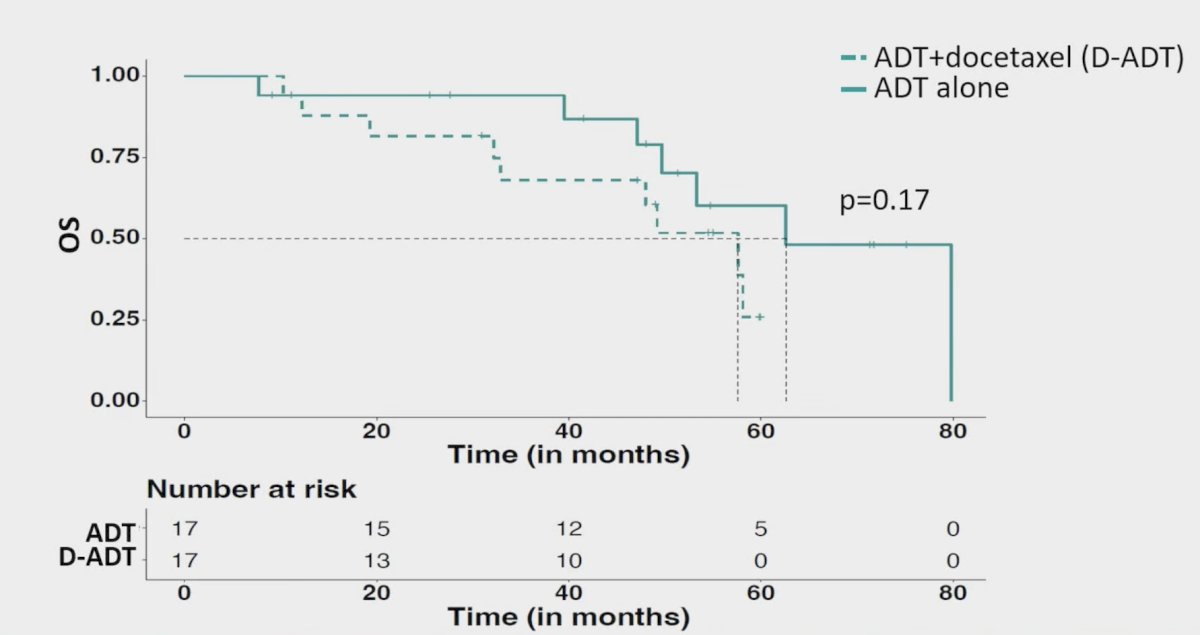
Patients who were APUC-6 low/androgen receptor low significantly benefited from the addition of docetaxel to ADT compared to ADT alone (HR 0.39, p = 0.0019):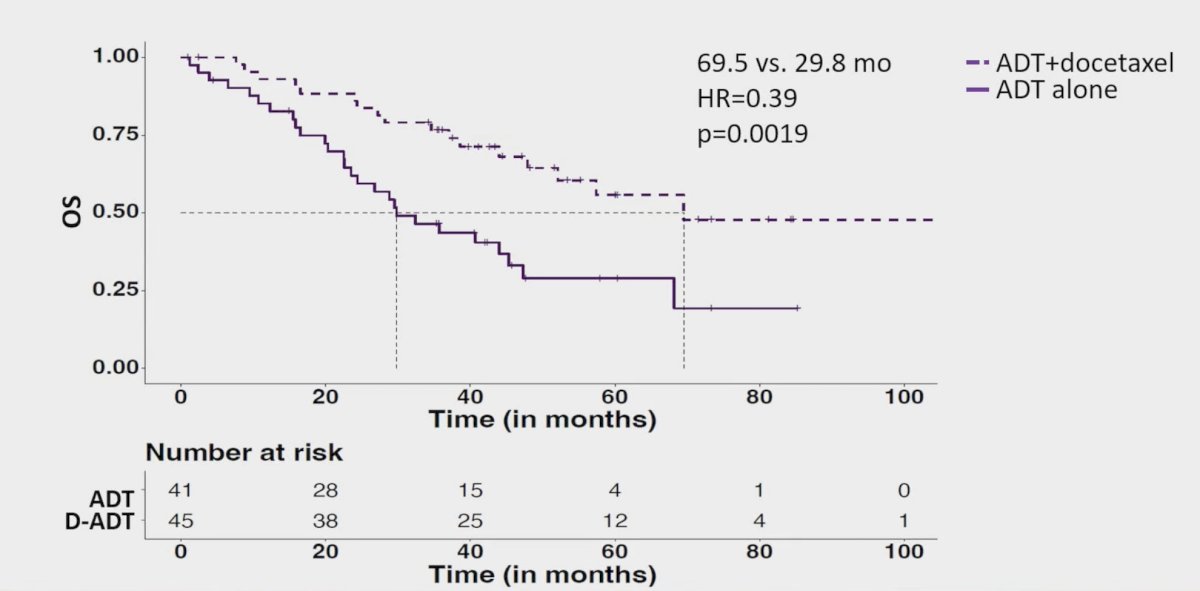
Additionally, APUC-6 low patients, regardless of androgen receptor expression, significantly benefited from docetaxel + ADT compared to ADT alone (HR 0.43, p = 0.00041):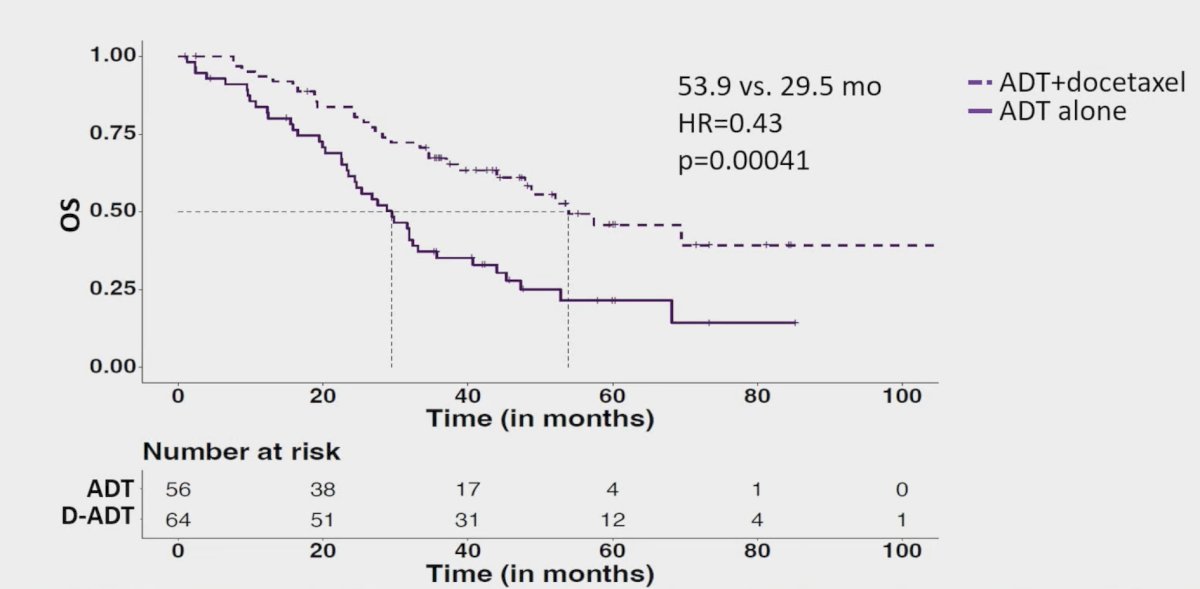
Based on time to castration resistance and overall survival analysis, an interaction analysis suggested that APUC-6 low/androgen receptor low was a predictor of docetaxel benefit:
Dr. Tran noted several limitations of the current analysis, including the small sample size of 160 patients, and that docetaxel + ADT is no longer standard of care for metastatic hormone-sensitive prostate cancer in the setting of ADT + androgen receptor pathway inhibitors +/- docetaxel.
Dr. Tran concluded his presentation discussing validation of six androgen production, uptake, and conversion genes in the ECOG-ACRIN E3805 CHAARTED prostate cancer trial with the following take-home points:
- APUC-6 and androgen receptor expression are negatively correlated
- APUC-6 high/androgen receptor low patients exhibited favorable overall survival. However, no additional survival benefit was noted for adding docetaxel to ADT
- APUC-6 low/androgen receptor low patients significantly benefited from docetaxel + ADT, which was also seen in all APUC-6 low patients, regardless of androgen receptor expression
- APUC-6 low/androgen receptor low predicts benefit to docetaxel
- This study highlights the potential of using APUC-6/androgen receptor expression to identify patients who are more or less likely to benefit from docetaxel, leading to more personalized treatment decisions
Presented by: Phuoc Tran, MD, PhD, University of Maryland, Baltimore, MD
Written by: Zachary Klaassen, MD, MSc – Urologic Oncologist, Associate Professor of Urology, Georgia Cancer Center, Wellstar MCG Health, @zklaassen_md on Twitter during the 2025 American Society for Radiation Oncology (ASTRO) Annual Meeting, San Francisco, CA, Sat, Sept 27 – Wed, Oct 1, 2025.
References:
- Sweeney CJ, Chen YH, Carducci M, et al. Chemohormonal Therapy in Metastatic Hormone-Sensitive Prostate Cancer. N Engl J Med. 2015;373(8):737-746.
- Bergom HE, Boytim E, McSweeney S, et al. Androgen production, uptake, and conversion (APUC) genes define prostate cancer patients with distinct clinical outcomes. JCI Insight. 2024 Oct 22;9(20):e183158.