

(UroToday.com) The 2025 ASTRO annual meeting featured a biomarker breakthroughs in prostate cancer session and a presentation by Dr. Vaseem Khatri on behalf of Dr. Kosj Yamoah discussing genomic classifier and multimodal artificial intelligence biomarkers in localized prostate cancer. The predictive accuracy of prostate cancer specific outcomes using conventional clinical risk classifiers remains suboptimal. The emergence of personalized biomarkers such as the Decipher prostate genomic classifier and Artera multimodal artificial intelligence has shown superior prognostic performance by more accurately identifying aggressive subsets of prostate cancer. At ASTRO 2025, Dr. Khatri and colleagues reported on the clinical and biological correlation between genomic classifier and multimodal artificial intelligence as predictors of metastasis among patients with localized prostate cancer.
This was a retrospective analysis of patients with localized prostate cancer who had available genomic data and digital histopathologic images from four cohorts:
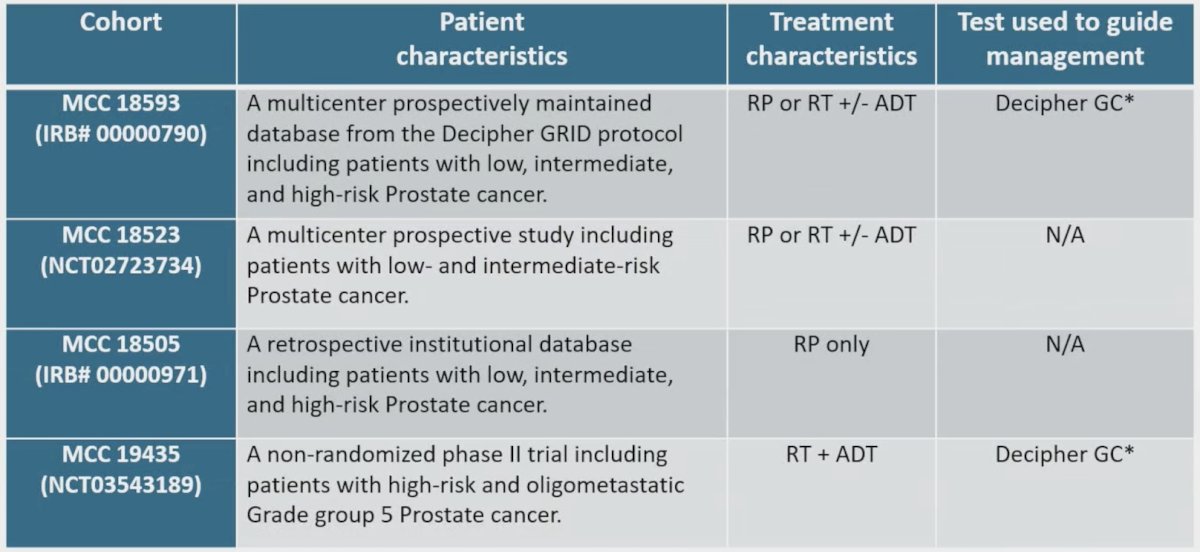
Genomic classifier scores were generated using RNA sequencing data, whereas multimodal artificial intelligence scores were generated utilizing histopathological image features combined with clinicopathologic parameters. Both genomic classifier and multimodal artificial intelligence scores were evaluated as continuous variables. The primary aim was to establish the correlation between genomic classifier and multimodal artificial intelligence biomarkers for predicting biochemical recurrence and metastasis using linear regression. Next, an intergene correlational matrix was performed using derived gene signatures to identify distinct biological pathways that associate with genomic classifier and multimodal artificial intelligence scores in predicting metastasis.
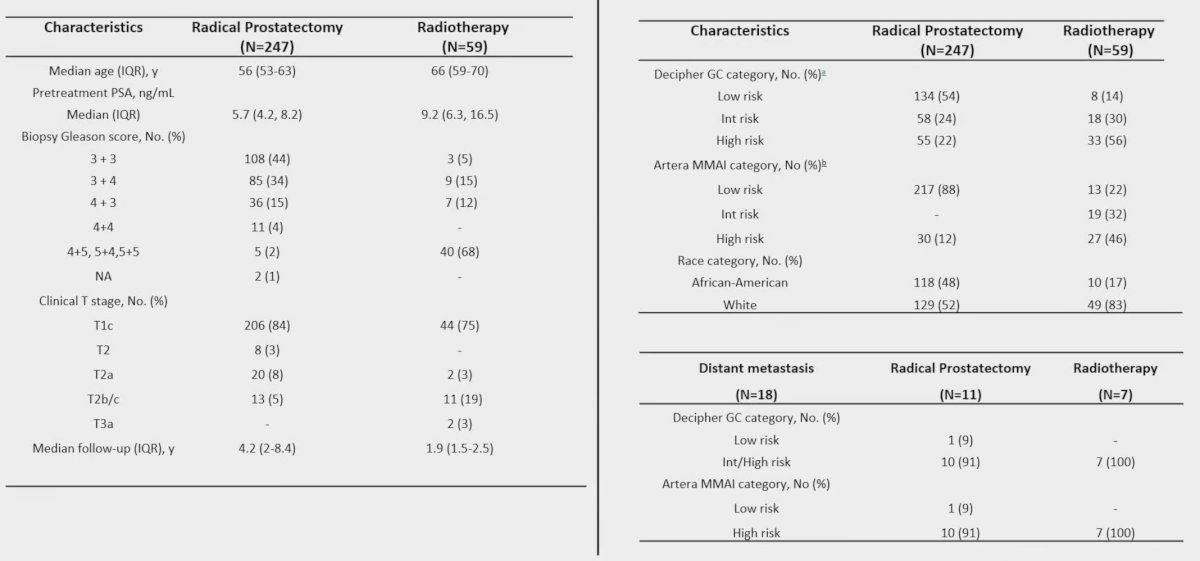
The final analytical cohort included 306 evaluable cases (247 radical prostatectomy and 59 radiotherapy cases) with both genomic classifier and multimodal artificial intelligence information. This included 18 metastatic events (11 radical prostatectomy, 7 radiotherapy) with a median follow up of 5.8 years:
The concordance between genomic classifier and multimodal artificial intelligence scores among the surgical cohort is as follows:

This showed that genomic classifier and multimodal artificial intelligence scores exhibited a ~15% discordance rate (low multimodal artificial intelligence score versus high genomic classifier), and ~13% discordance rate (high multimodal artificial intelligence score versus low genomic classifier), respectively. The concordance between genomic classifier and multimodal artificial intelligence scores among the radiotherapy cohort is as follows:
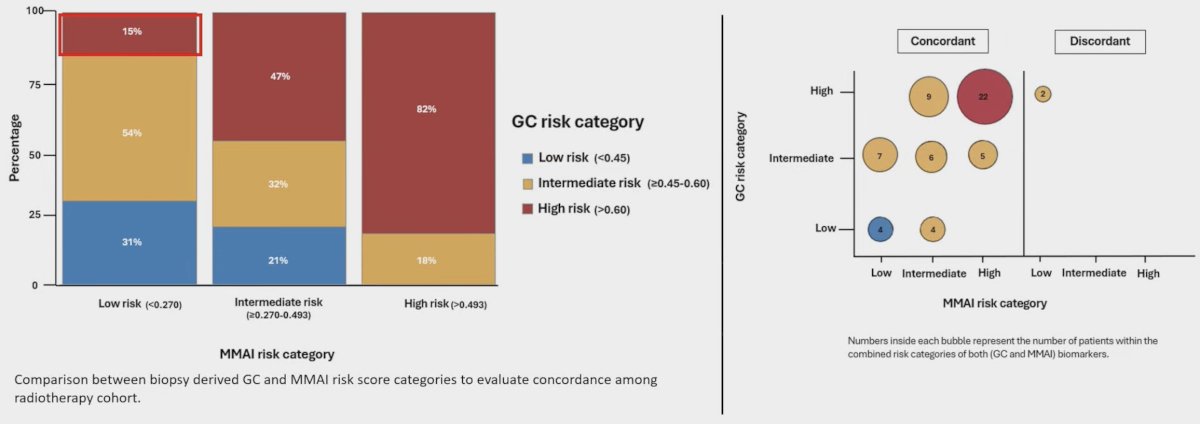
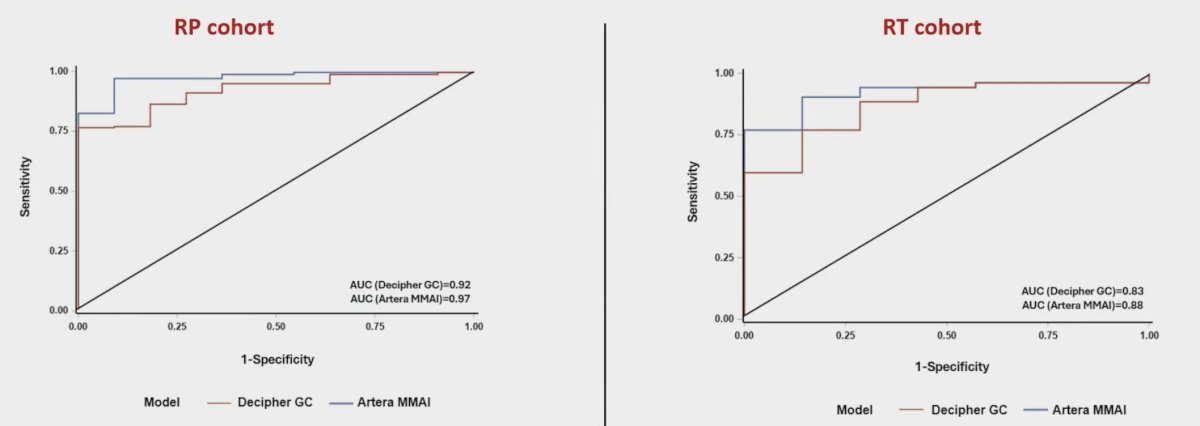
This showed that genomic classifier and multimodal artificial intelligence scores exhibited a ~15% discordance rate (low multimodal artificial intelligence score versus high genomic classifier), and no discordance was observed between high multimodal artificial intelligence score versus low genomic classifier. Among both the radical prostatectomy and radiotherapy cohorts, genomic classifier and multimodal artificial intelligence score-based models yielded AUCs of radical prostatectomy (genomic classifier = AUC 0.92; multimodal artificial intelligence = AUC 0.97) and radiotherapy (genomic classifier = AUG 0.83; multimodal artificial intelligence = AUC 0.88), respectively, indicating excellent discriminatory performance of both genomic classifier and multimodal artificial intelligence scores in distinguishing between patients who experienced distant metastasis and those who did not:
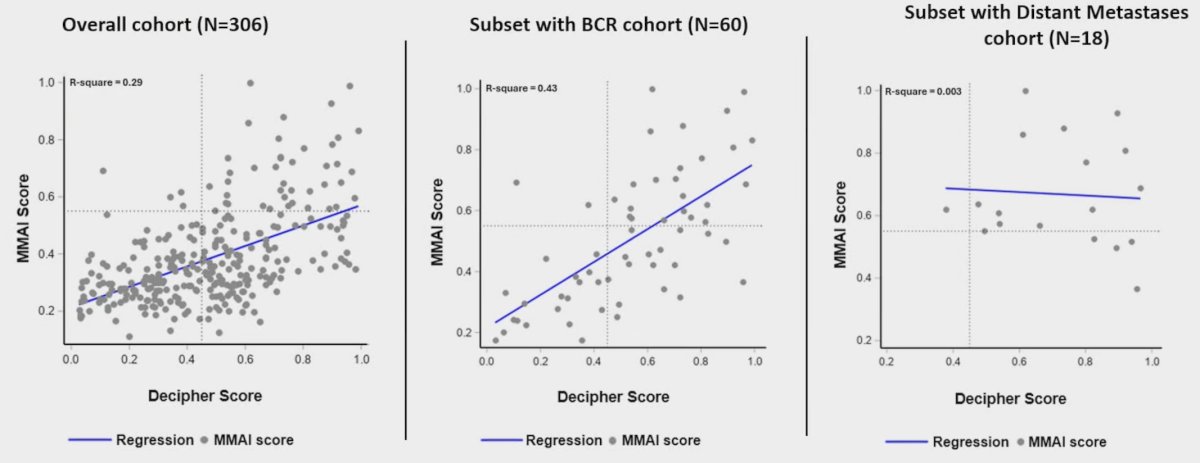
Linear regression demonstrated a weakly positive association between the two scores (R2 = 0.29) in the overall cohort. Among patients with biochemical recurrence, the association remained fair (R2 = 0.43), and no correlation (R2 = 0.003) was observed among patients with metastasis:
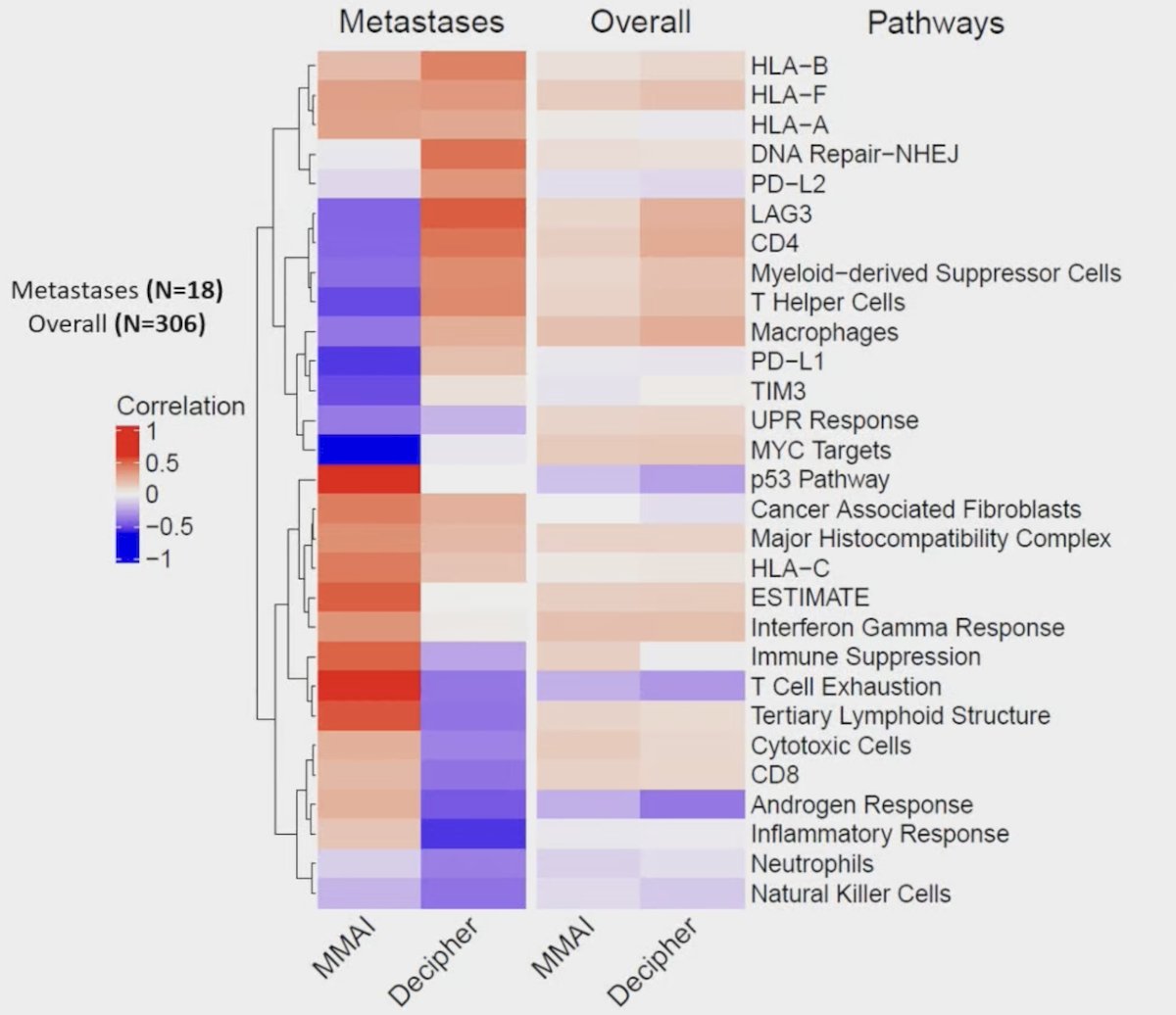
Among the metastases cohort, intergene correlation matrix revealed a strongly positive correlation between multimodal artificial intelligence score and immune-related pathways (T-cell exhausting: r = 0.62, estimate: r = 0.53, immune suppression: r = 0.52) and p53 pathway: r = 0.70. The genomic classifier showed strongly positive correlation with immune-related (LAG3: r = 0.53, CD4: r = 0.46, HLA-B: r = 0.42) and DNA repair (r = 0.48) pathways. Importantly, there was minimal overlap between the specific target genes that constitute the distinct signature pathways:
Limitations of this study include the short follow-up with few events, and the genomic classifier being used in some of the cohorts prospectively to guide management, which could attenuate outcomes.
Dr. Khatri concluded his presentation discussing genomic classifier and multimodal artificial intelligence biomarkers in localized prostate cancer with the following take home points:
- Decipher genomic classifier and Artera multimodal artificial intelligence scores are weakly positively correlated, especially among those that developed metastasis
- However, extreme reclassifications (ie. high genomic classifier with low multimodal artificial intelligence or low genomic classifier with high multimodal artificial intelligence) were low (<15%) in both the radical prostatectomy and radiotherapy cohorts
- Genomic classifier and multimodal artificial intelligence both demonstrated excellent discrimination and prediction for the distant metastasis endpoint
- Both scores are strongly yet independently associated with distinct biological pathways in patients who developed metastases
- Further research will determine how the integration of transcriptomic and digital pathology based biomarkers may better define the biological spectrum of aggressive prostate cancer
Presented by: Vaseem Khatri, MD, H. Lee Moffitt Cancer Center & Research Institute, Tampa, FL
Written by: Zachary Klaassen, MD, MSc – Urologic Oncologist, Associate Professor of Urology, Georgia Cancer Center, Wellstar MCG Health, @zklaassen_md on Twitter during the 2025 American Society for Radiation Oncology (ASTRO) Annual Meeting, San Francisco, CA, September 28th – 30th, 2025