

(UroToday.com) The 2025 ASTRO annual meeting featured a localized prostate cancer session and a presentation by Dr. Jonathan Lischalk discussing results of a phase I/Ib, single arm study of two fraction stereotactic body radiation therapy with simultaneous integrated boost for the treatment of localized prostate cancer. Stereotactic body radiation therapy has been established as an effective modality for localized prostate cancer, with recent level 1 evidence supporting its comparative efficacy and toxicity. Simultaneous integrated boosts to the dominant intraprostatic lesion have demonstrated improved oncologic outcomes based on the FLAME trial1 for patients with localized intermediate- and high-risk prostate cancer, significant for 10-year biochemical disease free survival but less significant toxicity and quality of life. The purpose of this phase I/Ib study is to evaluate the feasibility and safety of a novel 2-fraction stereotactic body radiation therapy regimen with an MRI-guided simultaneous integrated boosts to the dominant intraprostatic lesions (PI-RADS 4+) stratified by genomic risk classification.
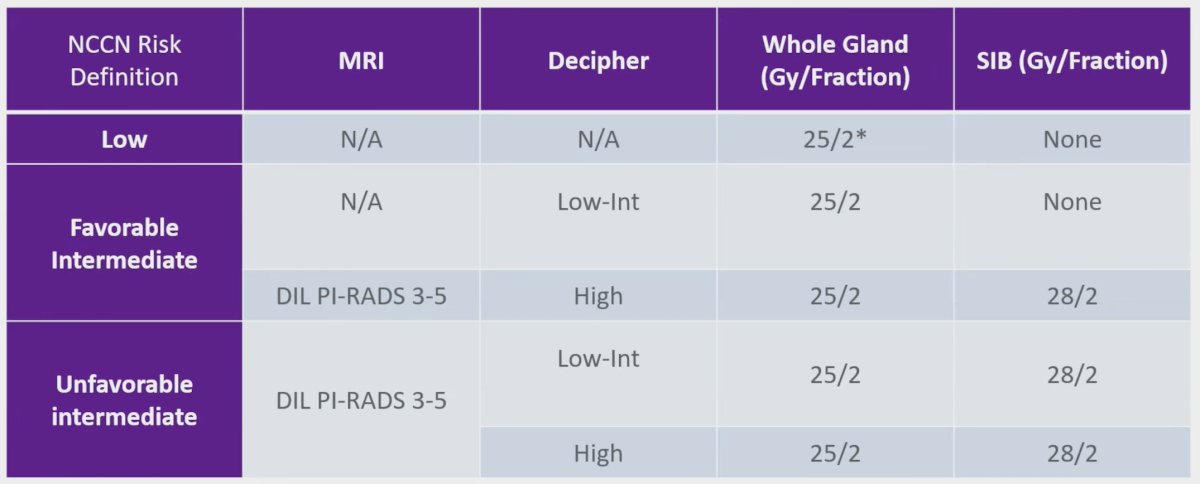
This single arm, prospective study explored patients with biopsy-proven localized prostate cancer classified as low to intermediate risk per NCCN criteria. All patients underwent MRI based stereotactic body radiation therapy treatment planning with fiducial marker and rectal spacer placement. Two fractions of stereotactic body radiation therapy were delivered to a total dose of 25 Gy in 2 weekly treatment fractions to the whole prostate with a 28 Gy simultaneous integrated boosts to the dominant lesion in patients with unfavorable intermediate risk disease or favorable intermediate risk with an elevated Decipher score:

The dose fraction and simultaneous integrated boost schedule for this trial is as follows:
The DVH parameters are highlighted in the following table:

Primary physician reporting grade 2+ toxicity per CTCAE version 5.0 was the primary endpoint. Follow-up was performed 30 days post-treatment and subsequently every 3 to 4 months for 2 years:

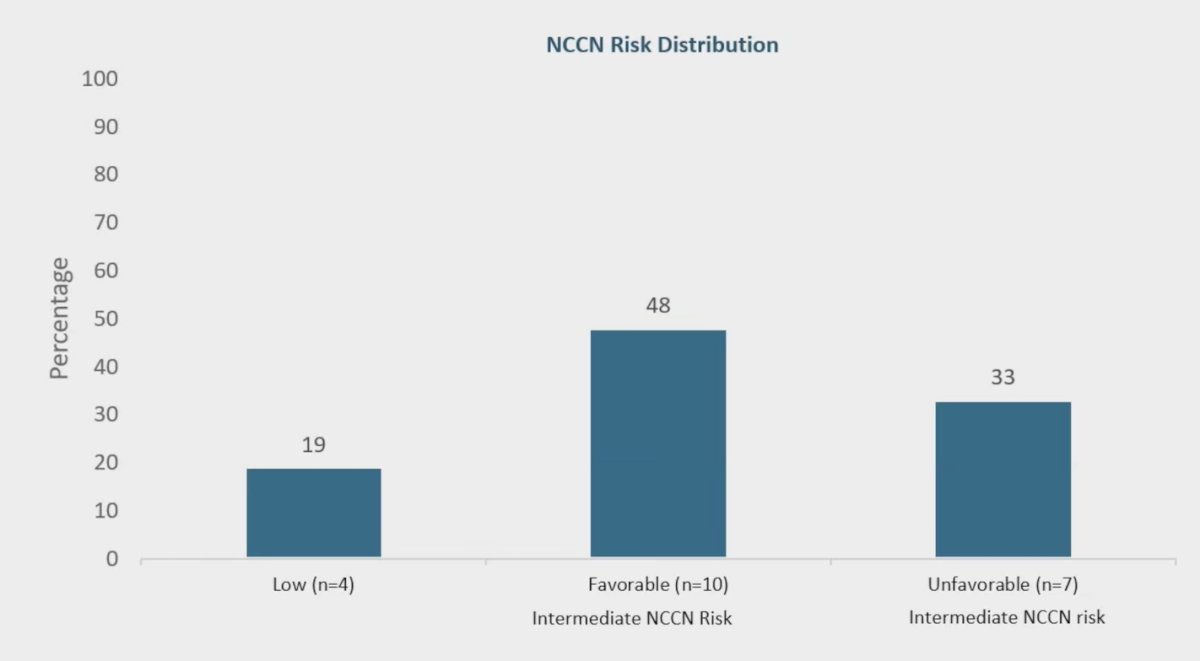
A total of 21 patients with a median age of 71 years completed treatment. Of the entire cohort, median prostate volume was 39.5 cc, 38% underwent an intraprostatic microboost with 8 patients due to an elevated Decipher score, and 14% (n = 3) received ADT as a component of treatment. Prostate cancer distribution was as follows: low (n = 4, 19%), favorable intermediate (n = 10, 48%), and unfavorable intermediate (n=7, 33%):
The Decipher score distribution was as follows: low (n = 10, 48%), intermediate (n = 3, 14%), and high (n = 8, 38%):

With an early median follow-up of 9.47 months, grade 2 genitourinary toxicity was 14%:

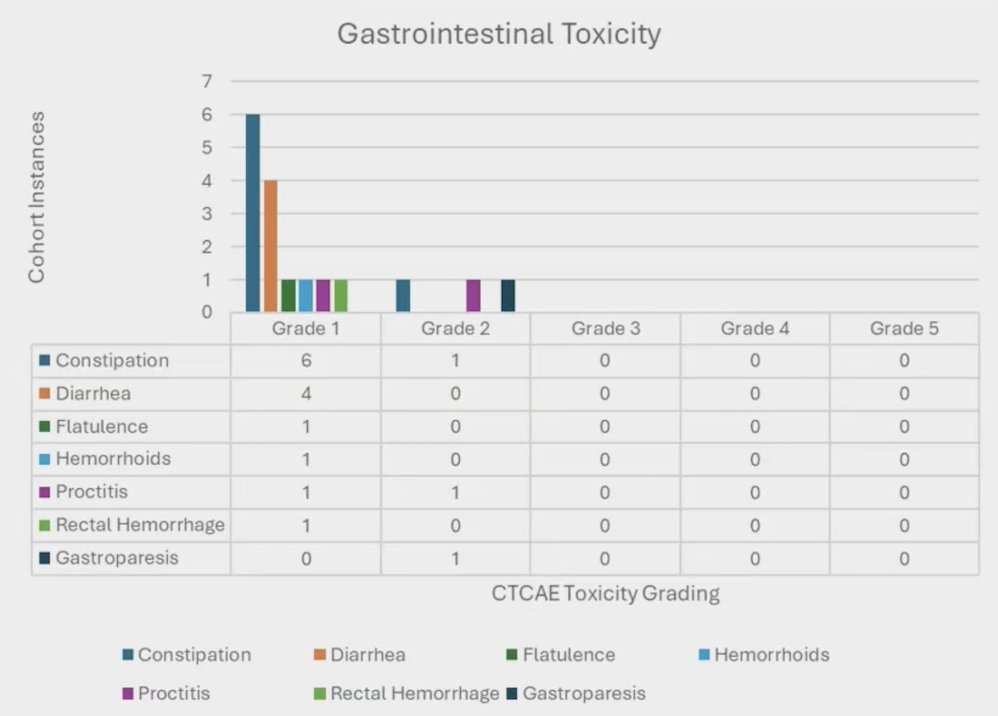
Early grade 2 gastrointestinal toxicity was 14%:
Dr. Lischalk concluded his presentation discussing results of a phase I/Ib, single arm study of two fraction stereotactic body radiation therapy with simultaneous integrated boost for the treatment of localized prostate cancer with the following take home points:
- This novel fractionation regimen may offer a highly efficient and a biologically effective treatment option for selected patients minimizing treatment burden and optimizing disease control using modern genomic stratification and advanced treatment delivery
- The approach personalizes therapy and intensifies treatment where needed without blanket escalation. Microboosts, based on genomic profiling, is a promising direction
- In the future, additional genomic markers may refine patient selection further, and collaboration with other centers could validate these findings in larger populations
- Ultimately, this phase I/Ib study suggests that 2-fraction stereotactic body radiotherapy with a genomically guided and MRI directed simultaneous integrated boost is a feasible and well tolerated approach for localized prostate cancer
- Toxicities with early follow-up appear limited (14%) and similar or lower than historical controls utilizing a 2-fraction regimen
- Further follow-up is required to determine the long term efficacy and late toxicity trends
Presented by: Jonathan Lischalk, MD, Georgetown University School of Medicine, Washington, DC
Written by: Zachary Klaassen, MD, MSc – Urologic Oncologist, Associate Professor of Urology, Georgia Cancer Center, Wellstar MCG Health, @zklaassen_md on Twitter during the 2025 American Society for Radiation Oncology (ASTRO) Annual Meeting, San Francisco, CA, September 28th – 30th, 2025.
References:
- Kerkmeijer LGW, Groen VH, Pos FJ, et al. Focal boost to the intraprostatic tumor in external beam radiotherapy for patients with localized prostate cancer: Results from the FLAME randomized phase III trial. J Clin Oncol. 2021 Mar 1;39(7):787-796.