

(UroToday.com) The 2025 ASTRO annual meeting featured a localized prostate cancer session and a presentation by Dr. Kaori Fukunishi discussing treatment outcomes and prognostic factors of carbon ion radiation therapy for localized prostate cancer. Carbon ion radiation therapy is characterized by its excellent dose concentration and high biological effectiveness.
In localized prostate cancer, carbon ion radiation therapy is expected to provide high local control rates and reduce adverse events. This study retrospectively analyzed the treatment outcomes and prognostic factors of carbon ion radiation therapy for prostate cancer at a single Japanese institution.
Patients who underwent carbon ion radiation therapy for localized prostate cancer between August 2013 and July 2024 were included in the study. The total dose administered was 51.6 Gy in 12 fractions over 3 weeks. The endpoints evaluated included biochemical recurrence-free survival, overall survival, cancer-specific survival, local control rate, and acute and late adverse events. Prognostic factor analysis was conducted for age, sex, performance status, disease stage, and other clinical parameters.
A total of 7,054 patients with histologically confirmed localized prostate cancer underwent carbon ion radiation therapy during the study period. The median age was 71 years (range: 40–92 years). The distribution of T-stage classification was as follows:
- T1a: n = 8
- T1b: n = 10
- T1c: n = 2,158
- T2a: n = 2,124
- T2b: n = 692
- T2c: n = 1,062
- T3a: n = 696
- T3b: n = 269
- T4: n = 35
The Gleason score distribution was as follows:
- Gleason 4: n = 1
- Gleason 5: n = 4
- Gleason 6: n = 1,208
- Gleason 7: n = 3,204
- Gleason 8: n = 1,613
- Gleason 9: n = 918
- Gleason 10: n = 104
- Unclassifiable: n = 2
The median PSA level was 8.05 ng/mL (range: 1.04–473 ng/mL). According to the D'Amico classification, 755 patients were classified as low-risk, 2,631 as intermediate-risk, and 3,668 as high-risk. The median follow-up period was 43 months (maximum: 136 months). For the entire cohort, the 5-year biochemical recurrence-free survival was 92.0%, overall survival was 96.3%, cancer-specific survival was 99.8%, and local control rate was 98.2%. According to risk classification, the 5-year biochemical recurrence-free survival, overall survival, cancer-specific survival, and local control rates were:
- Low risk: 92.0%, 98.4%, 100%, and 96.5%, respectively
- Intermediate risk: 94.0%, 97.6%, 99.9%, and 98.1%, respectively
- High risk: 90.4%, 94.8%, 99.6%, and 98.8%, respectively
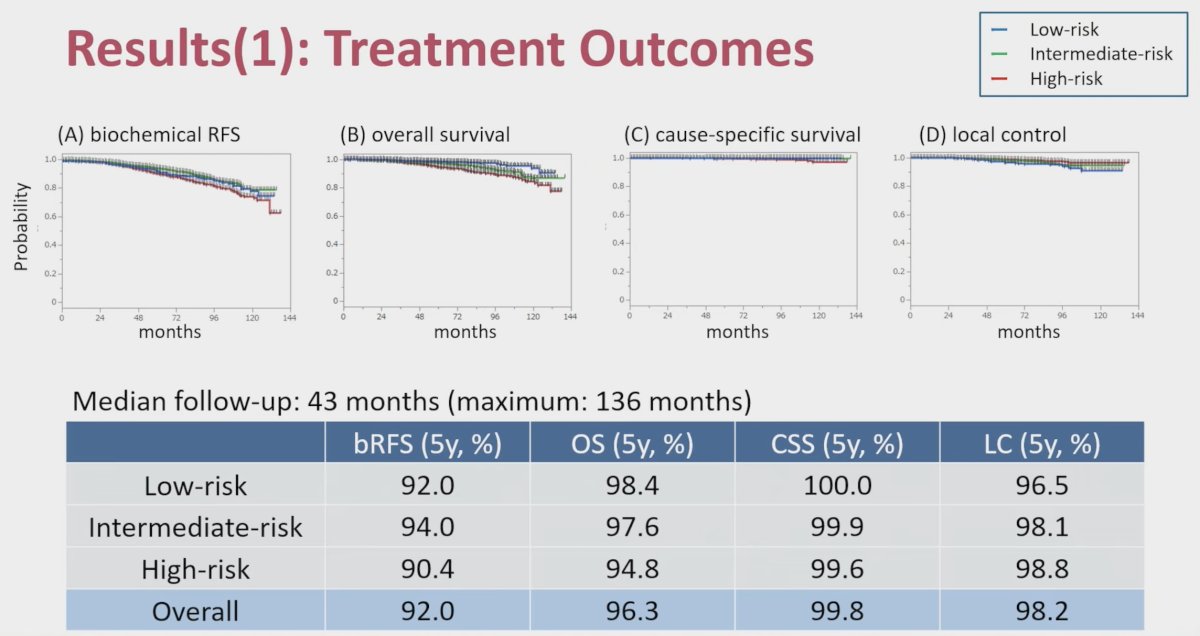
Multivariate analysis identified age (>= 76 years), D'Amico classification (high risk), Gleason score (>=8), duration of ADT (>= 24 months), and diabetes mellitus status (present) as significant prognostic factors for overall survival. A total of 18 cases (0.26%) with grade 3 or higher adverse events were observed. Among acute adverse events, three cases of grade 3 dysuria were observed. Among late adverse events, six cases of grade 3 rectal hemorrhage and eight cases of grade 3 hematuria were observed. No grade 4 or higher adverse events were reported.
Carbon-ion radiation therapy in the context of published treatment outcomes of localized prostate cancer is highlighted in the following table:
Dr. Kaori Fukunishi concluded her presentation discussing treatment outcomes and prognostic factors of carbon ion radiation therapy for localized prostate cancer with the following take-home points:
- This study indicates that carbon ion radiation therapy is an effective treatment for localized prostate cancer with a low incidence of severe adverse events
- Age, D'Amico classification, Gleason score, ADT duration, and diabetes mellitus status were identified as potential prognostic factors for overall survival
Presented by: Kaori Fukunishi, Ion Beam Therapy Center, SAGA-HIMAT Foundation, Tosu, Japan
Written by: Zachary Klaassen, MD, MSc – Urologic Oncologist, Associate Professor of Urology, Georgia Cancer Center, Wellstar MCG Health, @zklaassen_md on Twitter during the 2025 American Society for Radiation Oncology (ASTRO) Annual Meeting, San Francisco, CA, Sat, Sept 27 – Wed, Oct 1, 2025.