

(UroToday.com) The 2026 ASCO GU Annual Symposium was host to a prostate cancer poster session. Dr. Sagar Patel presented the results of a study evaluating the association of a post-prostatectomy digital pathology-based multimodal artificial intelligence (MMAI) biomarker with nodal and extra-pelvic metastasis on PET/CT at the time of biochemical recurrence and event-free survival following salvage radiotherapy.
Clinical prostate cancer variables have limited ability to predict patterns of recurrence or outcomes after radical prostatectomy (RP). The study investigators evaluated the performance of a digital pathology MMAI algorithm in predicting patterns of recurrence at the time of post-RP biochemical recurrence (BCR) and oncologic outcomes following PET-guided salvage radiotherapy (RT).
The study population included patients from the randomized EMPIRE-1 (NCT01666808) and EMPIRE-2 (NCT03762759) trials, which evaluated the association of PET-guided salvage RT on event-free survival (EFS) in men with BCR following RP. A subset of patients with available digitized histopathologic images from RP specimens was identified for MMAI analysis. The locked Post-RP MMAI model (v1.1) was applied to generate continuous MMAI scores from digitized H&E pathology images.
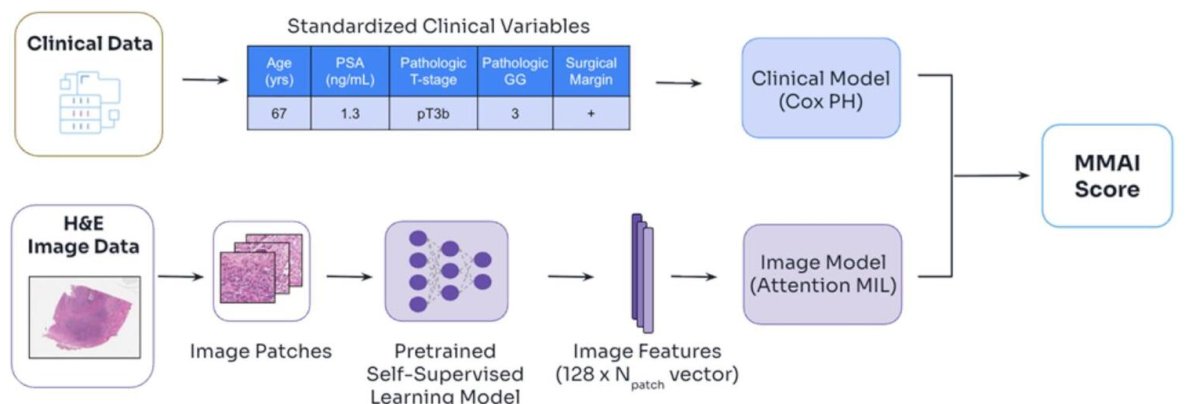
The primary objective was to evaluate the association between MMAI score and 18F-fluciclovine or 68Ga-PSMA-11 PET uptake at the time of BCR. PET uptake was categorized as:
- Prostate bed only (PB-only)
- Pelvic lymph node (PLN)
- Extrapelvic (EP)
Multivariable analysis (MVA) adjusted for pathologic nodal (pN) status.
The secondary objective was to assess the association between MMAI score and EFS following salvage RT in this contemporary cohort managed with PET/CT and early SRT. EFS was defined as PSA >0.2 ng/mL above nadir followed by another rise, PSA persistence, radiographic/DRE recurrence, or initiation of systemic therapy. MVA adjusted for ADT use.
Of 223 patients enrolled in EMPIRE-1 and EMPIRE-2 and who underwent PET/CT at the time of BCR, 92 had digital prostatectomy histopathology images available for MMAI analysis. The median PSA at time of PET/CT was 0.30 ng/mL (IQR 0.20–0.70), representing an early BCR cohort.
Association Between MMAI Score and PET-Detected Disease
The first table presents the univariable analysis examining the association between MMAI score and PET-detected recurrence pattern.
A higher MMAI score (per 1 standard deviation increase in score) was:
- Not associated with PB-only recurrence (OR 0.89; p=0.69)
- Significantly associated with pelvic lymph node recurrence (OR 2.44; 95% CI 1.39–4.61; p=0.003)
- Strongly associated with extrapelvic recurrence (OR 4.13; 95% CI 1.60–13.86; p=0.009)

The multivariable table demonstrates that MMAI score remained independently associated with metastatic recurrence patterns after adjusting for pN status:
For pelvic LN recurrence:
- MMAI score OR 2.44 (95% CI 1.39–4.61; p=0.003)
- pN1 vs pN0 was not significant (p=0.18)
For extrapelvic recurrence:
- MMAI score OR 4.13 (95% CI 1.60–13.86; p=0.009)
- pN1 vs pN0 remained significant (OR 4.42; p=0.04)
These findings demonstrate that the MMAI biomarker independently predicts PET-detected metastatic extent beyond conventional nodal staging.
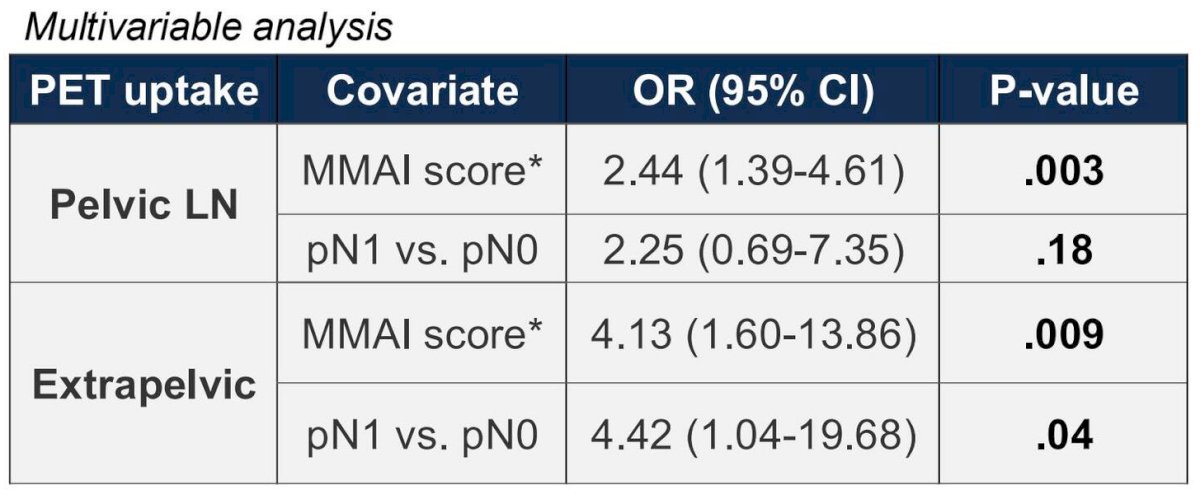
The key clinical implication here is that digital pathology–derived biologic risk may stratify metastatic phenotype at BCR more effectively than traditional pathologic nodal status alone.
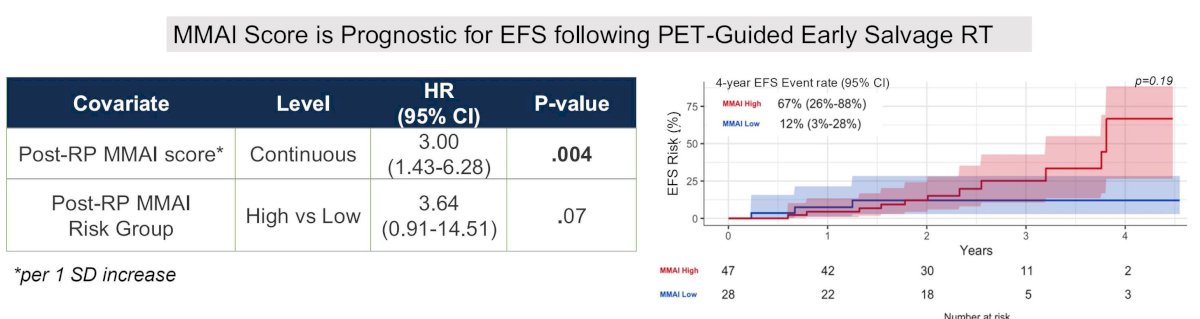
Association With Event-Free SurvivalThe MMAI score was shown to be a prognostic marker for EFS following PET-guided early salvage RT. When modeled as a continuous variable (per 1 SD increase):
- HR 3.00 (95% CI 1.43–6.28; p=0.004)
This indicates a threefold increase in risk of events per SD increase in MMAI score.
When stratified by high vs low MMAI risk group:
- HR 3.64 (95% CI 0.91–14.51; p=0.07)
Although the dichotomized analysis did not reach statistical significance, the magnitude of effect remains substantial.
The Kaplan–Meier curve illustrates clear separation between MMAI-high and MMAI-low groups. At 4 years:
- MMAI High: 67% EFS event rate (95% CI 26–88%)
- MMAI Low: 26% EFS event rate (95% CI 3–28%)
The visual separation of curves reinforces the strong prognostic gradient, even though p=0.19 for the dichotomized comparison. The wide confidence intervals likely reflect sample size limitations.
Dr. Patel concluded that in a contemporary post-RP BCR cohort managed with PET-guided salvage RT, post-RP MMAl score was associated with both PET-detected disease extent and EFS, supporting its potential role in biologic risk stratification beyond imaging alone
Presented by: Sagar A. Patel, MD, Associate Professor, Department of Radiation Oncology, Emory University School of Medicine, Atlanta, GA, USA
Written by: Rashid K. Sayyid, MD, MSc, Assistant Professor, Urologic Oncologist, Department of Urology at The University of Arizona and Banner University Medical Center, Tucson, AZ – @rksayyid on X during the 2026 American Society of Clinical Oncology Genitourinary (ASCO GU) cancers symposium held in San Francisco, CA, between February 26th and 28th, 2026.