

(UroToday.com) The 2026 American Society of Clinical Oncology Genitourinary (ASCO GU) cancers symposium held in San Francisco, CA, was host to the Poster Session A: Prostate Cancer. Dr. Kevin Shee presented Poster 402: Integrating genomic prognostic and hallmark signatures from Decipher GRID to predict adverse outcomes in men on active surveillance for prostate cancer.
Dr. Shee highlighted that, to date, active surveillance is the guideline-recommended standard for appropriately selected patients with low-risk disease. The optimal role of genomic classifiers in active surveillance remains under investigation. Emerging institutional data suggest that a high-risk Decipher score is associated with major upgrading and unfavorable histology, rather than with any grade progression, underscoring its potential value in identifying clinically meaningful reclassification events.
She also discussed the Decipher GRID platform, a proprietary resource that integrates validated prognostic signatures, hallmark pathway scores, and additional gene expression signatures. This platform may offer a more refined approach to risk stratification in active surveillance. The current analysis aimed to evaluate whether available Decipher GRID prognostic and hallmark pathway signatures could help anticipate prostate cancer outcomes in patients managed with active surveillance.
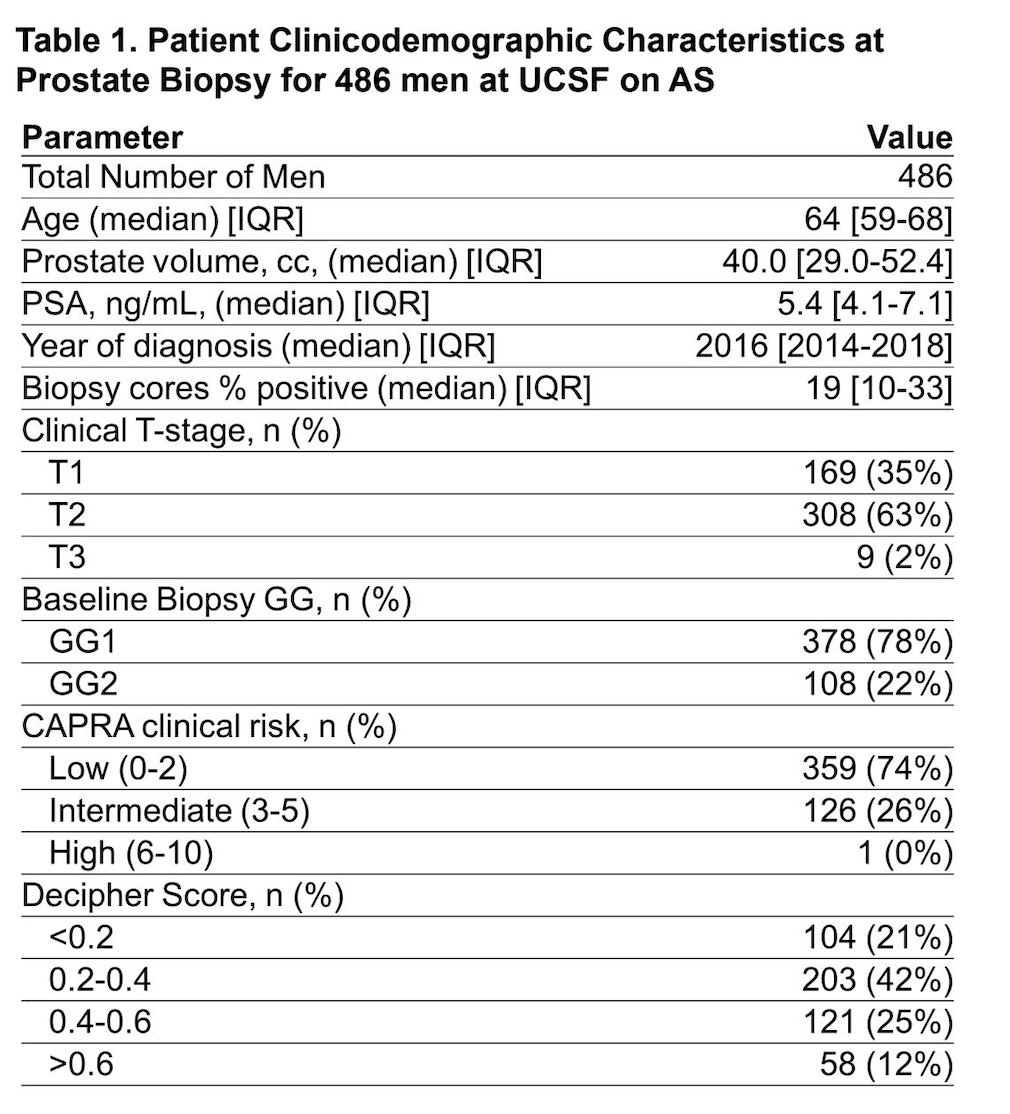
Using the UCSF Urologic Outcomes Database, men on AS with at least two biopsies and Decipher testing performed on biopsy tissue were identified. Outcomes of interest included any Gleason Grade Group upgrade, major upgrade to Grade Group 3 or higher, and the development of unfavorable histology such as expansile cribriform or intraductal carcinoma. An average genomic risk score was calculated, and multivariable Cox proportional hazards models were used to assess associations between 18 validated prognostic gene signatures and 37 hallmark cancer pathways, adjusting for CAPRA score.
A total of 486 men met inclusion criteria, with a median follow-up of 70 months. At diagnosis, 78% had Grade Group 1 disease and 22% had Grade Group 2. Most patients had low CAPRA risk at baseline. The median average genomic risk score was 0.25.
After adjusting for CAPRA, several genomic signatures retained independent prognostic significance. The Long 2014 and Yu 2007 signatures were independently associated with both overall upgrade and major upgrade. The Lapointe 2004 signature independently predicted the development of unfavorable histology.
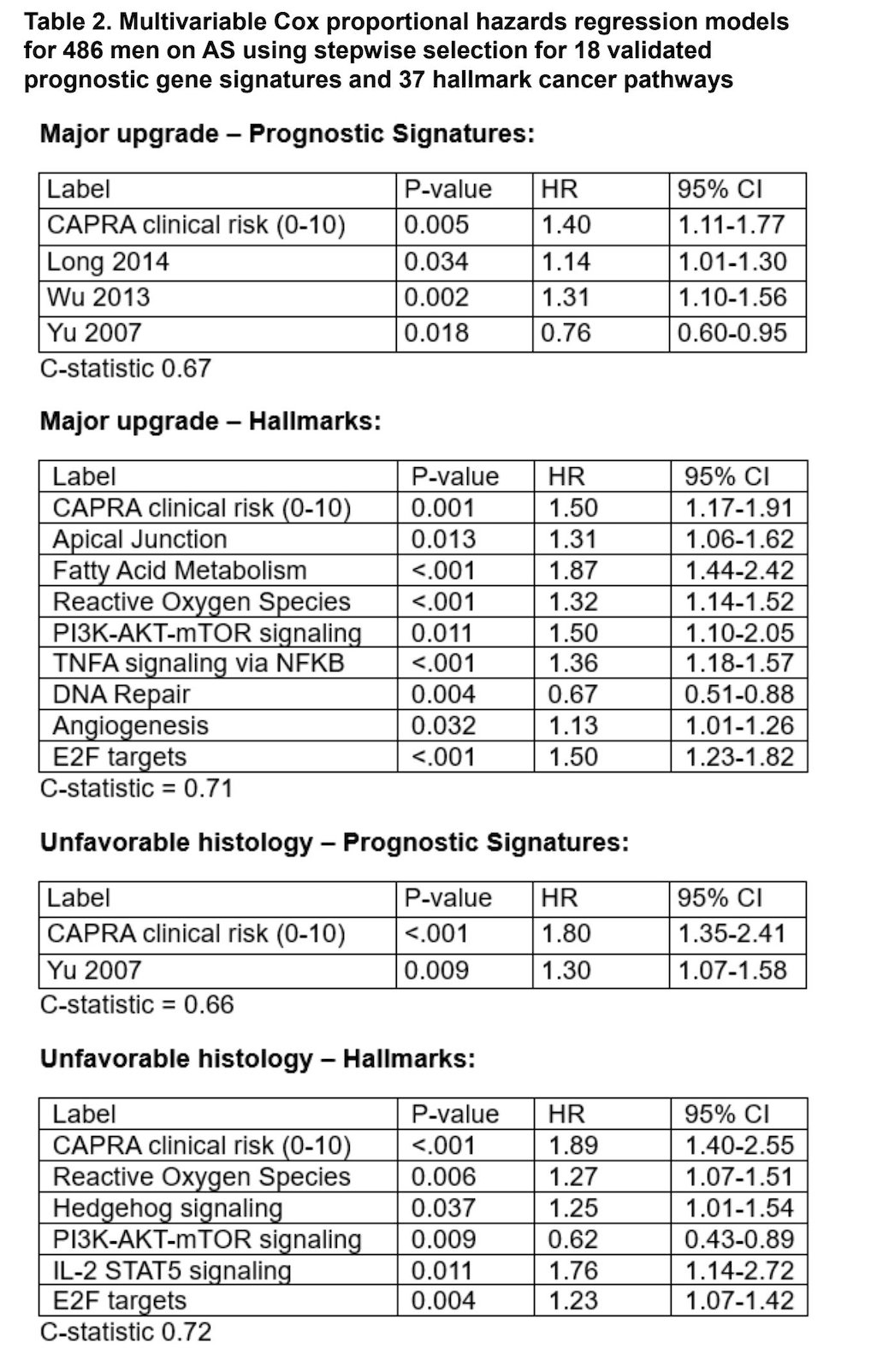
In addition, hallmark pathway analysis revealed that PI3K/AKT/mTOR signaling and reactive oxygen species pathways were independently associated with all adverse outcomes, even after accounting for CAPRA risk.
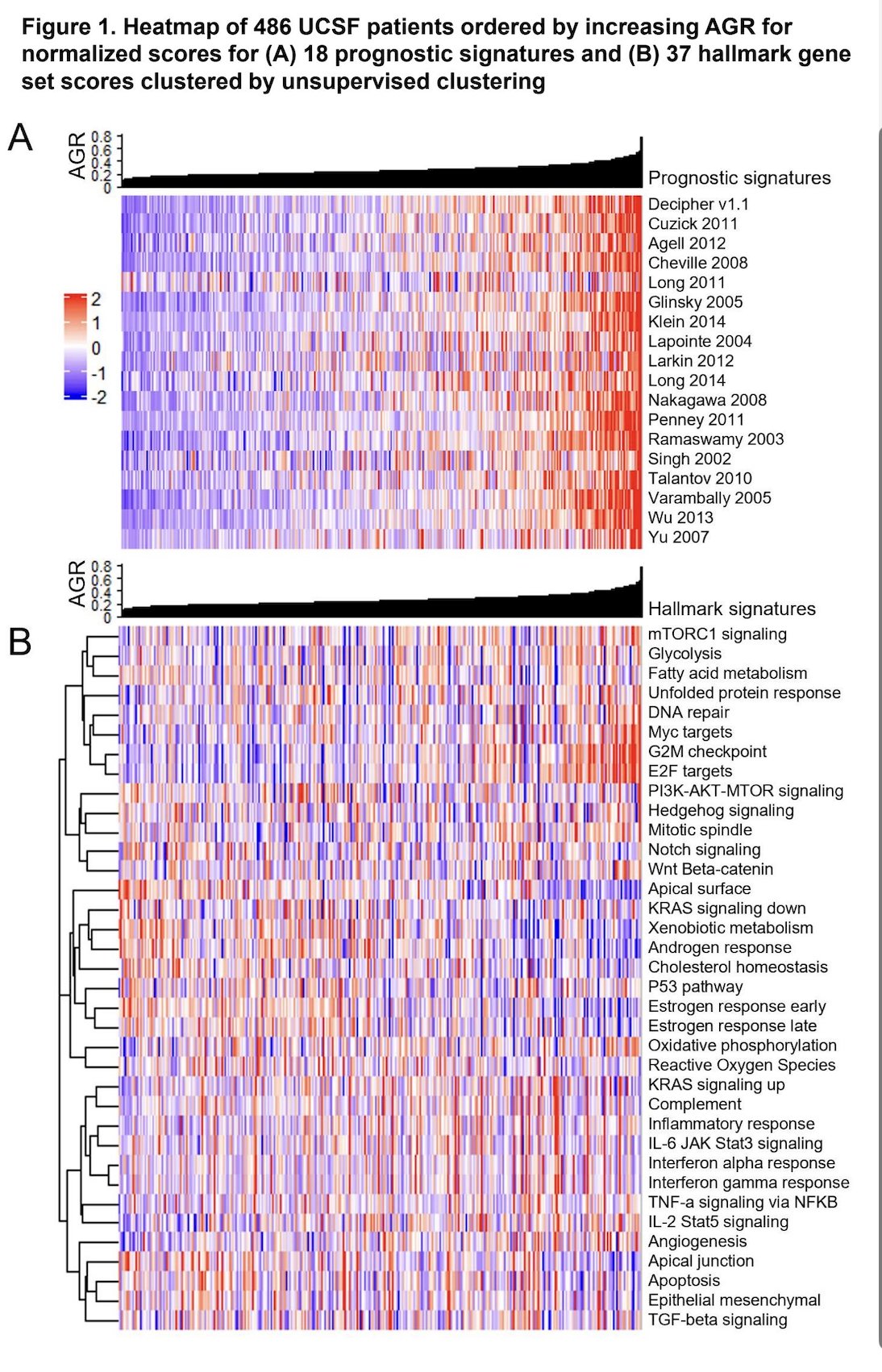
Lastly, the heatmap analysis of 486 UCSF patients demonstrated a coordinated increase in multiple validated prognostic signatures and hallmark pathway scores with rising adverse genomic risk. Unsupervised clustering revealed enrichment of proliferative and aggressive tumor programs, including MYC targets, E2F signaling, G2M checkpoint, DNA repair, PI3K–AKT–mTOR signaling, and epithelial–mesenchymal transition, supporting the biological coherence of higher-risk profiles within the active surveillance cohort.
Lastly, Dr. Shee emphasized several key implications of this research:
- Multiple genomic and pathway-based signatures provided independent prognostic information beyond CAPRA in men on active surveillance.
- Certain validated expression signatures were associated with grade progression and adverse histologic features.
- Hallmark pathways related to PI3K/AKT/mTOR signaling and oxidative stress may play a biological role in disease progression during surveillance.
- Further validation of these genomic signatures is warranted to enhance risk stratification and guide AS in prostate cancer patients.
Presented by: Kevin Shee, MD, PhD, Urology Resident Physician · University of California, San Francisco (UCSF), San Francisco, CA
Written by: Julian Chavarriaga, MD – Urologic Oncologist, Department of Urology at Penn State Health. @chavarriagaj on Twitter during the 2026 American Society of Clinical Oncology Genitourinary (ASCO GU) cancers symposium held in San Francisco, CA, between February 26th and 28th, 2026.