

(UroToday.com) The 2026 GU ASCO annual meeting featured a prostate cancer session and a presentation by Dr. Frankis Almaguel discussing results from the ECLIPSE study assessing pharmacokinetics and dosimetry of Lutetium Lu 177 zadavotide guraxetan in patients with metastatic castration resistant prostate cancer (mCRPC).
PSMA targeted radioligand therapy has emerged as an effective treatment option for patients with mCRPC that has progressed after treatment with an androgen receptor pathway inhibitor, with or without taxane-based chemotherapy. Lutetium Lu 177 zadavotide guraxetan, a proprietary formulation of lutetium Lu 177-PSMA-I&T, is a PSMA-targeted ligand conjugated with the beta-emitting radioisotope lutetium-177. ECLIPSE is an ongoing prospective, randomized, open-label, multicenter, phase 3 trial that is evaluating the efficacy and safety of lutetium Lu 177 zadavotide guraxetan versus standard of care hormone therapy in patients with mCRPC that has progressed on 1 prior androgen receptor pathway inhibitor
Eligible patients were males ≥18 years of age with progressive mCRPC who had been previously treated with an androgen receptor pathway inhibitor and who had PSMA-positive tumors, as confirmed by blinded independent central review of PSMA–PET scans. Key exclusion criteria included:
- Prior chemotherapy for CRPC (prior taxane-based chemotherapy in the hormone-sensitive setting was permitted if ≤6 doses were received, the last dose was administered >1 year prior to consent, and disease progression did not occur during treatment)
- ECOG performance status score ≥2
- Superscan seen on the baseline bone scan, as determined by the investigator
Patients received a target dose of 7.4 ± 10% GBq (200 mCi) lutetium Lu 177 zadavotide guraxetan IV at the beginning of each 6-week cycle for up to 6 cycles. At ASCO GU 2026, the following assessments and analyses were presented: biodistribution, dosimetry, and pharmacokinetic results from Cycle 1.
SPECT/CT imaging was performed at 4, 24, 48, and 168 hours post-injection, and whole blood samples for pharmacokinetic analyses were collected pre-injection and at 1, 4, 24, 48, and 168 hours post-injection, and plasma was measured for radioactivity using a gamma counter. Imaging data were analyzed using Invicro’s VivoQuant software and quantified based on the Medical Internal Radiation Dose (MIRD) principles, and Organ Level Internal Dose Assessment (OLINDA) software was used to compute organ- and whole body–absorbed radiation doses for each patient. Red marrow absorbed dose was estimated using CT-based segmentation of the lumbar vertebrae (L2–L4), cumulative absorbed radiation doses over 6 cycles were predicted by extrapolation from Cycle 1 data, and pharmacokinetic plasma time-activity curves were fitted with a biexponential function to derive outcome parameters, such as half-life (t1/2) and clearance.
Overall, 27 patients were included in the substudy. Lutetium Lu 177 zadavotide guraxetan was predominantly observed in the kidneys, urinary bladder, gastrointestinal tract, lacrimal glands, and salivary glands at Cycle 1:
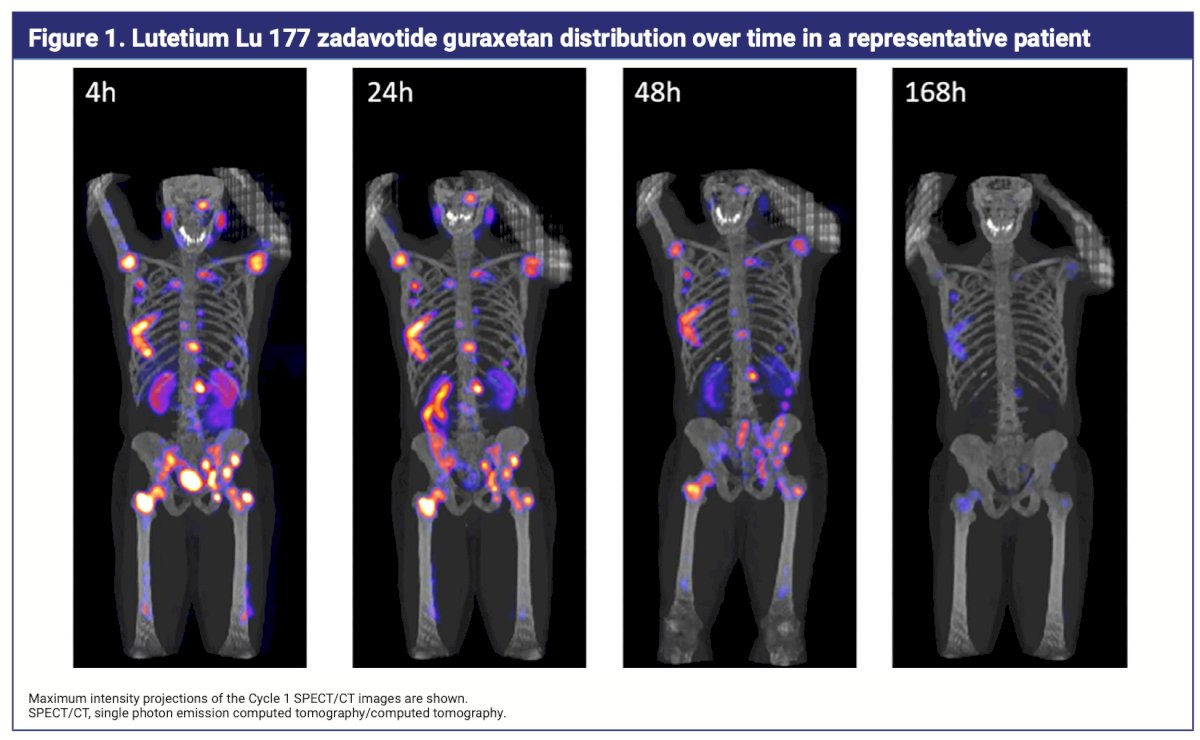
The highest absorbed doses were observed in the kidneys (mean ± SD, 0.41 ± 0.15 Gy/GBq), urinary bladder (0.41 ± 0.05 Gy/GBq), lacrimal glands (0.40 ± 0.36 Gy/GBq), salivary glands (0.19 ± 0.16 Gy/GBq), and in some parts of the gastrointestinal tract (left colon, 0.47 ± 0.31 Gy/GBq; rectum, 0.44 ± 0.30 Gy/GBq). Urinary excretion was the primary elimination pathway, as reflected by activity accumulation in the urinary bladder:
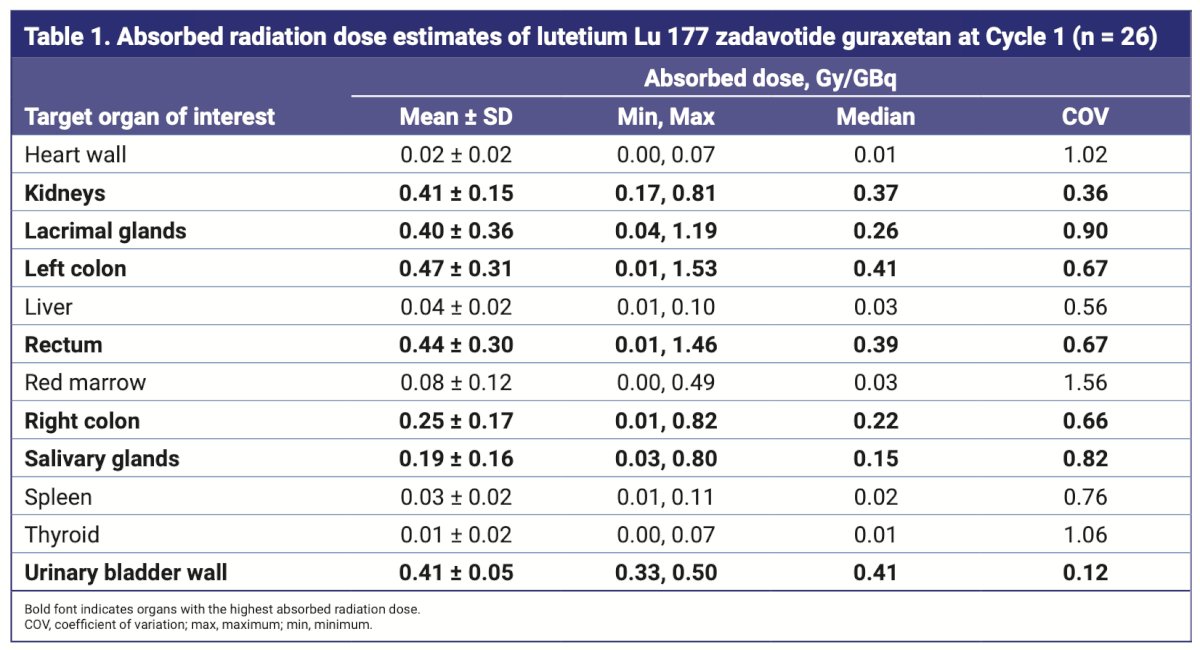
The mean ± SD absorbed radiation dose to the red marrow was 0.08 ± 0.12 Gy/GBq, with high variability associated with diffuse bone involvement in 6 patients, which led to increased bone uptake and consequently higher absorbed radiation doses in the red marrow. After exclusion of those 6 patients, the remaining 20 patients had a mean ± SD red marrow absorbed dose of 0.02 ± 0.02 Gy/GBq. Based on absorbed dose estimates in the kidney, extrapolation to a cumulative activity of 44.4 GBq over 6 cycles yielded a mean estimated absorbed dose of 18.2 Gy, which is below the prespecified tolerance threshold of 23 Gy and supports an increase in the maximum number of cycles to 6 cycles. The cumulative absorbed doses over 6 cycles were estimated to be 8.4 Gy for the salivary glands and 17.8 Gy for the lacrimal glands
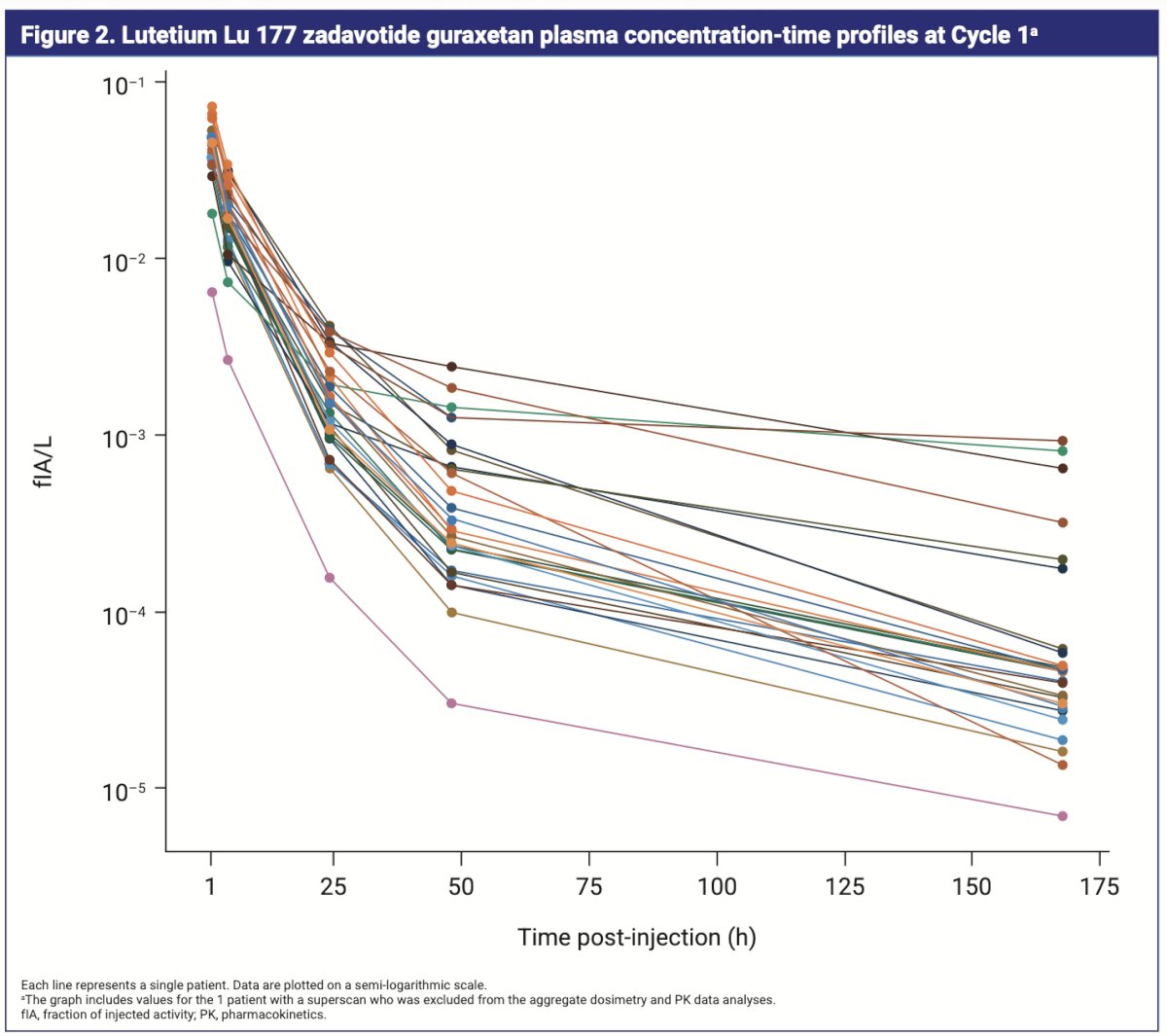
Plasma concentration decreased over time and showed a biphasic profile that was characterized by a rapid initial decline followed by a slower elimination phase:
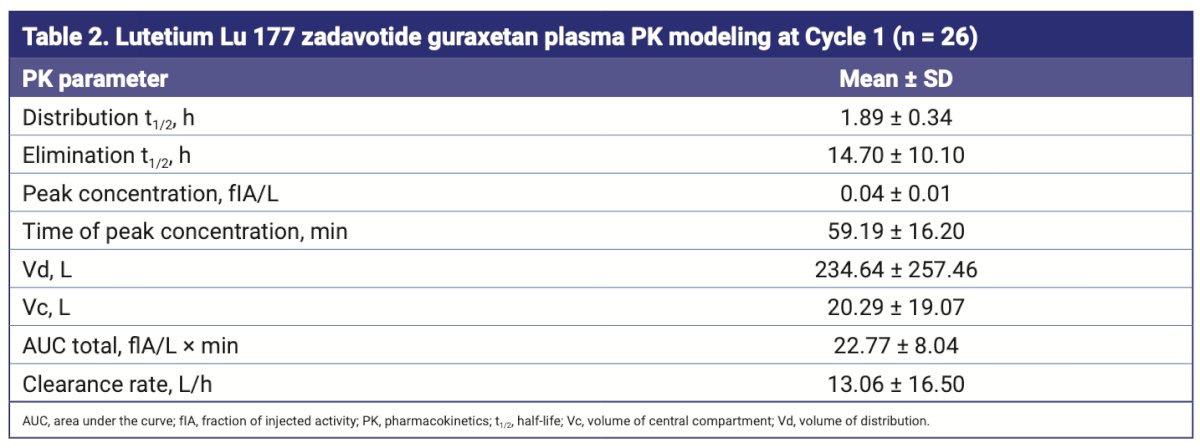
A summary of the plasma pharmacokinetic data is as follows:
- The mean ± SD distribution t1/2 was 1.89 ± 0.34 hours
- The mean ± SD elimination t1/2 was 14.70 ± 10.10 hours
- The clearance values (mean ± SD, 13.06 ± 16.50 L/h) indicated rapid clearance of the majority of the injected dose from the plasma
Dr. Almaguel concluded his presentation discussing results from the ECLIPSE study with the following take-home points:
- The ECLIPSE dosimetry/pharmacokinetics substudy provided a quantitative assessment of organ dosimetry and the pharmacokinetics of lutetium Lu 177 zadavotide guraxetan in patients with mCRPC
- Extrapolation of Cycle 1 kidney-absorbed dose estimates demonstrated that the projected mean cumulative renal doses remained below 23 Gy for a 6-cycle treatment regimen
- Red marrow absorbed dose variability was primarily influenced by skeletal disease burden
- Overall, these findings establish a robust dosimetric and pharmacokinetic profile for lutetium Lu 177 zadavotide guraxetan that aligns with current international guidelines for best practice
Presented by: Frankis Almaguel, MD, PhD, Loma Linda University Health Cancer Center, Center for Health Disparities and Molecular Medicine, Loma Linda, CA
Related content: ECLIPSE Trial Explores Dosimetry for PSMA-Targeted Therapy in mCRPC - Frankis Almaguel & Jason Hafron