

(UroToday.com) The 2026 American Society of Clinical Oncology Genitourinary (ASCO GU) cancers symposium held in San Francisco, CA, was host to the Poster Session A: Prostate Cancer. Dr. Melissa L. Abel presented Poster 192: Radium-223 without ADT in patients with biochemically recurrent prostate cancer and PET findings in the bones.
Dr. Abel presented early results from a phase 2 study (NCT04206319) evaluating radium-223 monotherapy in patients with biochemical recurrence (BCR) and PET-detected bone disease in the absence of androgen deprivation therapy (ADT).
As Dr. Abel noted, patients with BCR have rising PSA following definitive surgery or radiation, but conventional imaging with CT and Tc99 bone scans is negative. Although ADT-based approaches are commonly used in this setting, they carry significant toxicity and have not demonstrated a clear survival benefit in this population. Radium-223, an alpha-emitting radiopharmaceutical that targets areas of increased bone turnover, has shown an overall survival benefit in metastatic prostate cancer.1 However, its role as monotherapy in PET-positive BCR without concurrent ADT had not been previously explored.
Eligible patients had BCR after definitive therapy, testosterone >100 ng/dL, normal organ and marrow function, and negative conventional imaging. Importantly, patients were required to have findings suspicious for metastatic bone disease on NaF or PSMA PET that were not visible on Tc99 imaging. Radium-223 was administered at the approved dose of 55 kBq/kg for six cycles. PSA response was defined as two or more confirmed declines from an intra-study apex PSA (ISAP). All patients underwent pre- and post-treatment PSMA and NaF PET imaging. Immune response is the primary endpoint and will be evaluated at study completion.
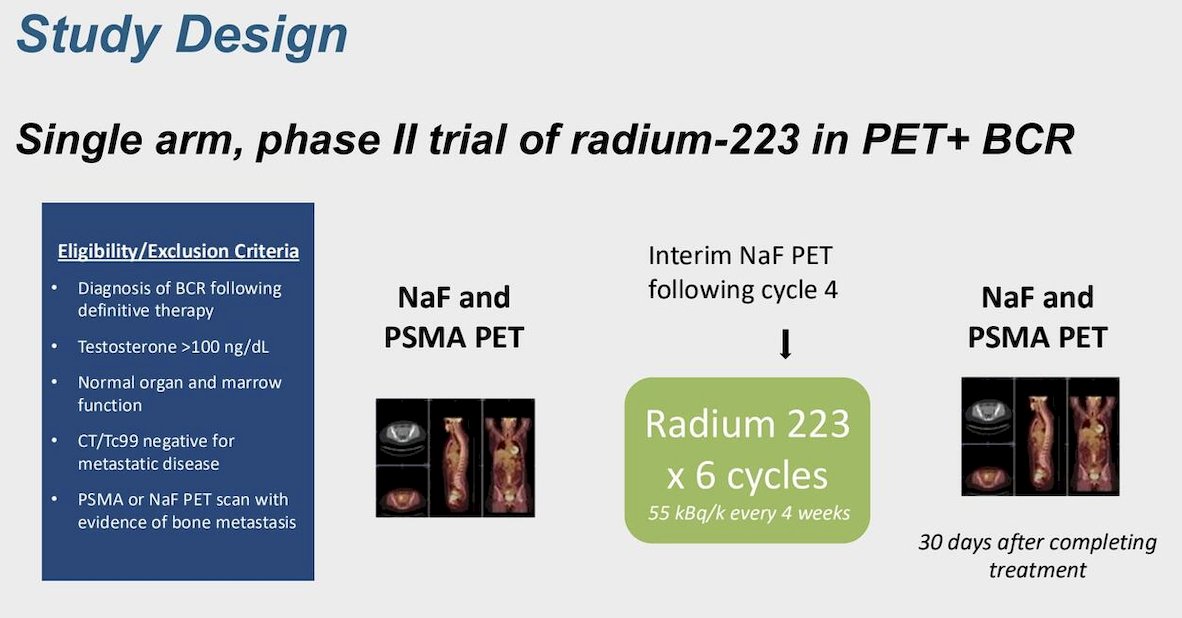
The primary Objective was to determine significant changes in immune cell populations compared to baseline in patients with NaF or PSMA PET+ BCR prostate cancer treated with radium-223
Secondary Objectives included:
- To determine changes in PSA kinetics after treatment with radium-223
- To evaluate changes in PSA kinetics and immune cell subsets relative to participants of a similar study undergoing surveillance
- To assess the safety and tolerability of radium-223 in patients with BCR
- To determine changes on 18F NaF or PSMA PET scans after treatment with radium-223
Dr. Abel reported that 25 patients have enrolled, with 24 currently evaluable for response. The median age was 69 years (range 57–80), and the median PSA at baseline was 1.75 ng/mL (range 0.2–49.5). The majority of patients demonstrated targetable disease, with 21 of 24 having PSMA-positive scans and 21 of 24 also positive on NaF PET imaging.
Two patients with rapid PSA doubling times discontinued early due to progression and were not evaluable for follow-up imaging. Among the 24 evaluable patients, 8 (33%) achieved confirmed ISAP PSA declines ranging from 12% to 80%, lasting 84 to 682 days, including two ongoing responses. Notably, delayed PSA responses were observed after completion of treatment.

Imaging responses were also encouraging, with 13 of 21 evaluable patients demonstrating a reduction in SUVmax on NaF PET, and 5 of 19 evaluable patients with PSMA-positive lesions achieving radiographic responses. Two patients experienced complete resolution of multiple PSMA-positive bone lesions, including one who remains PET-negative more than two years later with a stable PSA.

Treatment was well tolerated. There were no missed cycles due to toxicity and no Grade >3 adverse events. Grade 2 toxicities were rare, and no Grade 1 or 2 changes in hemoglobin or platelets were observed. Two patients with rapid PSA doubling times discontinued for progression and were not evaluable for follow-up imaging.
Five of 16 evaluable patients (31%) achieved confirmed ISAP PSA declines of 14%, 21%, 24%, 33%, and 57%, lasting 84, 173, 292, 246+, and 661+ days, respectively. Among 11 evaluable patients with follow-up imaging, 8 demonstrated decreased standardized uptake value on NaF PET after treatment. Two patients had resolution of multiple PSMA-positive bone lesions, and one remains without detectable bone lesions on PET after more than two years with a stable PSA.
An illustrative example was presented of a delayed and prolonged PSA response following completion of radium-223 therapy. In this participant, PSA levels continued to rise during treatment, without an immediate biochemical response. However, approximately three months after completing therapy, a sharp decline in PSA was observed. The PSA subsequently remained below the prior peak for more than one year, highlighting the potential for delayed therapeutic effects with radiopharmaceutical treatment and the importance of cautious interpretation of early PSA kinetics.

The treatment was well tolerated, with rare grade 2 toxicities, no grade 2 changes in hemoglobin or platelets, no grade 3 or 4 toxicities, and no missed cycles due to toxicity.

In discussing these findings, Dr. Abel highlighted several key takeaways from her presentation:
- Radium-223 in the BCR setting appears safe, with rare grade 1–2 toxicities.
- Decreases in SUV on most NaF PET scans suggest biologic uptake and activity of radium-223 in NaF-positive lesions.
- Substantial improvements on PSMA PET imaging have been observed in a subset of patients.
- Delayed but confirmed PSA declines were seen in 33% of patients.
- Radium-223 monotherapy may have therapeutic activity in PSMA PET–positive BCR, though further studies are needed to better define its role.
Presented by: Melissa Abel, MD, Medical Oncologist at the Center for Cancer Research, National Cancer Institute, Bethesda, MD
Written by: Julian Chavarriaga, MD – Urologic Oncologist, Department of Urology at Penn State Health. @chavarriagaj on Twitter during the 2026 American Society of Clinical Oncology Genitourinary (ASCO GU) cancers symposium held in San Francisco, CA, between February 26th and 28th, 2026.
References:- Parker C, Nilsson S, Heinrich D, Helle SI, O'Sullivan JM, Fosså SD, Chodacki A, Wiechno P, Logue J, Seke M, Widmark A, Johannessen DC, Hoskin P, Bottomley D, James ND, Solberg A, Syndikus I, Kliment J, Wedel S, Boehmer S, Dall'Oglio M, Franzén L, Coleman R, Vogelzang NJ, O'Bryan-Tear CG, Staudacher K, Garcia-Vargas J, Shan M, Bruland ØS, Sartor O; ALSYMPCA Investigators. Alpha emitter radium-223 and survival in metastatic prostate cancer. N Engl J Med. 2013 Jul 18;369(3):213-23. doi: 10.1056/NEJMoa1213755. PMID: 23863050.