

(UroToday.com) The 2026 GU ASCO annual meeting featured a prostate cancer session and a presentation by Dr. Scott Tyldesley discussing the 15-year survival analysis from the ASCENDE-RT randomized trial of external beam boost versus brachytherapy boost in localized prostate cancer.
There are several impacts of biochemical relapse after local therapy for prostate cancer, including anxiety, leading to additional treatment (often ADT), and the possible impact on overall and prostate cancer-specific survival. The Androgen Suppression Combined with Elective Nodal and Dose Escalated Radiation Therapy (ASCENDE-RT) trial randomized patients (n = 398, between November 2002-December 2011) 1:1 to prostate brachytherapy or the external beam radiotherapy boost. All patients received 1 year of ADT and 46 Gy in 23 fractions of pelvic radiotherapy. Patients in the external beam radiotherapy arm received an additional 32 Gy in 16 fractions, and those in the prostate brachytherapy arm received a 115 Gy 125I implant:
The trial previously demonstrated a 10 year freedom from biochemical failure (85% versus 67%) for prostate brachytherapy versus external beam radiotherapy (p = 0.0004).1 At present, the median follow-up from the start of treatment of all patients is 15 (IQR 10.7, 17.8) years. At ASCO GU 2026, Dr. Tyldesley and colleagues reported the 15-year actuarial survival events.
Two hundred patients with a median age of 68 (IQR 62,73) were randomized to external beam radiotherapy and 198 to prostate brachytherapy, with active study follow-up stopped at 10 years. Cause of death was determined on chart review and study report forms during active study follow-up, and was augmented with death registry data and medical records audits thereafter. Fifteen-year overall survival and cumulative risk of death from prostate cancer were estimated using Cox and Fine and Gray analysis, respectively, with multivariable analysis of significant variables on univariate analysis, including randomization, clinical T stage, log of initial PSA, Gleason grade group (1-3 versus 4-5), percent positive cores, and age at treatment. A sensitivity analysis included an unknown cause of death as prostate death.
For the most current analysis, 213 patients (54%) have died: 64 (16%) of prostate cancer, 48 (12%) of other cancer, 35 (9%) of cardiovascular disease, 49 (12%) of other known causes, and 17 (4%) of unknown cause of death:

The median age of patients alive at last censoring was 82 (IQR 77,88):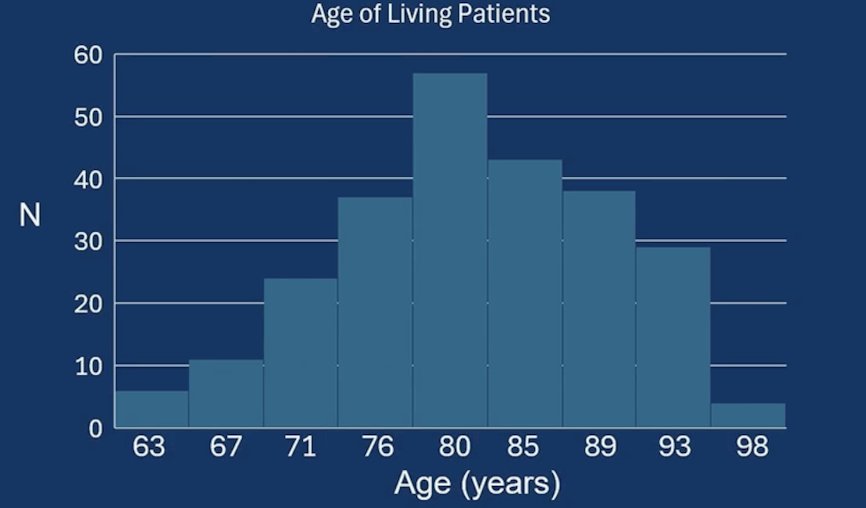
Overall survival at 15 years was 55.0% (95% CI 48.4 – 62.4) and 60.9% (95% CI 54.4 – 68.1) for external beam radiotherapy and prostate brachytherapy arms, respectively (HR 1.02, 95% CI 0.78 – 1.33, p = 0.908 on multivariable analysis):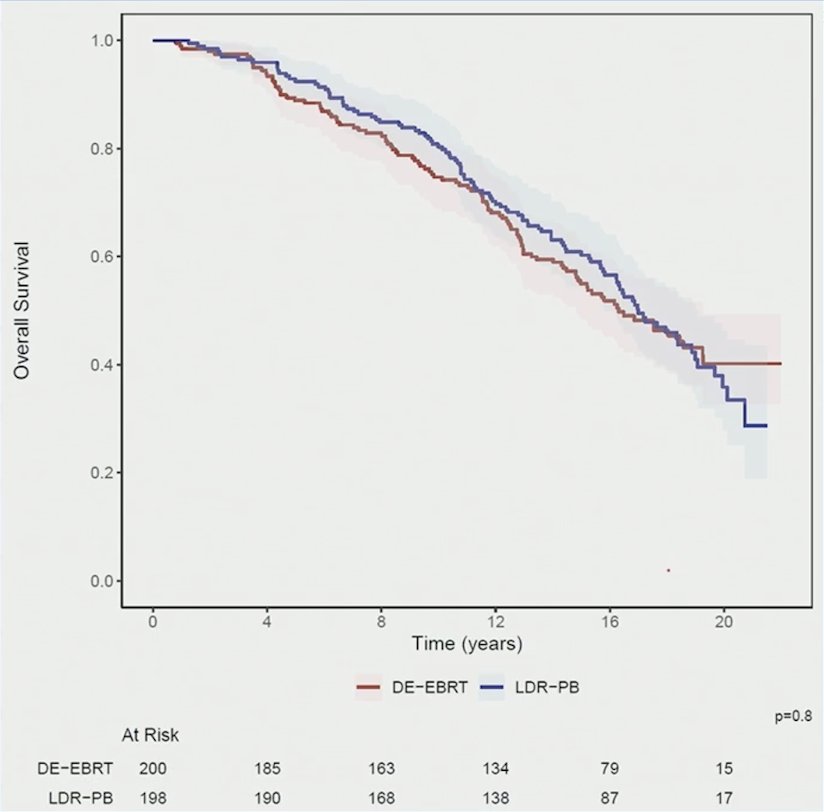
The cumulative incidence of prostate death at 15 years was 8.6% (95% CI 5.2 – 13.0) for prostate brachytherapy and 16.4% (95% CI 11.6 – 22.0) for external beam radiotherapy (p = 0.007):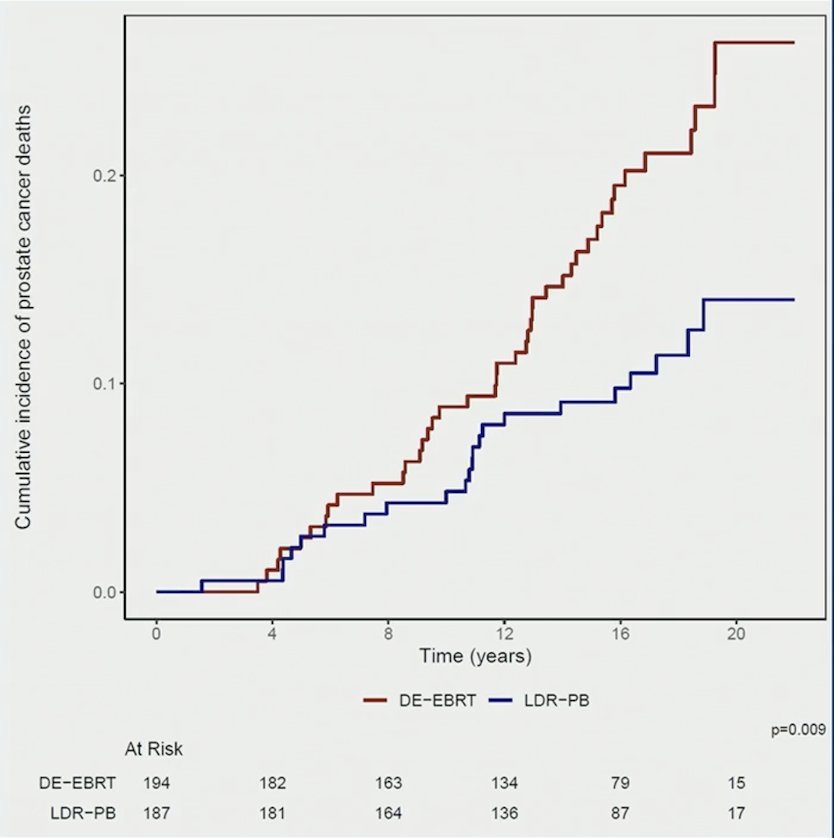
In a sensitivity analysis where cases of unknown cause of death were counted as prostate deaths, the cumulative incidence of prostate death at 15 years was 14.3% (95% CI 9.8 – 19.5) for prostate brachytherapy and 19.4% (95% CI 14.2 – 25.3) for external beam radiotherapy (p = 0.067).
Dr. Tyldesley noted several limitations of their analysis including (i) alpha spending on overall survival and cumulative incidence of prostate cancer mortality was not pre-specified as survival was not the primary endpoint, (ii) the study was not powered for overall survival or cumulative incidence of prostate cancer mortality, and (iii) prostate cancer specific mortality is difficult to resolve, and death ascertainment is an issue, as if often the case with trails of localized prostate cancer.
Dr. Tyldesley concluded his presentation discussing the 15-year survival analysis from the ASCENDE-RT randomized trial with the following take-home points:
- At 15 years, there is no definite evidence of an overall survival benefit with prostate brachytherapy boost in ASCENDE-RT, and the trend to a prostate cancer-specific survival advantage with prostate brachytherapy is limited by the ascertainment of cause of death
- Although prostate cancer was the single most common cause of mortality in ASCENDE-RT, these results suggest that even large improvements in biochemical no evidence of disease, such as those demonstrated with prostate brachytherapy in ASCENDE-RT, are unlikely to improve 15-year overall survival by more than 10% for a population whose median age, performance status, and prognostic variables are similar to ASCENDE-RT participants
Presented by: Scott Tyldesley, MD, MPA, ABR, FRCPC, BC Cancer Center, Vancouver, British Columbia, Canada
Related content: ASCENDE-RT Trial Reports 15-Year Survival Update in High-Risk Prostate Cancer - Scott Tyldesley
Reference:
- Oh J, Tyldesley S, Pai H, et al. An updated analysis of the survival endpoints of ASCENDE-RT. Int J Radiat Oncol Biol Phys. 2023 Apr 1;115(5):1061-1070.