

(UroToday.com) The 2026 American Society of Clinical Oncology Genitourinary (ASCO GU) cancers symposium held in San Francisco, CA, was host to the Poster Session A: Prostate Cancer. Dr. Andrew J. Armstrong presented Poster 162: Trial design and objectives for prostate cancer: Recommendations from the Prostate Cancer Clinical Trials Working Group 4 (PCWG4).
Dr. Armstrong began by noting that the conduct of clinical trials in advanced prostate cancer has evolved dramatically over the past decade. The integration of novel imaging modalities, particularly PSMA PET molecular phenotyping, genetic subtyping, refined prognostic tools, and an expanding therapeutic landscape across disease states has created an urgent need to modernize terminology and standardize best practices in clinical trial design.
To address this, PCWG4 convened an international multidisciplinary panel between 2016 and 2025 to update and expand upon prior PCWG2 and PCWG3 recommendations. These updates reflect emerging clinical trial data and the increasing incorporation of biomarker-driven and advanced imaging-based strategies. The PCWG41 clinical states model is shown below:
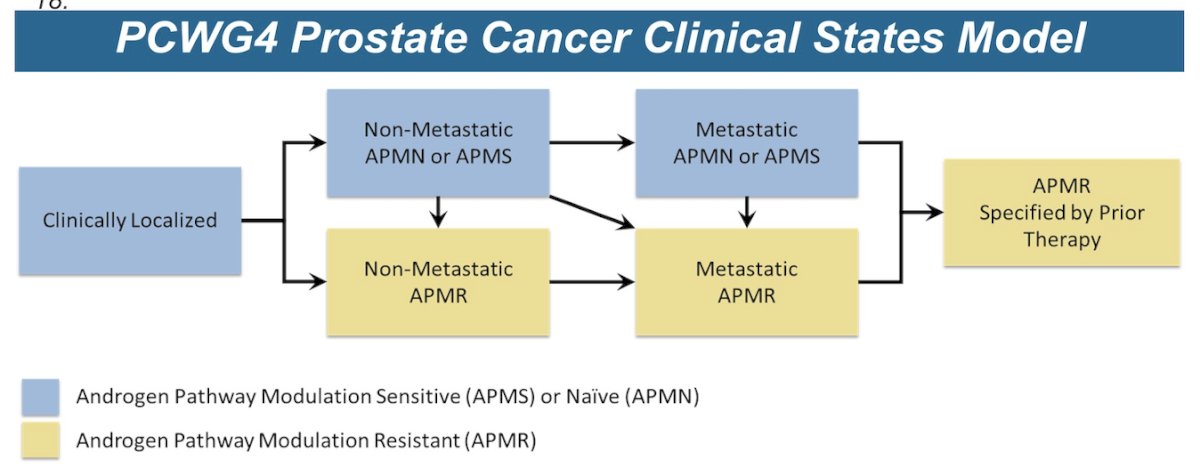
PCWG4 redefines disease state terminology in a more patient-centric framework, incorporating prior therapies, imaging modalities, and biologic context. Particular attention is given to PET-defined disease states and how they should be integrated into eligibility criteria and endpoint assessment.
A executive summary of changes was presented by Dr. Armstrong and is shown below:
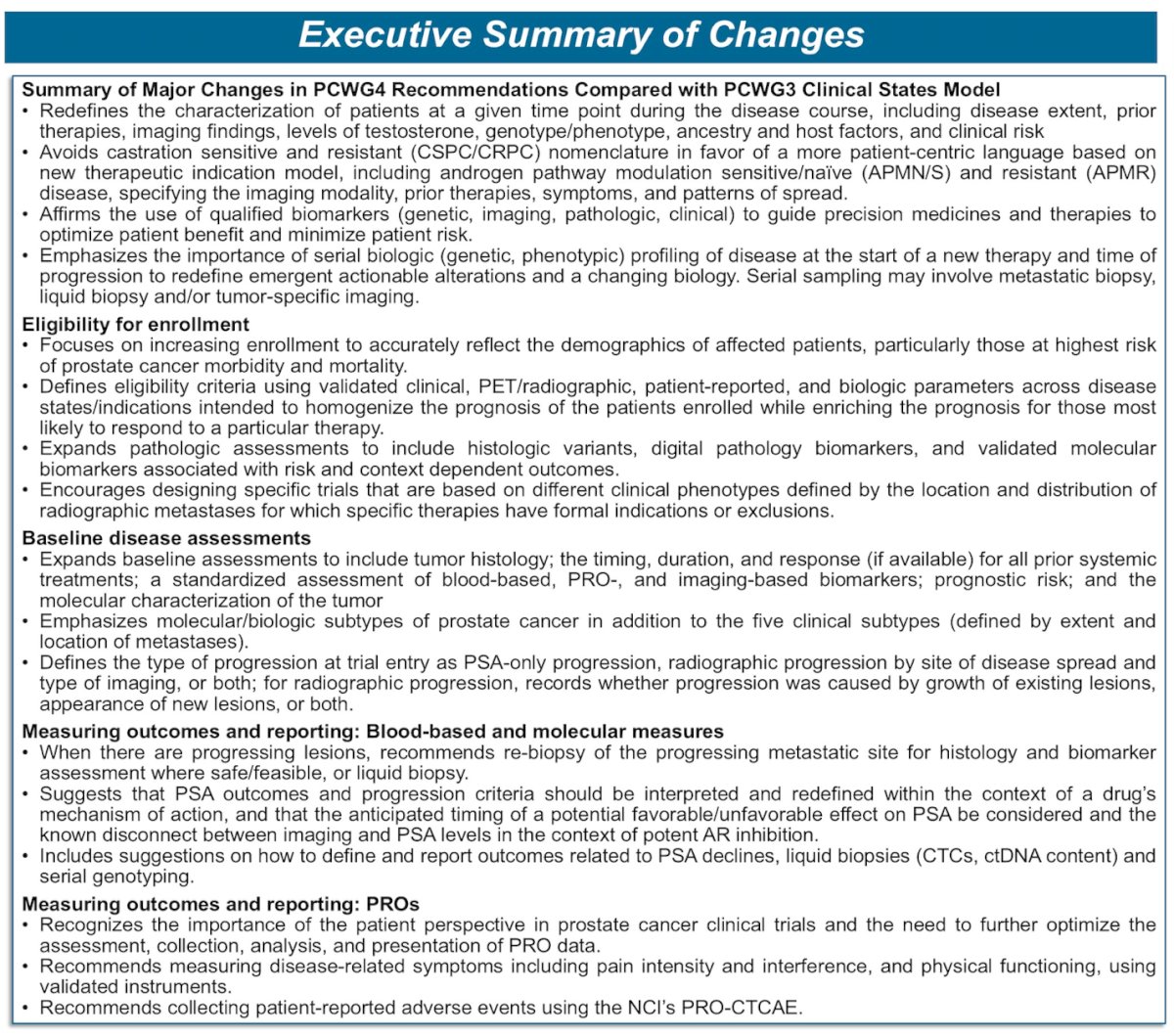
Among the key advances, PCWG4:
- Provides updated guidance on defining disease states and prior treatment exposure in both ADT-sensitive and ADT-resistant settings.
- Expands recommendations for imaging- and non-imaging-based response criteria.
- Defines delay/prevent endpoints incorporating pathology-based responses, ctDNA dynamics, circulating tumor cells, and PSA declines.
- Specifies standardized intervals for imaging reassessments, biomarker evaluation, and patient-reported outcomes.
- Proposes updated imaging-specific radiographic progression-free survival (rPFS) criteria, including structured guidance for serial PSMA PET/CT imaging.
Notably, PCWG4 provides detailed recommendations for interpreting progression by imaging modality, including bone scintigraphy, CT/MRI, and PSMA PET. Updated criteria clarify how new lesions should be confirmed and incorporated into rPFS determinations, particularly in the setting of PET-defined metastatic disease.
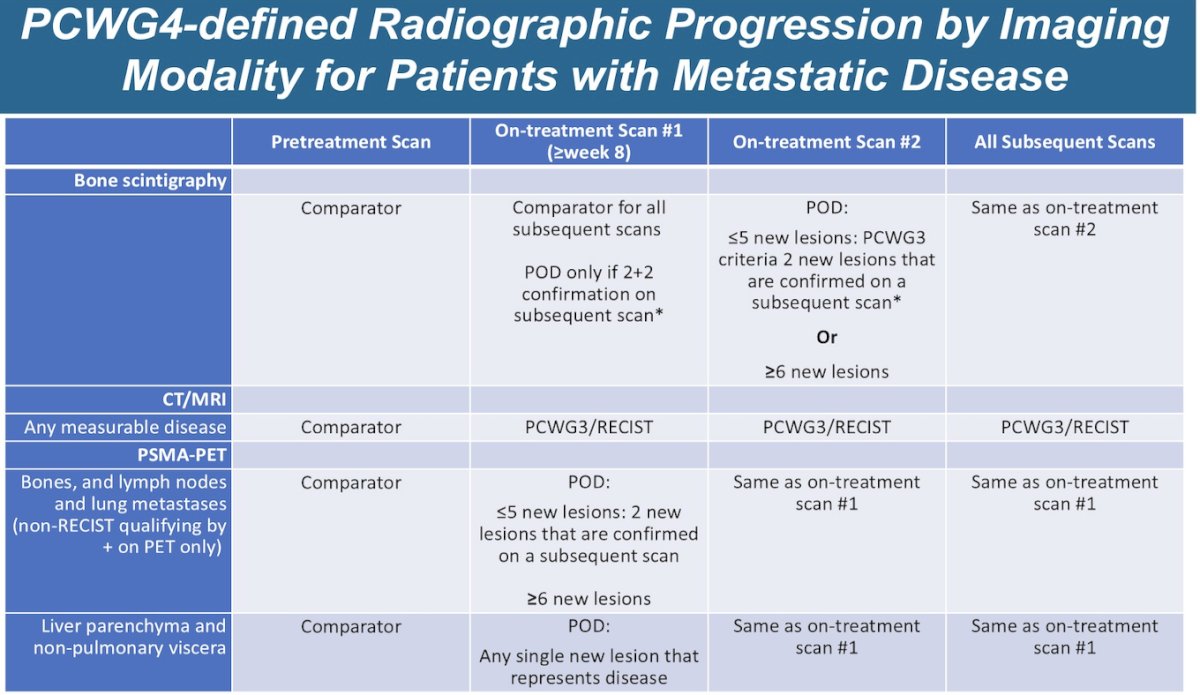
The working group emphasizes the need for validated PET imaging criteria, as well as molecular and phenotypic biomarkers, to improve patient risk stratification, predict therapeutic benefit, and reliably measure post-treatment outcomes within modern clinical trial frameworks.
Dr. Armstrong concluded his presentation with the following key takeaways:
- PCWG4 expands and modernizes clinical trial guidance in advanced prostate cancer to reflect contemporary imaging, biomarker integration, and therapeutic advances.
- Updated terminology and eligibility recommendations aim to create a more patient-centric and biologically informed framework across both ADT-sensitive and ADT-resistant disease states.
- New imaging-specific rPFS criteria, including guidance for serial PSMA PET/CT, address a critical gap in the interpretation of progression in the PET era.
- Integration of molecular, phenotypic, and imaging biomarkers into trial design is essential to improve risk stratification, assess benefit more precisely, and optimize patient outcomes.
This updated framework represents an important evolution in standardizing trial conduct and endpoint assessment in advanced prostate cancer.
Presented by: Andrew Armstrong, MD, MSc, Medical Oncologist, Professor of Medicine, Surgery, Pharmacology and Cancer Biology, Director of the Urologic Research, Duke Cancer Institute, Center for Prostate and Urologic Cancers, Durham, NC
Written by: Julian Chavarriaga, MD – Urologic Oncologist, Department of Urology at Penn State Health. @chavarriagaj on Twitter during the 2026 American Society of Clinical Oncology Genitourinary (ASCO GU) cancers symposium held in San Francisco, CA, between February 26th and 28th, 2026.
Related content: Working Group 4 Introduces Updated Terminology for Advanced Prostate Cancer - Andrew Armstrong
Prostate Cancer Working Group 4 Addresses PSMA PET as a Clinical Trial Endpoint - Michael Morris
PCWG4 Amends Terminology and Biomarker Standards for Advanced Prostate Cancer - Andrew Armstrong
- In press: Armstrong A, Morris MJ, et al. Trial Design and Objectives for Patients with Prostate Cancer: Recommendations from Prostate Cancer Working Group 4. J Clin Oncol. 2026.