

(UroToday.com) The 2026 GU ASCO annual meeting featured a kidney cancer session and a presentation by Dr. Wenzin Xu discussing biomarker analysis of the CAN-I trial assessing circulating KIM-1 in metastatic renal cell carcinoma (RCC) with divergent histologies. The CAN-I trial was a multi-center single-arm phase II trial that evaluated cabozantinib, nivolumab, and ipilimumab for the treatment of metastatic RCC with divergent histologies.
Previous studies have shown that circulating KIM-1 is associated with prognosis in clear cell RCC and that changes in KIM-1 are associated with treatment response. Preclinical data have shown that KIM-1 is overexpressed in most RCCs with divergent histologies except those that have a non-proximal tubular cell of origin, such as chromophobe RCC. At ASCO GU 2026, Dr. Xu and collaborators evaluated whether KIM-1 is associated with histology and outcomes in RCC with divergent histologies.
Patients with RCC with divergent histologies were treated with cabozantinib, nivolumab, and ipilimumab with the following trial schema:
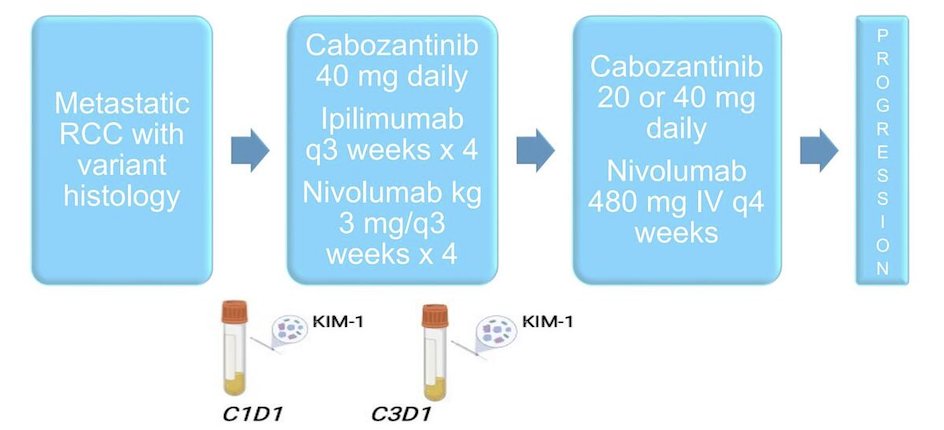
Plasma KIM-1 was evaluated at baseline and cycle 3 day 1 (C3D1) using an established enzyme-based electrochemiluminescence assay:
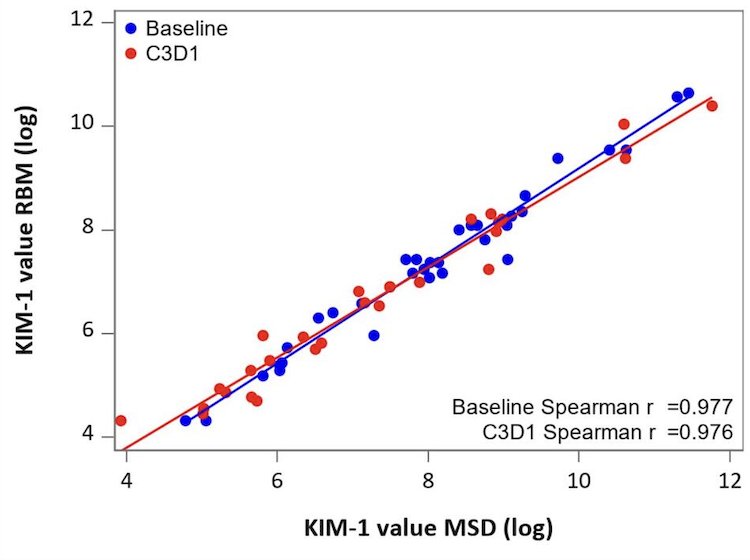
Cox proportional hazards models were used to evaluate the associations between KIM-1 levels and outcomes.
Of 59 patients enrolled, 43 (73%) had plasma available for analysis. The median baseline KIM-1 was 3040 pg/mL (IQR: 842–8512) among patients with non-chromophobe RCC and 63 (IQR: 31–83) among patients with chromophobe RCC (Wilcoxon test, p < 0.0001):

Higher KIM-1 at baseline was associated with worse IMDC risk score (Spearman rho = 0.37, p = 0.015). Among non-chromophobe RCC patients with paired samples (n = 28), KIM-1 at C3D1 was significantly lower compared to baseline (median: 2,900 versus 1,232 pg/mL, Wilcoxon paired test, p = 0.002) and was strongly prognostic for progression-free survival and overall survival after adjustment for IMDC risk and histology:
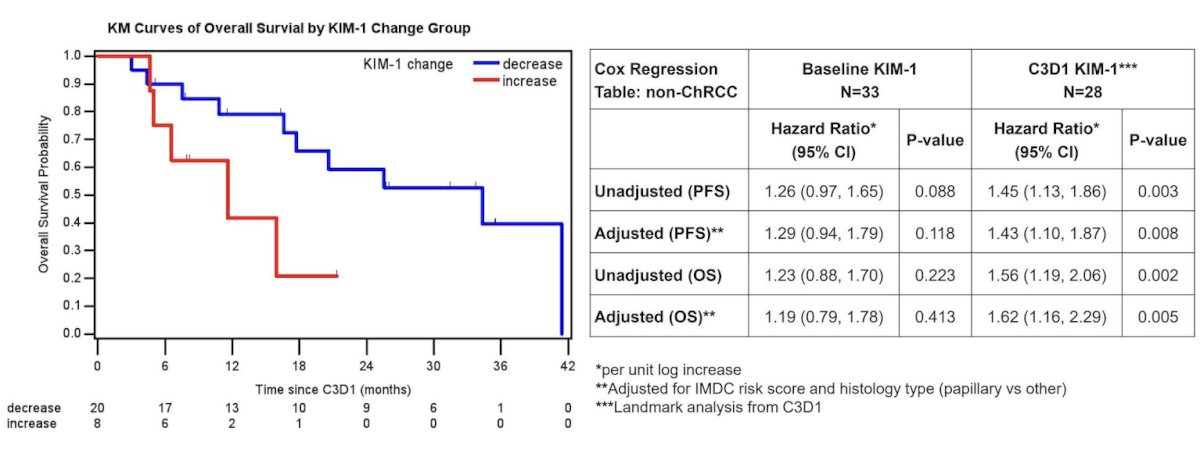
The 12-month overall survival rate from C3D1 was 79% among non-chromophobe patients who had decreasing KIM-1, and 42% among patients who had increasing KIM-1.
Dr. Xu concluded this presentation discussing biomarker analysis of the CAN-I trial assessing circulating KIM-1 in metastatic RCC with divergent histologies, with the following take-home points:
- KIM-1 is overexpressed in papillary, translocation, and unclassified RCC, but is not overexpressed in chromophobe RCC
- Change in KIM-1 at C3D1 is associated with treatment outcomes
- KIM-1 is a potentially useful dynamic biomarker for non-chromophobe RCC divergent histology, and plans for prospective evaluation are underway
Presented by: Wenzin Xu, MD, Dana Farber Cancer Institute, Boston, MA