

(UroToday.com) The 2026 GU ASCO annual meeting featured a kidney cancer trials in progress session and a presentation by Dr. Eric Jonasch discussing a randomized phase 2 trial of nivolumab + relatlimab + ipilimumab versus nivolumab + ipilimumab in first-line advanced renal cell carcinoma (RCC). Ipilimumab + nivolumab is a standard of care for treatment-naïve metastatic clear cell RCC based on the CheckMate-214 trial.1
While the durability of response may be superior to combination therapy with PD-1 inhibitors and agent tyrosine kinase inhibitors, ipilimumab + nivolumab has a relatively low objective response rate and relatively high progressive disease as best response. Building on the benefits of ipilimumab + nivolumab through additional immune manipulation has a biologic rationale and could expand the efficacy of this regimen.
Lymphocyte-associated gene 3 (LAG3) is an inhibitory receptor on activated immune cells that plays a role in T cell exhaustion. LAG3 is expressed on T cells and is co-expressed with other inhibitory receptors such as PD-1. This co-expression induces the dysfunction of T cells and thus limits the anti-tumor T cell response. Relatlimab is a human LAG-3-specific antibody that binds to the LAG-3 receptor with high affinity and blocks LAG-3 interactions with its canonical ligand, major histocompatibility complex (MHC) Class II, which is the peptide antigen presentation molecule recognized by CD4+ T cells. Relatlimab binding inhibits the negative regulatory function of LAG-3 in vitro and restores the effector function of exhausted T cells. Combined LAG3 inhibition with relatlimab and PD-1 inhibition with nivolumab was recently demonstrated in the RELATIVITY-047 melanoma study. These compelling preclinical and clinical data have led to the hypothesis that adding relatlimab to ipilimumab plus nivolumab will increase the objective response rate in patients with metastatic clear cell RCC.
This is a phase 2 randomized, multicenter, study investigating the efficacy of nivolumab 480 mg every 4 weeks (Q4W), relatlimab 160 mg Q4W and ipilimumab 1 mg/kg every 8 weeks (Q8W) IV versus a doublet arm treating with nivolumab 480 mg Q3W and ipilimumab 1mg/kg Q3W IV followed by maintenance nivolumab in first-line advanced clear cell RCC.:
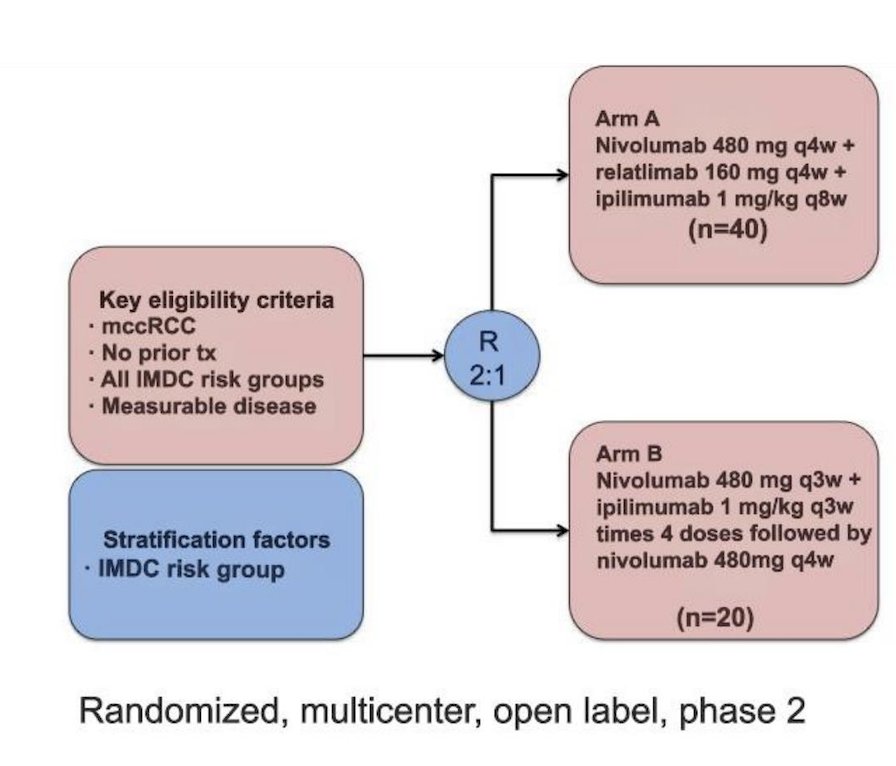
The co-primary endpoints include safety and objective response rate. Up to 60 patients with treatment-naive, biopsy-proven clear cell RCC with adequate organ/marrow function with at least one evaluable lesion by RECIST 1.1 will be enrolled and randomized 2:1 to the experimental arm versus ipilimumab + nivolumab. Ongoing safety and futility monitoring will employ a 2-arm Bayesian optimal phase 2 design. The sample size provides 64% power at a one-sided 0.15 significance level to detect a difference between the arms, assuming the overall response rates are 40% versus 60% for ipilimumab + nivolumab versus the experimental arm, respectively. Secondary endpoints include progression-free survival and overall survival. To explore the effects of the treatment on inducing activated T cell infiltration, biopsies and circulating immune cell subsets will be obtained for single-cell analysis and spatial transcriptomic studies. To date, more than 10 patients have been enrolled.
Presented by: Eric Jonasch, MD, Oncologist, Professor, Department of Genitourinary Medical Oncology, Division of Cancer Medicine, The University of Texas, MD Anderson Cancer Center, Houston, TX
Reference: