

(UroToday.com) The 2026 GU ASCO annual meeting featured a kidney cancer trials in progress session and a presentation by Dr. Bradley A. McGregor discussing STRIKE! an Alliance A032201 trial assessing short term intensified pembrolizumab and tivozanib for high risk RCC. Pembrolizumab for one year following resection of localized high risk clear cell RCC in a phase 3 trial resulted in improvement in relapse-free survival and overall survival.1,2 However, 20% of patients still experienced a relapse within two years with no biomarker yet identified to predict who will respond to or need adjuvant therapy. The addition of a tyrosine kinase inhibitor to immunotherapy is a standard of care in metastatic clear cell RCC, but to date, no studies have addressed the addition of a tyrosine kinase inhibitor to immunotherapy in the adjuvant setting. Subsequently, phase 3 STRIKE! was developed to explore the benefit of 6 months of tivozanib added to pembrolizumab versus pembrolizumab alone in the adjuvant setting for resected high risk clear cell RCC.
Eligible patients have an ECOG performance status ≤2 and a histologically confirmed diagnosis of RCC with clear cell component with or without sarcomatoid features after complete resection of the primary tumor, with pathology revealing pT2 grade 4 disease or any grade ≥ T3 or TxN1. Patients are also eligible if they developed metastasis within a year after resection and then underwent resection, definitive radiation, or ablation of solid, isolated, soft tissue metastases (excluding brain and bone lesions) with no evidence of active disease (M1NED). Patients will be randomized 1:1 to intravenous pembrolizumab for 48 weeks with or without the addition of tivozanib 1.34 mg by mouth daily D1-21 every 28 days for 6 months, stratified by stage (T2T3 versus T4/N1 versus M1 NED). With no limit on dose holds or interruptions of tivozanib, dose reductions of tivozanib to 0.89 mg D1-21 every 28 days or tivozanib 0.89 mg every other day are allowed:
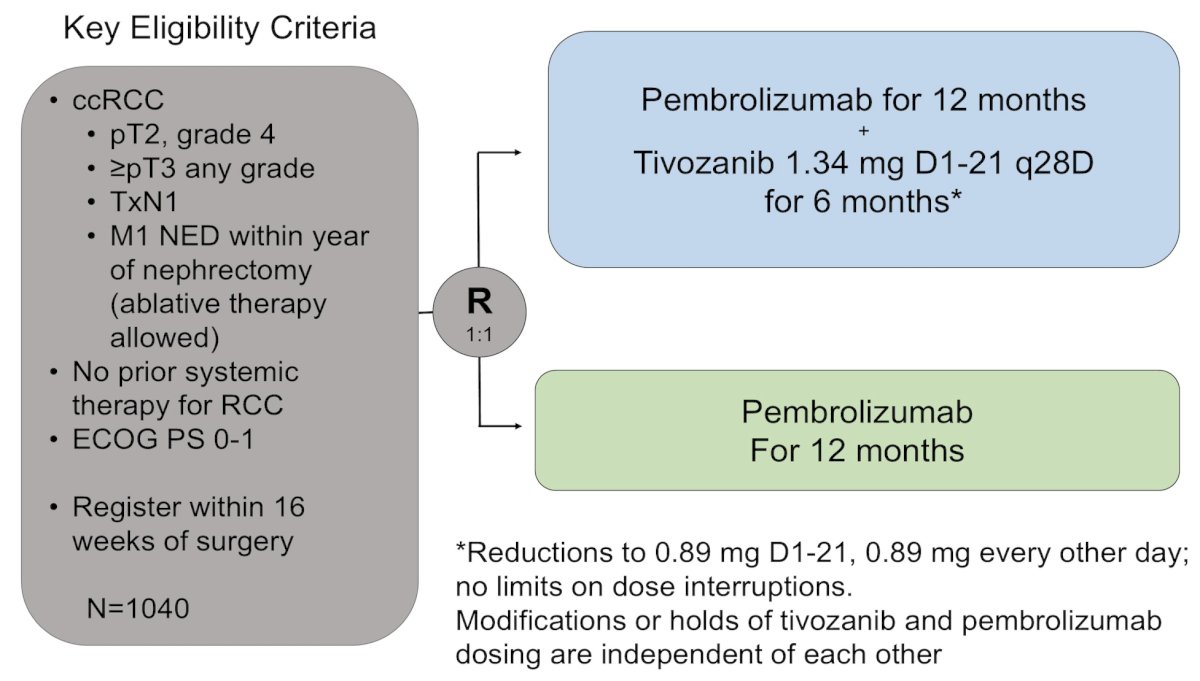
No dose reductions of pembrolizumab are permitted. Following baseline imaging to confirm no disease, imaging is performed every 12 weeks for the first year, every 16 weeks for second year, every 24 weeks for third year, and then annually until 5 years after registration or progression. The primary endpoint will be disease free survival as assessed by the investigator, with secondary endpoints being overall survival, safety, and tolerability. The study will enroll 1,040 patients to detect a minimum detectable hazard ratio of 0.67 (24-month disease free survival 84% in the experimental arm) with 90% power. Quality of life analysis will compare global quality of life and fatigue between the two arms. Imaging and specimens will be banked for future research. The study opened to accrual in April 2025, and at this time 106 patients have enrolled.
Presented by: Bradley A. McGregor, MD, Dana Farber Cancer Institute, Harvard Medical School, Boston, MA
Written by: Zachary Klaassen, MD, MSc – Urologic Oncologist, Associate Professor of Urology, Georgia Cancer Center, Wellstar MCG Health, @zklaassen_md on Twitter during the 2026 American Society of Clinical Oncology Genitourinary (ASCO GU) cancers symposium held in San Francisco, CA, between February 26th and 28th, 2026.
References:
- Choueiri TK, Tomczak P, Park SH, et al. Adjuvant Pembrolizumab after Nephrectomy in Renal-Cell Carcinoma. N Engl J Med. 2021 Aug 19;385(8):683-694.
- Choueiri TK, Tomczak P, Park SH, et al. Overall Survival with Adjuvant Pembrolizumab in Renal-Cell Carcinoma. N Engl J Med. 2024 Apr 18;390(15):1359-1371.