

(UroToday.com) The 2026 GU ASCO annual meeting featured a kidney cancer session and a presentation by Dr. David F. McDermott discussing results of the phase 1/2 LITESPARK-024 study part 1 assessing ascending dose escalation of belzutifan + palbociclib for previously treated advanced clear cell RCC. Novel mechanisms of action remain an unmet need for patients with advanced clear cell RCC with progressive disease after multiple therapies. Previously, a combination of HIF-2α and CDK4/6 inhibitors showed synthetic lethality in preclinical clear cell RCC models.1 The phase 1/2 LITESPARK-024 study evaluates safety and efficacy of belzutifan + palbociclib in patients with advanced clear cell RCC with progressive disease after ≥2 systemic regimens, including both anti-PD-(L)1 and VEGFR-TKI therapy, and no prior HIF-2α and CDK4/6 inhibitors.
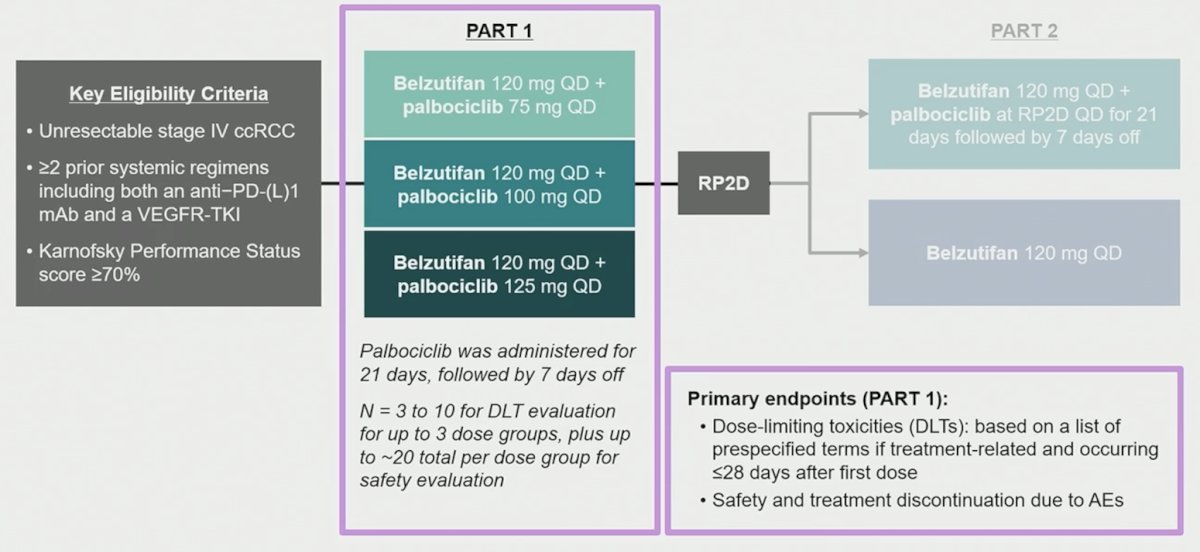
Eligible adults had unresectable stage IV clear cell RCC, radiographic progressive disease on/after most recent treatment, and ≥2 prior systemic regimens (including both anti–PD-[L]1 and VEGFR-TKI). Part 1 aimed to determine the recommended phase 2 dose by evaluating dose limiting toxicities (based on a list of prespecified terms if treatment-related and occurring ≤28 days after first dose) and safety (evaluated in all patients who received ≥1 dose study drug). Patients received belzutifan 120 mg daily + palbociclib 75 mg, 100 mg, or 125 mg daily for 21 days followed by 7 days off until progressive disease, unacceptable adverse events, patient withdrawal, or belzutifan discontinuation. Exploratory efficacy (objective response rate, disease control rate, and progression free survival by investigator per RECIST 1.1) in all enrolled patients is also reported:
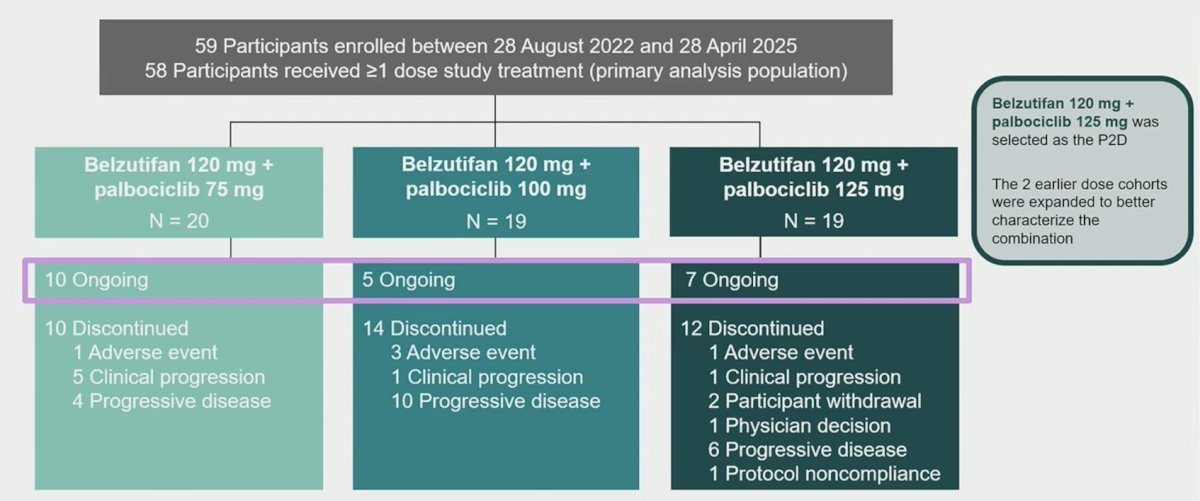
59 patients were enrolled and 58 patients received ≥1 dose study drug (n = 20 in 75 mg palbociclib group, n = 19 each in 100 mg and 125 mg groups), as well as one patient in the 100 mg group enrolled but not treated:
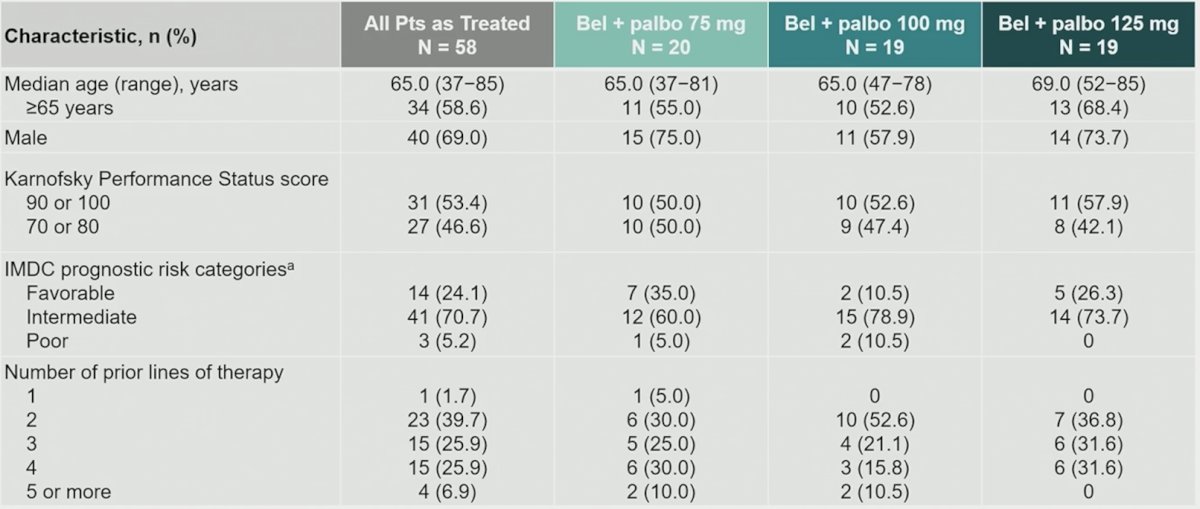
The baseline characteristics, delineated by palbociclib dose, are highlighted in the following table:
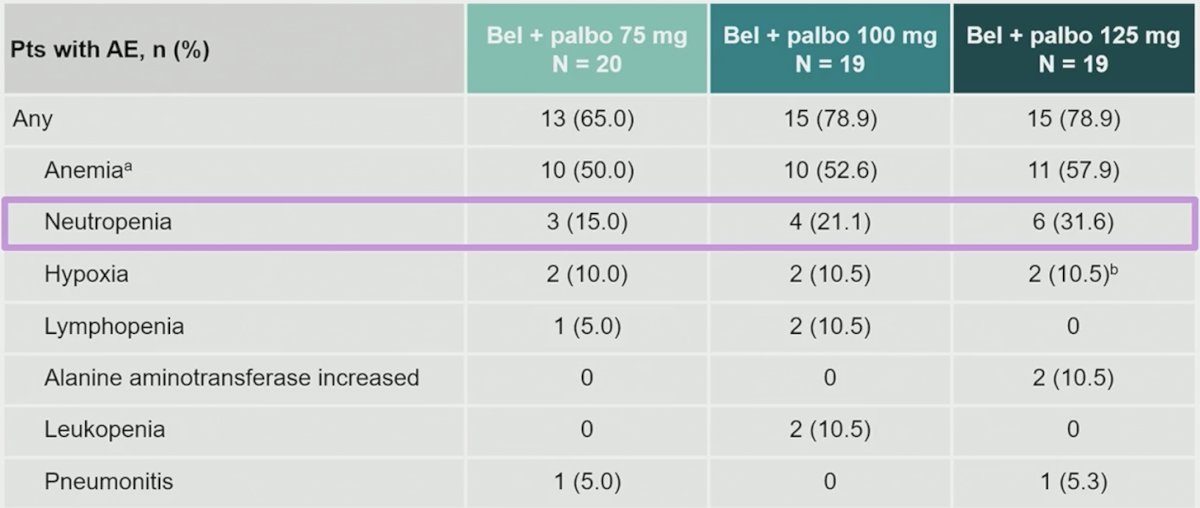
As of the data cutoff date of July 28, 2025, the median follow-up was 8.7 months (range: 3.0–35.0). The total median duration of therapy was 4.4 months (range: 0.2–23.4) for belzutifan and 3.5 months (range: 0.2–23.4) for palbociclib. There were two dose limiting toxicities that occurred: 1 grade 3 anemia, and 1 grade 3 hypoxia (both in the 125 mg group). Safety summary is shown in the Table:

The most common grade ≥3 treatment related adverse event was anemia (50.0% in 75 mg group, 52.6% in 100 mg group, 57.9% in 125 mg group):
The objective response rate and disease control rate were 15.0% (95% CI 3.2–37.9) and 70.0% (95% CI 45.7–88.1) in 75 mg group, 0.0% (95% CI 0.0–17.6) and 57.9% (95% CI 33.5–79.7) in 100 mg group, and 21.1% (95% CI 6.1–45.6) and 73.7% (95% CI 48.8–90.9) in 125 mg group:

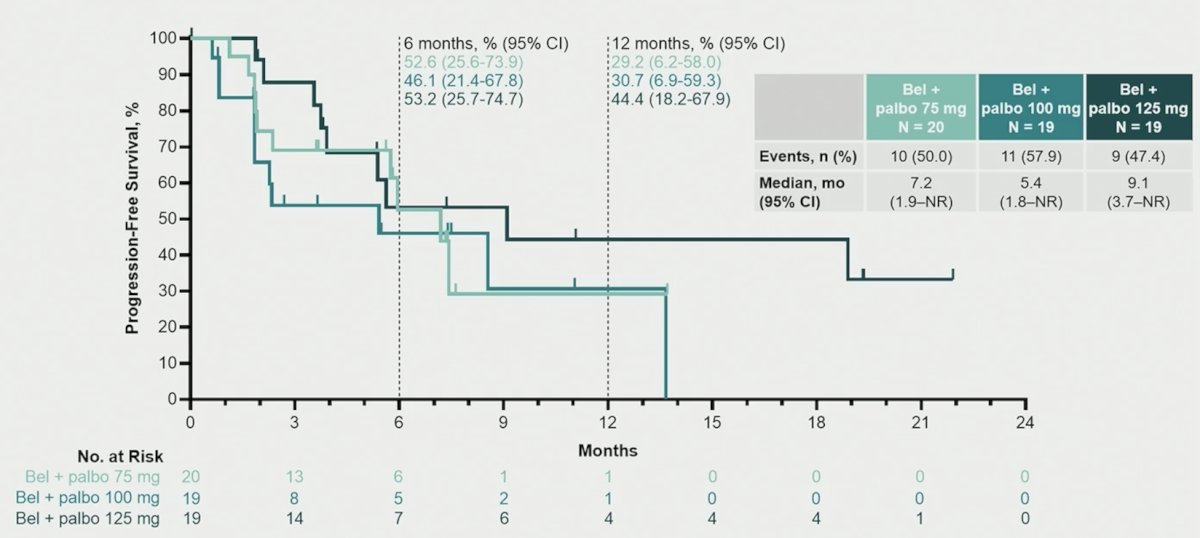
Median progression free survival was 7.2 months (95% CI 1.9–NR), 5.4 months (95% CI 1.8–NR), and 9.1 months (95% CI 3.7–NR) for the palbociclib 75 mg, 100 mg, and 125 mg dose, respectively:
Dr. McDermott concluded his presentation discussing the results of the phase 1/2 LITESPARK-024 study part 1 with the following take-home points:
- Palbociclib demonstrated synthetic lethality and additive benefit when combined with a HIF-2α inhibitor in preclinical clear cell RCC models
- In Part 1 of the LITESPARK-024 study in participants with heavily pretreated advanced ccRCC:
- Belzutifan plus palbociclib had a manageable safety profile
- Grade ≥3 treatment related adverse events were frequent, with grade ≥3 anemia being the most common across all 3 dose cohorts, and neutropenia increasing with dose of palbociclib
- No new safety signals were identified
- The planned maximum tolerated dose (120 mg belzutifan + 125 mg palbociclib) was associated with a similar objective response rate to historical belzutifan monotherapy data, potentially lower primary progressive disease rate, and a median progression free survival of 9.1 months in this heavily pretreated, biomarker-unselected patient population
- Interpretation of exploratory efficacy findings was limited by the small sample size and single-arm study design
- While part 2 of LITESPARK-024 will not be initiated, further investigation of HIF-2α inhibitor-based combinations remains of high interest
Presented by: David F. McDermott, MD, Beth Israel Deaconess Medical Center, Boston, MA
Written by: Zachary Klaassen, MD, MSc – Urologic Oncologist, Associate Professor of Urology, Georgia Cancer Center, Wellstar MCG Health, @zklaassen_md on Twitter during the 2026 American Society of Clinical Oncology Genitourinary (ASCO GU) cancers symposium held in San Francisco, CA, between February 26th and 28th, 2026.
Related content: LITESPARK-024: Belzutifan Plus Palbociclib in Advanced Clear Cell RCC - David McDermott
References:
- Nicholson HE, Tariq Z, Housden BE, et al. HIF-independent synthetic lethality between CDK4/6 inhibition and VHL loss across species. Sci Signal. 2019 Oct 1;12(601):eaay0482.