

(UroToday.com) The 2026 GU ASCO annual meeting featured a urothelial carcinoma session and a presentation by Dr. Timothy Clinton discussing the interim safety and tolerability of TARA-002 in patients with BCG naïve and unresponsive high-grade non-muscle invasive bladder cancer in ADVANCED-2.
There continues to be a significant unmet need for safe, effective, and bladder-sparing treatment options for patients with non-muscle invasive bladder cancer. TARA-002 is a lyophilized biological preparation for intravesical instillation containing inactivated cells of Streptococcus pyogenes (Group A, type 3) Su strain. TARA-002 rapidly enters cancer cells, activating TLR2 and NOD2 to trigger innate immunity, inflammation, and potential immunogenic cell death. ADVANCED-2 is an ongoing phase 2, open-label study to evaluate the safety and efficacy of intravesical TARA002 in adults ≥ 18 years with high-grade non-muscle invasive bladder cancer CIS (± Ta/T1). Preliminary results showed promising complete response rates and durable responses in patients with high-grade non-muscle invasive bladder cancer treated with TARA-002. At ASCO GU 2026, Dr. Clinton and colleagues presented pooled safety data of TARA-002 from the BCG-naïve cohort and BCG-unresponsive cohort of the ADVANCED-2 study.
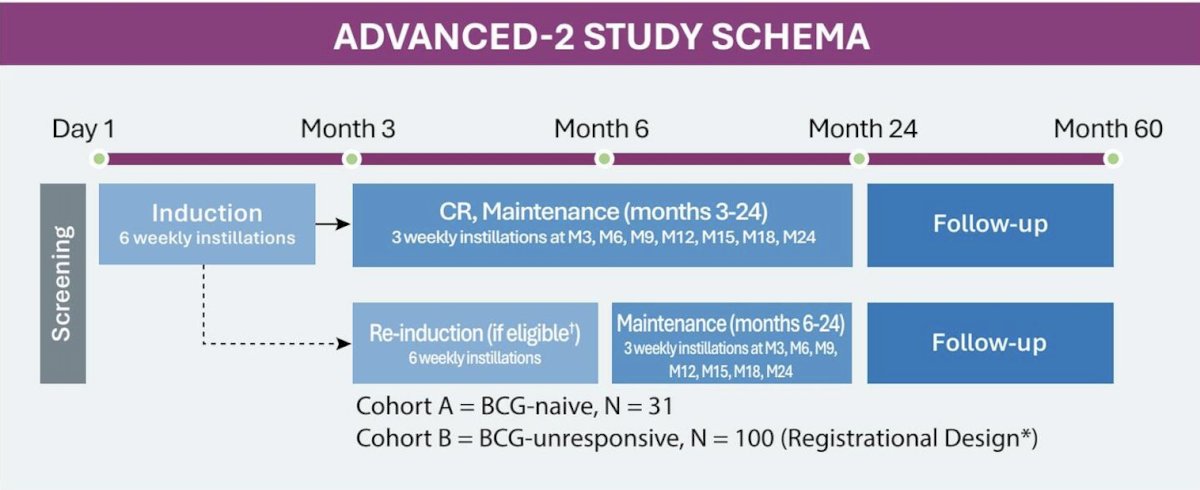
The ADVANCED-2 study includes 2 cohorts of BCG-naïve (Cohort A) and BCG-unresponsive (Cohort B) participants. Key exclusion criteria include penicillin allergy, history of ≥ T2 bladder cancer, nodal, or metastatic disease, and concomitant prostatic or upper tract urothelial involvement. Each participant is treated with TARA-002 to receive induction (6 weekly doses), reinduction (if persistent disease at 3 months), and maintenance (through 24 months). Response is assessed every 3 months for 2 years. Long-term follow-up is conducted up to 60 months, and safety is monitored throughout the study:
As of January 28, 2026, 74 participants (median age: 74; range: 45 to 92), have been enrolled and exposed to TARA-002: 31 BCG-naïve (Cohort A) and 43 BCG-unresponsive (Cohort B). In both cohorts, 19/74 (26%) participants reported drug-related treatment-emergent adverse events. Related treatment emergent adverse events were grade 1 (19/74; 26%) and grade 2 (4/74; 5%), with no reported grade 3-5 related treatment emergent adverse events:
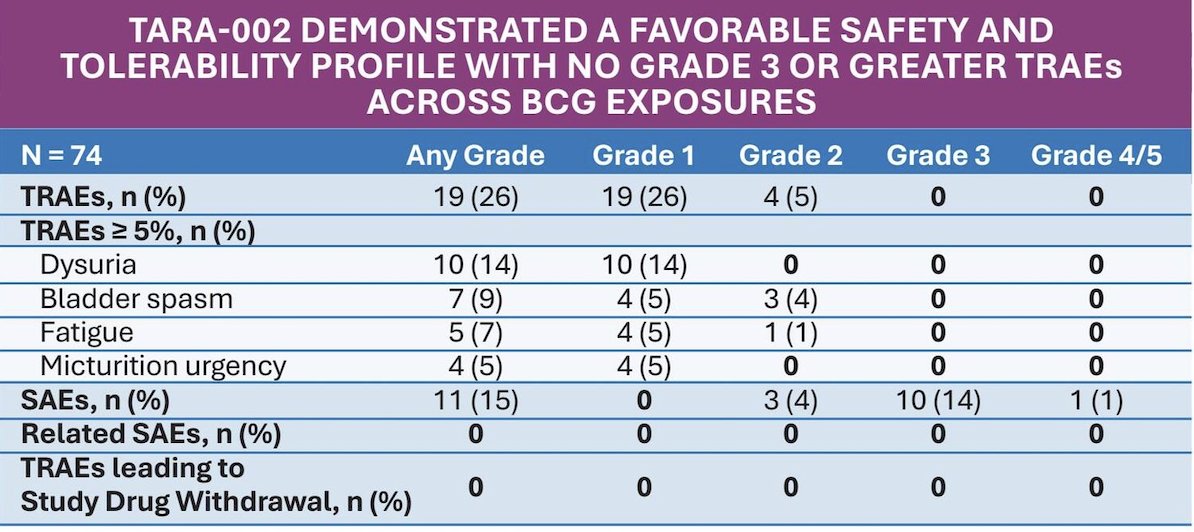
Commonly reported related treatment-emergent adverse events (≥ 5%) included bladder spasm (9%), dysuria (14%), fatigue (7%), and micturition urgency (5%). Most treatment-emergent adverse events were mild and transient. In both cohorts, 15% experienced serious adverse events: 3 were grade 2, 10 were grade 3, and 1 was grade 4/5. No participants experienced grade 3+ treatment-related adverse events, related serious adverse events, or treatment-related adverse events leading to withdrawal or death.
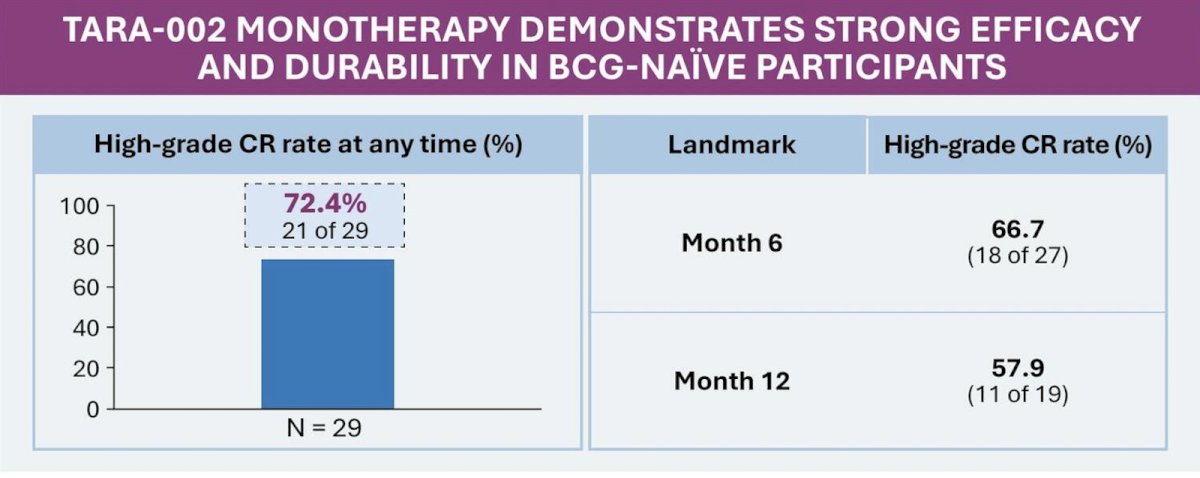
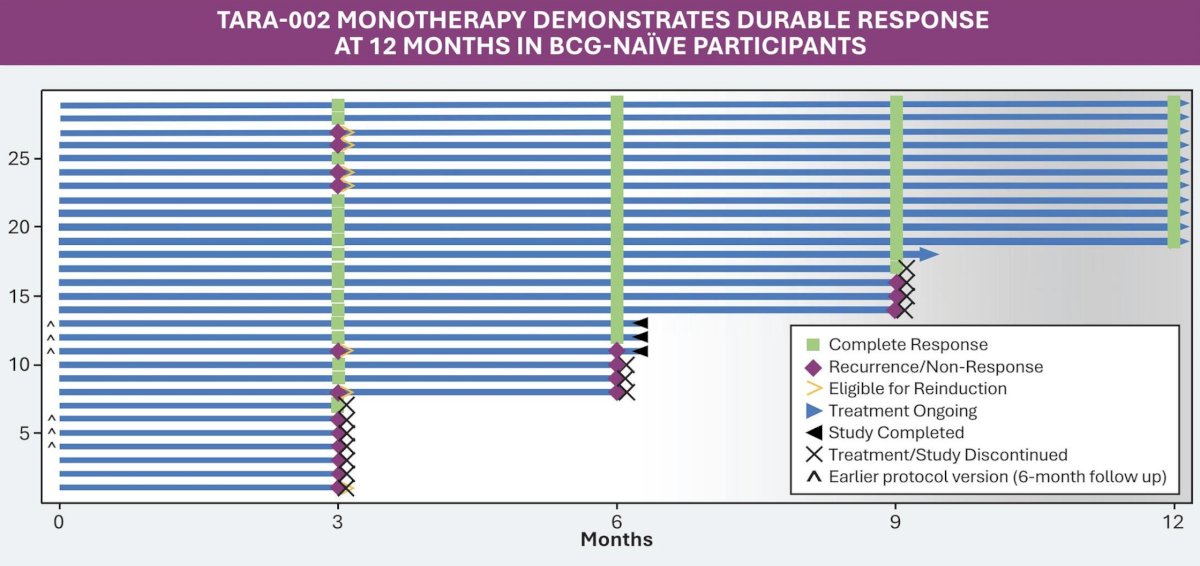
Interim data showed promising complete response rates and durable response in both BCG-naïve and BCG-unresponsive high-grade non-muscle invasive bladder cancer patients treated with TARA-002. In the BCG-naïve cohort, the rate of high-grade complete response was 72.4% (21 of 29) at any time, 66.7% (18 of 27) at month 6, and 57.9% (11 of 19) at month 12:
Dr. Clinton concluded his presentation discussing the interim safety and tolerability of TARA-002 with the following take-home points:
- TARA-002 monotherapy was well tolerated, thus demonstrating a favorable tolerability profile to date for the treatment of BCG-naïve and BCG-unresponsive high-grade non-muscle invasive bladder cancer with CIS (±Ta/T1)
- In BCG-naïve and BCG-unresponsive high-grade non-muscle invasive bladder cancer participants, TARA-002 demonstrated a high rate of complete response, with a substantial proportion maintaining a durable response
- TARA-002 has a promising safety and efficacy profile as a bladder-sparing treatment in high-grade non-muscle invasive bladder cancer across BCG exposure status
Presented by: Timothy Clinton, MD, Brigham and Women’s Hospital, Boston, MA