

(UroToday.com) The 2026 GU ASCO annual meeting featured a urothelial carcinoma session and a presentation by Dr. Yair Lotan discussing the validation of a CHAI prognostic biomarker in muscle invasive bladder cancer. Standard management for muscle invasive bladder cancer is radical cystectomy, which traditionally includes neoadjuvant chemotherapy that confers additional survival benefit. However, the absolute survival benefit of neoadjuvant chemotherapy is 5-10%, and only 30-40% of US muscle invasive bladder cancer cases receive neoadjuvant chemotherapy. These limitations underscore the need for a more personalized approach to identify patients most likely to benefit from treatment escalation or avoid overtreatment in those likely cured with radical cystectomy alone. The CHAI biomarker platform has previously been used to develop a now commercially-available prognostic tool in non-muscle invasive bladder cancer. Dr. Lotan and colleagues aimed to validate a novel prognostic biomarker, previously developed specifically for muscle invasive bladder cancer using the CHAI platform, in a multi-institutional real world muscle invasive bladder cancer cohort.
The CHAI platform applies deep-learning to extract quantitative histologic features from pre-treatment TURBT specimen H&E-stained whole-slide images:

The previously-developed muscle invasive bladder cancer biomarker was locked, and the model outputs a continuous histologic risk signature, which is dichotomized into unfavorable biomarker positive and favorable biomarker negative groups. Validation was done on an independent, held-out, retrospective, pooled, real world of clinical T2N0M0 muscle invasive bladder cancer patients who underwent radical cystectomy at multiple NCI-Designated Centers. Multivariate Cox proportional hazards models assessed associations with recurrence free survival, cause specific survival, and overall survival. Kaplan-Meier methods and log-rank tests were used for survival analysis.
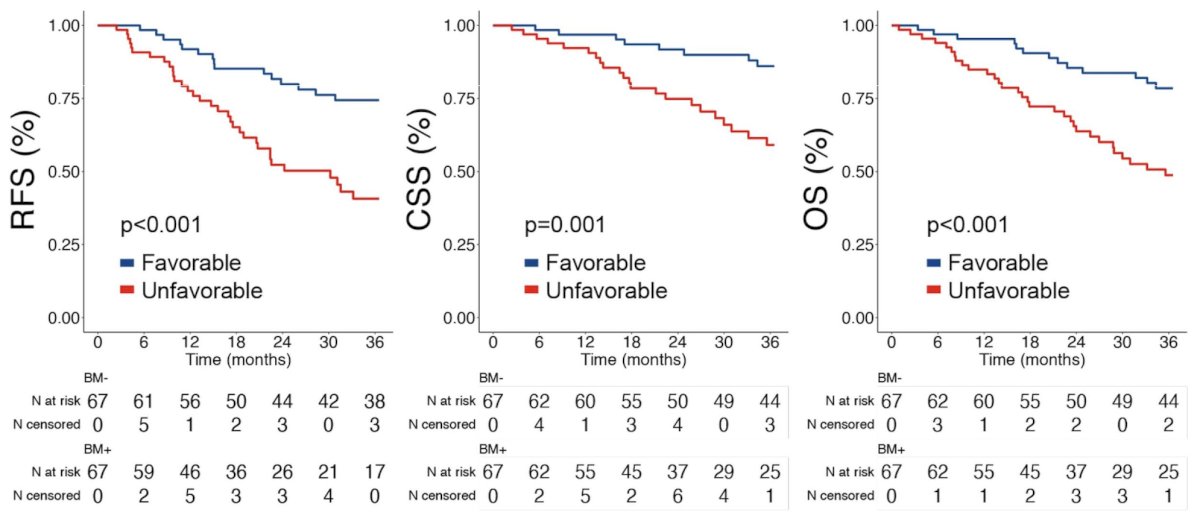
Among 134 patients with muscle invasive bladder cancer, 67 (50%) patients received cisplatin-based neoadjuvant chemotherapy. The biomarker stratified patients into 67 (50%) unfavorable risk (positive) and 67 (50%) favorable risk (negative). Among patients who received neoadjuvant chemotherapy, pathologic complete response was seen at radical cystectomy among 6/29 (20%) biomarker positive versus 13/38 (34%) biomarker negative patients. On multivariate analysis, controlling for age, sex, presence of CIS, variant histology, and neoadjuvant chemotherapy, biomarker positive was significantly associated with inferior recurrence free survival (HR 2.70, 95% CI 1.46, 4.97), cause specific survival (HR 2.60, 95% CI 1.29, 5.26) and overall survival (HR 2.29, 95% CI 1.29, 4.04), all p < 0.01:

With a 36-month median follow up, at 2 years, biomarker positive patients had worse outcomes: recurrence free survival 50% versus 18%, cause specific survival 25% versus 8.3%, and overall survival 36% versus 15%:
Dr. Lotan concluded his presentation discussing the validation of a CHAI prognostic biomarker in muscle invasive bladder cancer with the following take-home points:
- A histologic prognostic biomarker derived from pre-treatment H&E TURBT slides was validated, stratifying clinical T2 muscle invasive bladder cancer patients by risk of recurrence free survival, cause specific survival, and overall survival, even when controlling for neoadjuvant chemotherapy
- Future efforts will evaluate the ability to predict which patients benefit the most from additional treatment
- Such a tool could be used to optimize patient selection by identifying those most likely to benefit from perioperative therapies, and sparing those who may be cured with surgery alone
Presented by: Yair Lotan, MD, UT Southwestern University, Dallas, TX
Written by: Zachary Klaassen, MD, MSc – Urologic Oncologist, Associate Professor of Urology, Georgia Cancer Center, Wellstar MCG Health, @zklaassen_md on Twitter during the 2026 American Society of Clinical Oncology Genitourinary (ASCO GU) cancers symposium held in San Francisco, CA, between February 26th and 28th, 2026.
Related content: Artificial Intelligence Applied to TURBT Specimens in Muscle-Invasive Bladder Cancer - Yair Lotan