

(UroToday.com) The 2025 GU ASCO annual meeting featured a prostate cancer session and a presentation by Dr. Miguel Muniz discussing outcomes for 177Lu-PSMA-617 with and without concurrent use of androgen receptor pathway inhibitors in patients with metastatic castration resistant prostate cancer (mCRPC). There is now more than a decade of experience using androgen receptor pathway inhibitors across various disease states of prostate cancer, and the safety of their combination with 177Lu-PSMA-617 has been demonstrated in VISION1 and other large randomized clinical trials. However, real-world data on treatment patterns and outcomes involving combination therapies with 177Lu-PSMA-617 remain limited.
For this analysis, the investigators utilized the Mayo Clinic Rochester radiopharmaceutical database, a prospectively maintained retrospective database containing all patients who received 177Lu-PSMA-617 at the institution. Patients receiving an androgen receptor pathway inhibitor (abiraterone acetate, enzalutamide, apalutamide, or darolutamide) during the course of 177Lu-PSMA-617 treatment were identified, inclusive of patients who continued using an androgen receptor pathway inhibitor prescribed as a prior line of treatment and those who started (ie. switched) to a new androgen receptor pathway inhibitor. Best PSA response during treatment was reported as a percent decline from baseline. Survival was calculated from the date of the first cycle of 177Lu-PSMA-617. PSA50 response and overall survival outcomes for the two groups (concurrent use of androgen receptor pathway inhibitors versus 177Lu-PSMA-617 alone) were compared using the Chi-square test and Kaplan-Meier method, respectively.
An androgen receptor pathway inhibitor was prescribed to 106 of the 256 patients (41.4%) starting 177Lu-PSMA-617 in the interval of March 2022 to March 2023. With regards to baseline characteristics, those receiving an androgen receptor pathway inhibitor concurrently with 177Lu-PSMA-617 had a lower PSA (3.4 vs 29.7 ng/mL, p < 0.001) and a lower frequency of bone (77.4% vs. 87.4%, p = 0.035) and visceral metastases (18.9 vs 34%, p = 0.008) at the start of treatment: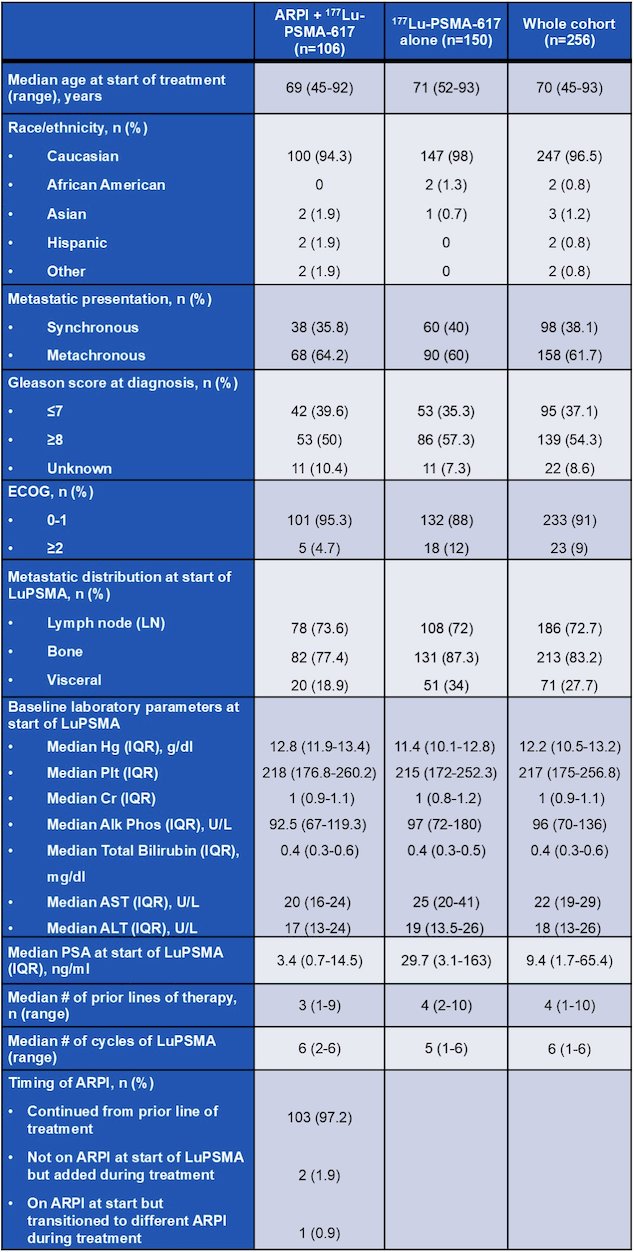
The median follow-up for the overall cohort was 19.1 months (IQR 8.7 – 23.6). Patients receiving an androgen receptor pathway inhibitor + 177Lu-PSMA-617, as compared to 177Lu-PSMA-617 alone, were more likely to complete all 6 planned doses of treatment (63.2% vs. 48.7%, p < 0.001), though the PSA50 response rate was similar (49.1% vs 47.3%, p = 0.786). Median overall survival for the overall cohort was 21.3 (95% CI 16.7 – 25.9) months and significantly longer for those receiving androgen receptor pathway inhibitors with 177Lu-PSMA-617 (NR, 95% CI NE – NE) as compared to 177Lu-PSMA-617 alone (15.3 months, 95% CI 11.6 – 19.1, p < 0.001):
However, on multivariate analysis including known prognostic variables, use of androgen receptor pathway inhibitors was not independently associated with improved survival (HR 1.03, 95% CI 0.68 to 1.55, p = 0.891):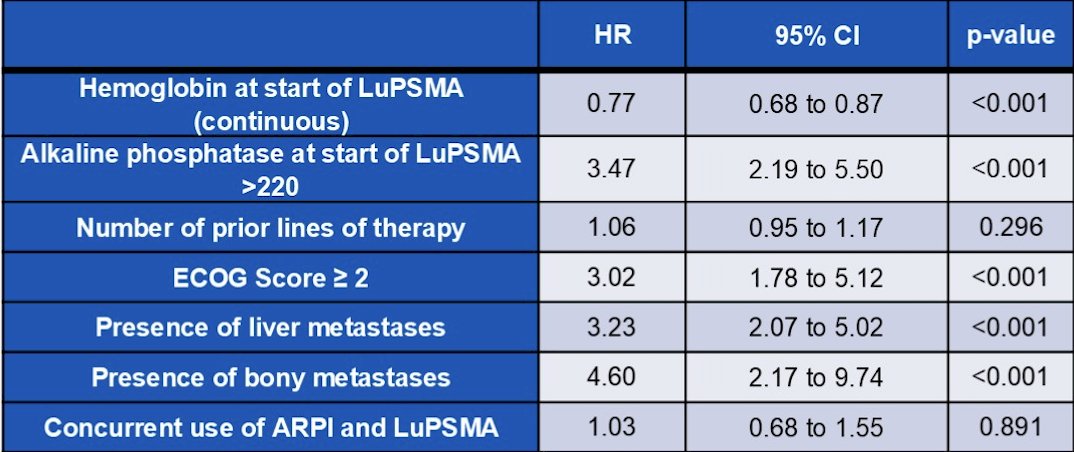
Dr. Muniz concluded his presentation discussing outcomes for 177Lu-PSMA-617 with and without concurrent use of androgen receptor pathway inhibitors in patients with mCRPC with the following take-home points:
- Patients receiving an androgen receptor pathway inhibitor with 177Lu-PSMA-617 were more likely to complete all 6 cycles of treatment
- There were no clear differences in survival (concurrent androgen receptor pathway inhibitor versus no androgen receptor pathway inhibitor) observed on multivariable analysis
Presented by: Miguel Muniz, MD, Department of Medical Oncology, Mayo Clinic, Rochester, MN
Written by: Zachary Klaassen, MD, MSc – Urologic Oncologist, Associate Professor of Urology, Georgia Cancer Center, Wellstar MCG Health, @zklaassen_md on Twitter during the 2025 Genitourinary (GU) American Society of Clinical Oncology (ASCO) Annual Meeting, San Francisco, CA, Thurs, Feb 13 – Sat, Feb 15, 2025.
Reference: