

(UroToday.com) The 2025 GU ASCO annual meeting featured a prostate cancer session and a presentation by Joseph Allen discussing PSA response and survival based on metastatic site in patients with metastatic castration resistant prostate cancer (mCRPC) treated with 177Lu-PSMA-617.
Patients with mCRPC can have different metastatic sites with variable outcomes. 177Lu-PSMA-617 is a novel treatment for mCRPC, but response and outcomes in the real world are still being defined. How a patient’s distribution of metastases at 177Lu-PSMA-617 initiation impact outcome is unknown. For this study, the investigators hypothesized that patients with lung and liver metastases would have worse outcomes (lower PSA response and shorter survival) with 177Lu-PSMA-617 than those without as advanced of disease spread.
This retrospective cohort study analyzed patients with mCRPC who were treated with at least one dose of 177Lu-PSMA-617. PSA50, PSA90, and overall survival were assessed for three comparisons of patients:
- Bone only versus other metastases (including other site ± bone)
- Lung-involved versus lung-absent
- Liver-involved versus liver-absent
PSA50 and PSA90 were defined as achieving any reduction in PSA below 50% and 90% of baseline prior to 177Lu-PSMA-617 therapy, respectively.
There were 100 patients included for the overall survival analyses and 96 patients for PSA50 and PSA90 analyses treated between March 2019 and September 2024. Four patients were excluded from PSA analyses due to absence of baseline PSA prior to 177Lu-PSMA-617. The median age at 177Lu-PSMA-617 start was 66 years, 67% of patients were white race, 45% were ever smokers, 6 median previous lines of treatment were received, 77% received prior chemotherapy, and 4 median number of 177Lu-PSMA-617 treatments were received: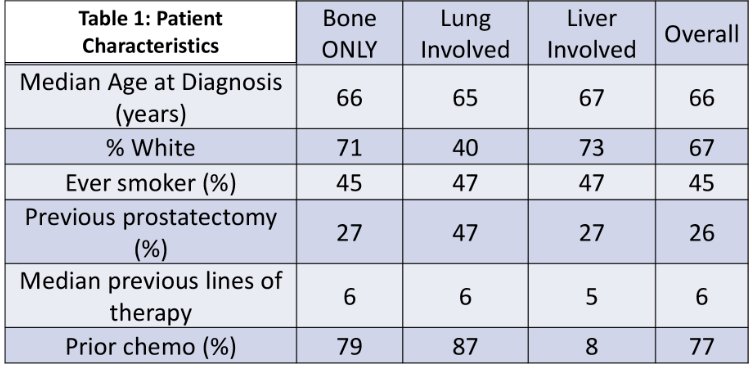
At the time of initial 177Lu-PSMA-617, 94% had at least bone metastases, 12% had lymph node metastases, 14% had lung metastases, 15% had liver metastases, and 9% had other metastases. Location of metastases was not strongly correlated with PSA50 or PSA90 response: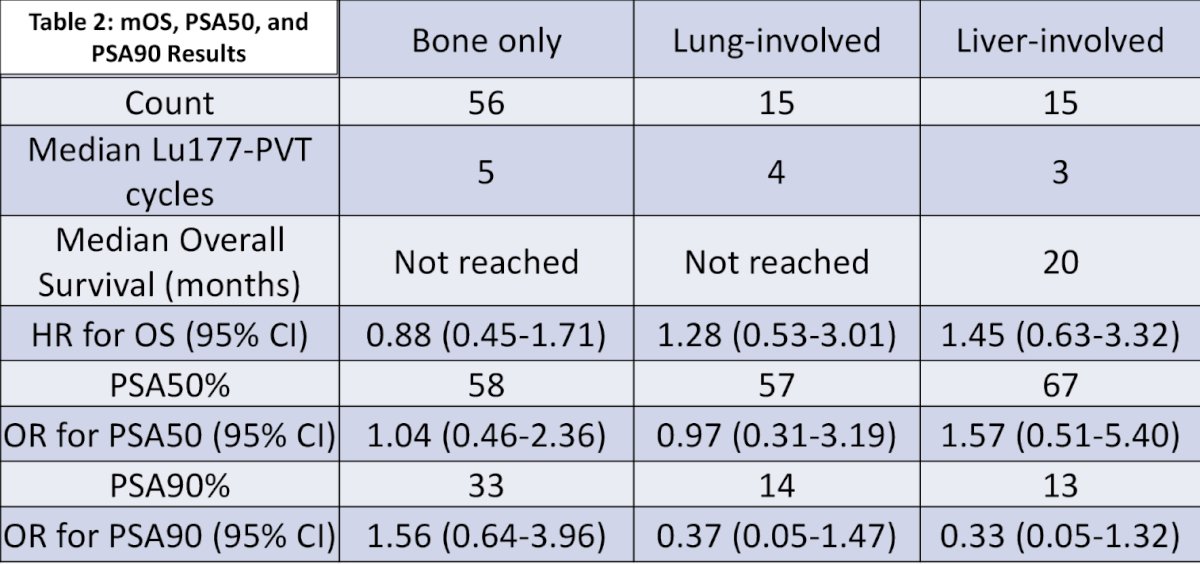
Patients with only bone metastases (versus those with other site ± bone) had numerically (but not significant) longer overall survival (median overall survival 19 versus 13 months, HR 0.88, p = 0.70). Patients with liver-involved (versus liver-absent) had a numerically shorter overall survival (median overall survival 15 versus 18 months, HR 1.45 p = 0.38). Patients with lung-involved (versus lung-absent) had numerically shorter overall survival (15 versus 18 months, HR 1.28, p = 0.58):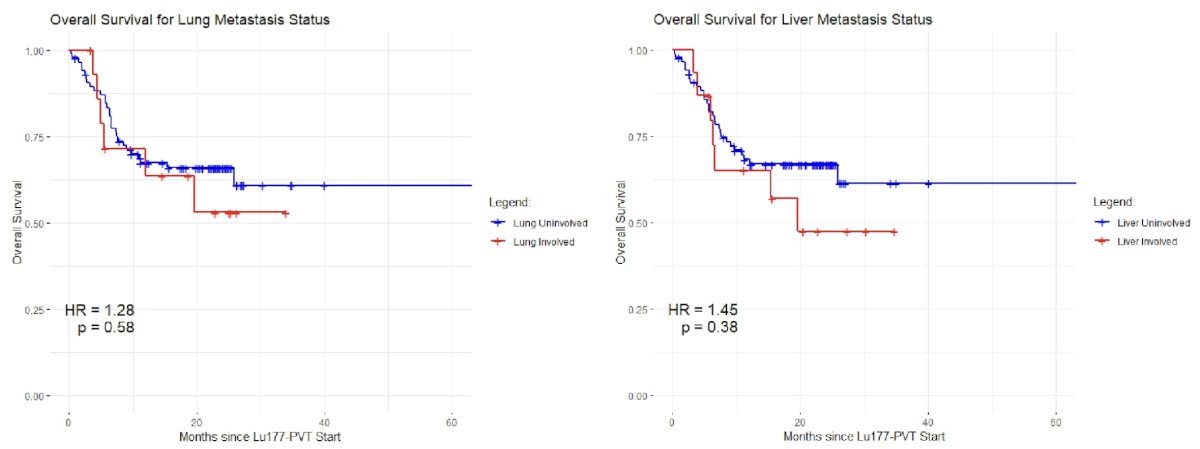
Joseph Allen concluded his presentation discussing PSA response and survival based on metastatic site in patients with mCRPC treated with 177Lu-PSMA-617 with the following take-home points:
- Patients with mCRPC responded to 177Lu-PSMA-617 regardless of metastatic sites, though liver metastases had numerically lower overall survival
- The study was limited by small power and its retrospective study design
- Future work is needed to further dissect the interplay between 177Lu-PSMA-617 response and metastatic disease sites
Presented by: Joseph D. Allen, Stanford University School of Medicine, Palo Alto, CA
Written by: Zachary Klaassen, MD, MSc – Urologic Oncologist, Associate Professor of Urology, Georgia Cancer Center, Wellstar MCG Health, @zklaassen_md on Twitter during the 2025 Genitourinary (GU) American Society of Clinical Oncology (ASCO) Annual Meeting, San Francisco, CA, Thurs, Feb 13 – Sat, Feb 15, 2025.