

(UroToday.com) The 2025 GU ASCO annual meeting featured a prostate cancer session and a presentation by Benjamin Tward discussing the use of artificial intelligence to identify optimal clinical, genomic, and radiographic prognostic features and novel risk classifiers compared to routinely available risk classifiers. Conventional prostate cancer risk classification systems, such as D’Amico, NCCN, and CAPRA, largely rely on clinical parameters and often do not incorporate advanced imaging or genomic data. This study sought to develop novel, multimodal models integrating clinical, radiographic (MRI-derived), and genomic features using artificial intelligence and conventional statistical methods to more accurately predict metastasis in localized prostate cancer.
The investigators identified 448 node-negative, non-metastatic prostate cancer patients from a single institution registry, each with complete clinical data, MRI reports, and genomic cell cycle progression (CCP) score:
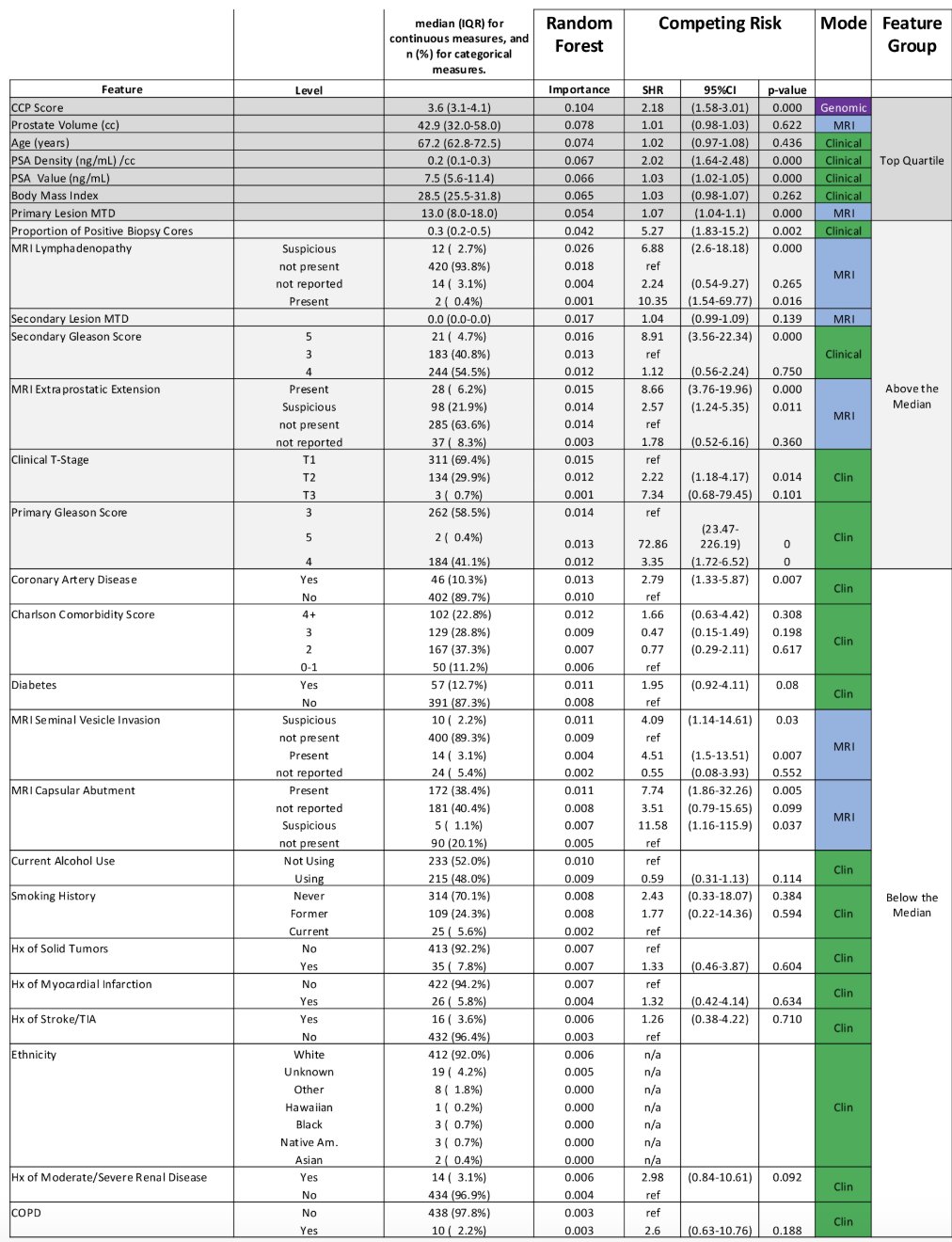
Following data preprocessing and dummy encoding, a random forest classifier was used to estimate feature importance. Three feature subsets (full, above-median importance, and top-quartile importance) were tested in two different deep-learning modeling approaches:
- A neural network (multi-layer perceptron) trained on a non-time-dependent metastasis outcomes, and
- DeepSurv for time to event analysis
Performance metrics included leave-one-out cross-validation and 5-fold cross validation area under the receiver operating characteristic curve (AUC), along with concordance indices in time to event analyses. All models were compared by putting the model predictions into a Fine-Gray competing risk regression. For comparison, conventional risk models (STARCAP, NCCN, CAPRA) were also evaluated.
The median follow-up was 5.1 years. The genomic derived CCP score emerged as the top-ranked feature, followed by prostate volume, age, PSA density, PSA value, BMI, and maximum tumor diameter. The DeepSurv model incorporating the top-quartile feature, including CCP, achieved the highest AUC (0.82), outperforming both the neural network models (AUC 0.75-0.76) and the best-performing conventional classifier, STARCAP (AUC 0.80):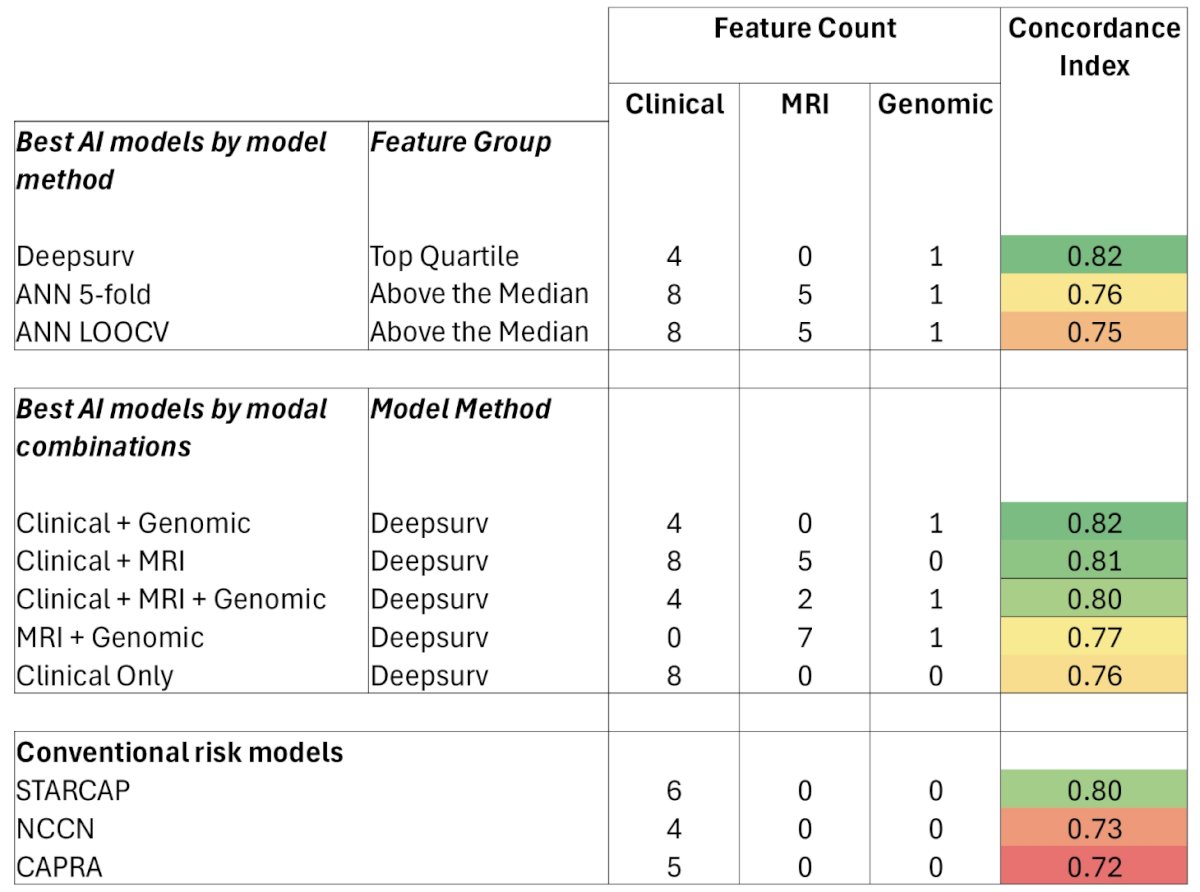
Several additional features (ie. extraprostatic extension, lymphadenopathy) demonstrated high hazard ratios, but were ranked lower in random forest importance. Models using exclusively clinical features performed sub-optimally compared to those that included genomic and radiographic data.
Benjamin Tward concluded his presentation discussing the use of artificial intelligence to identify optimal clinical, genomic, and radiographic prognostic features and novel risk classifiers compared to routinely available risk classifiers with the following take-home points:
- Integrating MRI report-based and genomic information with clinical features significantly improved the accuracy of metastasis prediction
- These findings highlight the potential artificial intelligence driven, multimodal prognostic models to refine prostate cancer risk stratification and personalize treatment, particularly in settings where certain high-value features may be unavailable
Presented by: Benjamin V. Tward, University of Michigan, Ann Arbor, MI
Written by: Zachary Klaassen, MD, MSc – Urologic Oncologist, Associate Professor of Urology, Georgia Cancer Center, Wellstar MCG Health, @zklaassen_md on Twitter during the 2025 Genitourinary (GU) American Society of Clinical Oncology (ASCO) Annual Meeting, San Francisco, CA, Thurs, Feb 13 – Sat, Feb 15, 2025.