

(UroToday.com) The 2025 American Society of Clinical Oncology Genitourinary (ASCO GU) cancers symposium held in San Francisco, CA was host to the Poster Session A: Prostate Cancer. Dr. Wayne Brisbane presented Abstract 338: Head-to-head comparison of micro-ultrasound, mpMRI, and PSMA PET/CT with a wholemount histopathology as gold standard in the detection and T staging of prostate cancer.
Micro-ultrasound (MicroUS) is an emerging imaging modality that offers improved accuracy in detecting prostate cancer (PCa) compared to conventional transrectal ultrasound. Previous studies have shown that MicroUS and multiparametric MRI (mpMRI) have comparable diagnostic accuracy, but their findings have been limited by the use of biopsy pathology as the reference standard. To date, no comprehensive studies have evaluated the diagnostic performance of MicroUS, mpMRI, and PSMA PET/CT for prostate cancer detection and extraprostatic extension (EPE) assessment using whole-mount histopathology (WMHP) as the gold standard. In this study, the investigators conducted a head-to-head comparison of these three imaging modalities against WMHP.
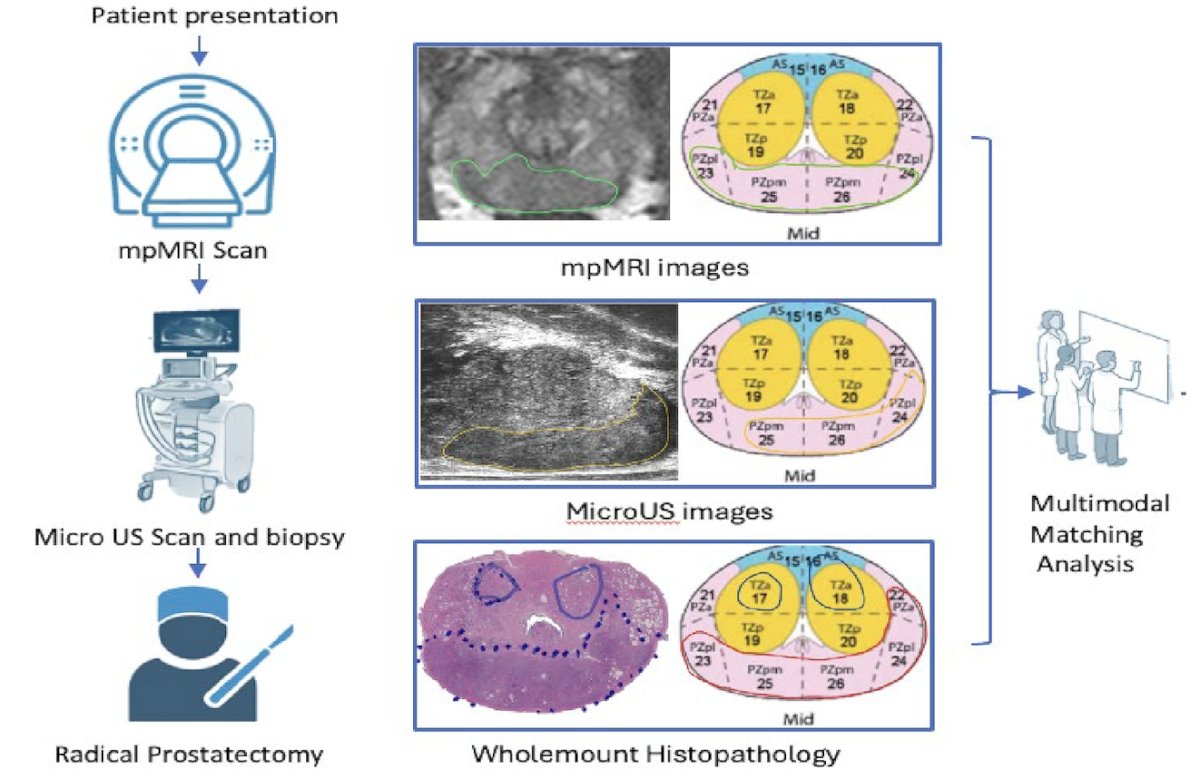
Patients with PCa who underwent MicroUS and MRI before radical prostatectomy were included in this analysis. A subgroup analysis was conducted for patients who also underwent PSMA PET/CT. Imaging findings and WMHP results were mapped onto a standardized 36-sector template. Diagnostic accuracy for detecting PCa, csPCa (ISUP grade group ≥2), and EPE was assessed using ROC curve analysis, with AUC as the primary metric.
For this analysis, they included 25 patients, with 19 undergoing PSMA PET/CT. Lesion-level detection rates for PCa and csPCa were 55% and 72% for MicroUS, 57% and 75% for MRI, and 53% and 70% for PSMA. Cribriform/intraductal carcinoma was identified in 94.1% of cases with MicroUS, 66.7% with MRI, and 62.5% with PSMA. EPE was detected in 44.4% with MicroUS, 66.7% with MRI, and 62.5% with PSMA.
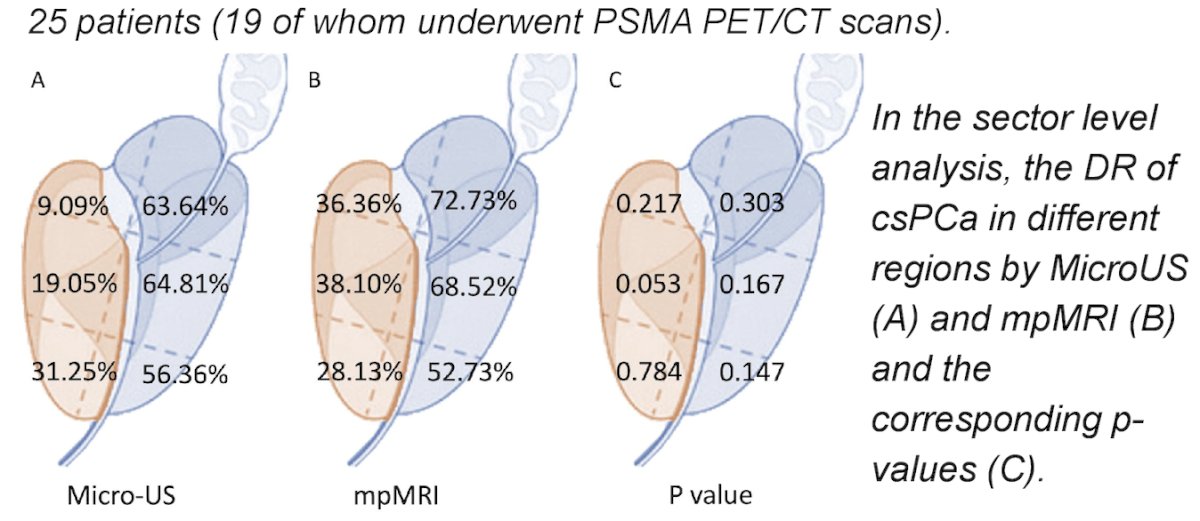
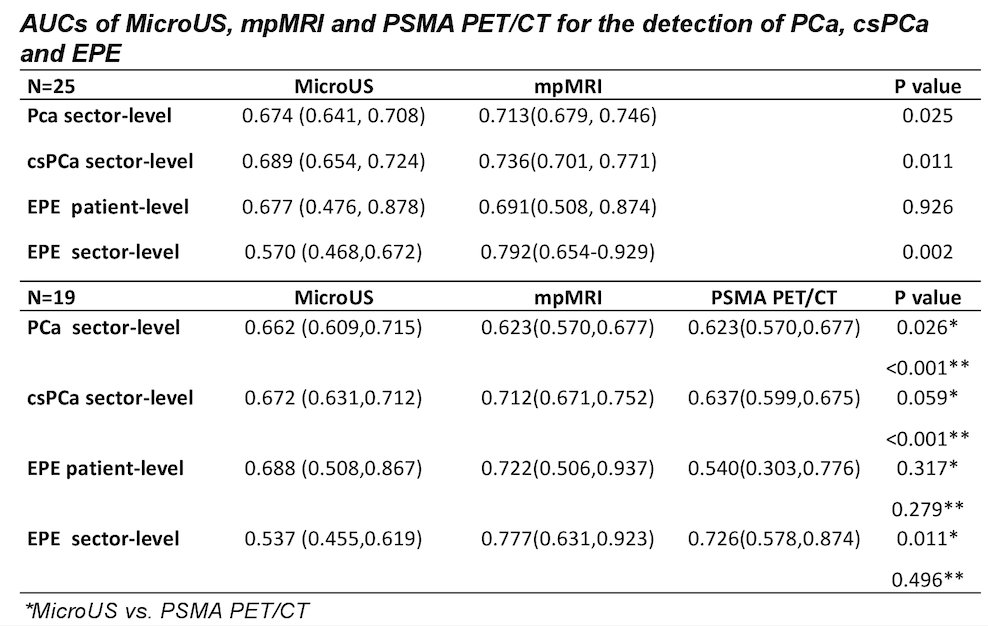
In the sector-level analysis, MRI demonstrated higher AUCs than MicroUS and PSMA for identifying PCa and csPCa (P<0.05). MicroUS and PSMA had comparable sector-level AUCs for PCa and csPCa. For sector-level EPE, MRI and PSMA outperformed MicroUS (P<0.05). The AUCs for predicting patient-level EPE were 0.68 for MicroUS, 0.722 for MRI, and 0.54 for PSMA (p = NS). Patient-level detection of PCa, csPCa, and specific pathologic features was similar across imaging modalities.
Dr. Brisbane concluded their presentation with the following key points:
- MicroUS demonstrated good reliability in identifying csPCa and patient-level EPE, performing comparably to MRI and PSMA PET/CT.
- At the patient level, MicroUS performed similarly to MRI, while MRI showed superior sector-level accuracy in detecting PCa and csPCa compared to both MicroUS and PSMA PET/CT.
- The comparable performance of MicroUS in lesion-level detection highlights its potential for targeted biopsy and improved diagnostic accuracy.
- Longitudinal randomized controlled studies are needed to assess the diagnostic efficacy of MicroUS compared to conventional imaging techniques and its impact on patient clinical outcomes.
Presented by: Wayne Brisbane, MD, Urologic Oncologist at University of California Los Angeles, Los Angeles, CA.
Written by: Julian Chavarriaga, MD – Urologic Oncologist at Cancer Treatment and Research Center (CTIC) via Society of Urologic Oncology (SUO) Fellow at The University of Toronto. @chavarriagaj on Twitter during the 2025 Genitourinary (GU) American Society of Clinical Oncology (ASCO) Annual Meeting, San Francisco, CA, Thurs, Feb 13 – Sat, Feb 15, 2025.