

(UroToday.com) The 2025 GU ASCO annual meeting featured a prostate cancer session and a presentation by Dr. Omid Yazdanpanah discussing a secondary analysis of the VISION trial assessing the efficacy of 177Lu-PSMA-617 with or without androgen receptor pathway inhibitors for the treatment of metastatic castration resistant prostate cancer (mCRPC). In the phase 3 VISION trial,1 treatment with the PSMA-targeted radioligand therapy 177Lu-PSMA-617 + protocol-permitted standard of care significantly improved median radiographic progression-free survival (8.7 versus 3.4 months) and overall survival (15.3 versus 11.3 months) in patients with mCRPC versus standard of care alone.
Approximately half of patients (n = 289/551; 52.5%) in the 177Lu-PSMA-617 treatment arm received concomitant androgen receptor pathway inhibitors during randomized treatment as part of the trial protocol-permitted standard of care. However, it is unclear how the addition of androgen receptor pathway inhibitors affected 177Lu-PSMA-617 treatment outcomes. At the 2025 GU ASCO annual meeting, Dr. Yazdanpanah and colleagues reported results comparing the efficacy and safety of 177Lu-PSMA-617 in patients treated with versus without concomitant androgen receptor pathway inhibitors.
In VISION, adult patients with PSMA-positive mCRPC previously treated with ≥1 prior androgen receptor pathway inhibitor and 1–2 taxane chemotherapy regimens were randomized 2:1 to receive 177Lu-PSMA-617 (7.4 GBq Q6W, 4–6 cycles) + standard of care (which included androgen receptor pathway inhibitors) versus standard of care alone. In this secondary analysis, the investigators assessed baseline characteristics, overall survival, radiographic progression-free survival, PSA response rate, duration of PSA response, PSA-progression free survival, and safety among patients in the intervention arm who were treated with versus without concomitant androgen receptor pathway inhibitors.
In total, 289 patients were treated with concomitant androgen receptor pathway inhibitors and 262 patients were not (n = 551). Imbalances between the groups were observed in some baseline characteristics: patients treated with concomitant androgen receptor pathway inhibitors were younger, had lower ECOG performance scores, lower mean PSA and lactate dehydrogenase levels, and fewer prior taxane chemotherapy regimens. Baseline mean standardized 68GaPSMA-11 uptake values and mean hemoglobin levels were well-balanced:
A statistically significant difference in median overall survival was observed in patients treated with concomitant androgen receptor pathway inhibitors versus those without (17.8 versus 12.4 months; HR 0.72; 95% CI 0.58–0.89; nominal p = 0.001):
PSA response was similar between the groups (OR 1.41, 95% CI 0.93-2.13), and PSA50 response was 49.7% in the 177Lu-PSMA-617 + androgen receptor pathway inhibitor group compared to 42.2% in the without androgen receptor pathway inhibitor group. Median duration of PSA50 response is as follows: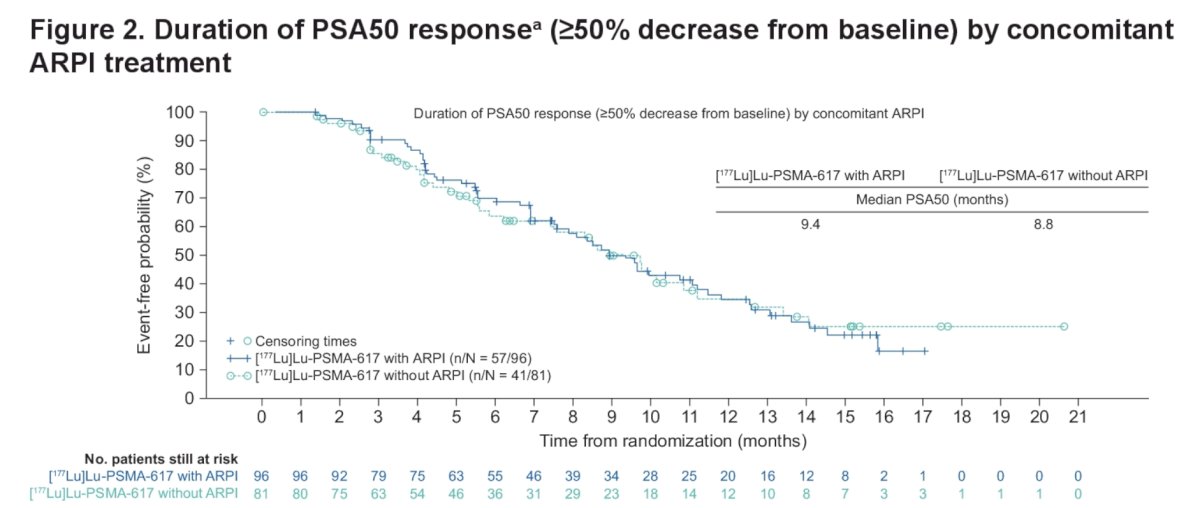
Median PSA progression free survival was 8.6 months and 7.3 months in the 177Lu-PSMA-617 with and without androgen receptor pathway inhibitors, respectively: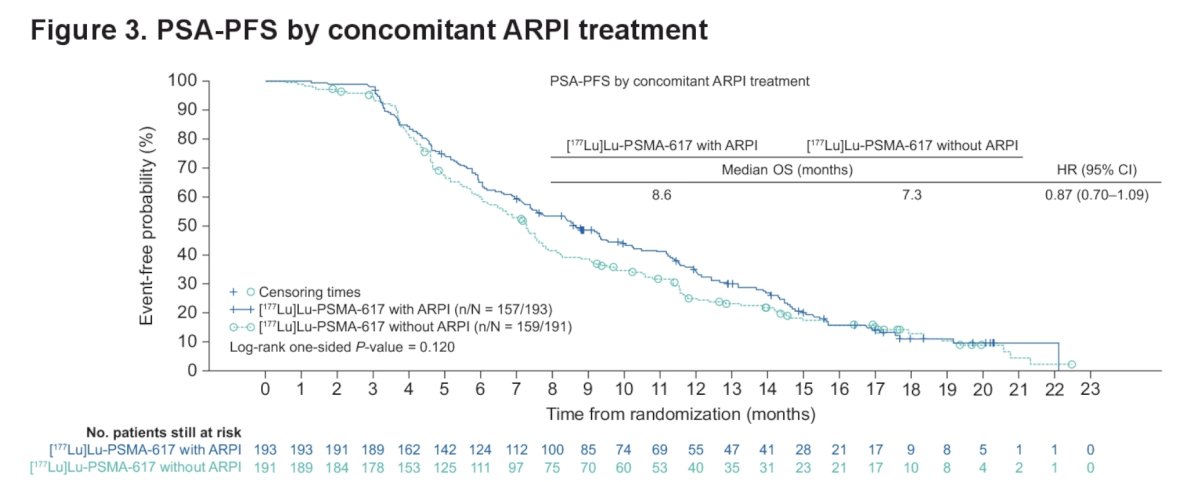
The median radiographic progression free survival was 10.2 months and 8.5 months for the 177Lu-PSMA-617 with or without androgen receptor pathway inhibitor, respectively (HR 0.93, 99.2% CI 0.66-1.31). The proportion of adverse events reported was similar in patients with or without concurrent androgen receptor pathway inhibitor, except for the number of adverse events leading to interruption of best supportive care/standard of care, which was higher in patients treated with concurrent androgen receptor pathway inhibitors: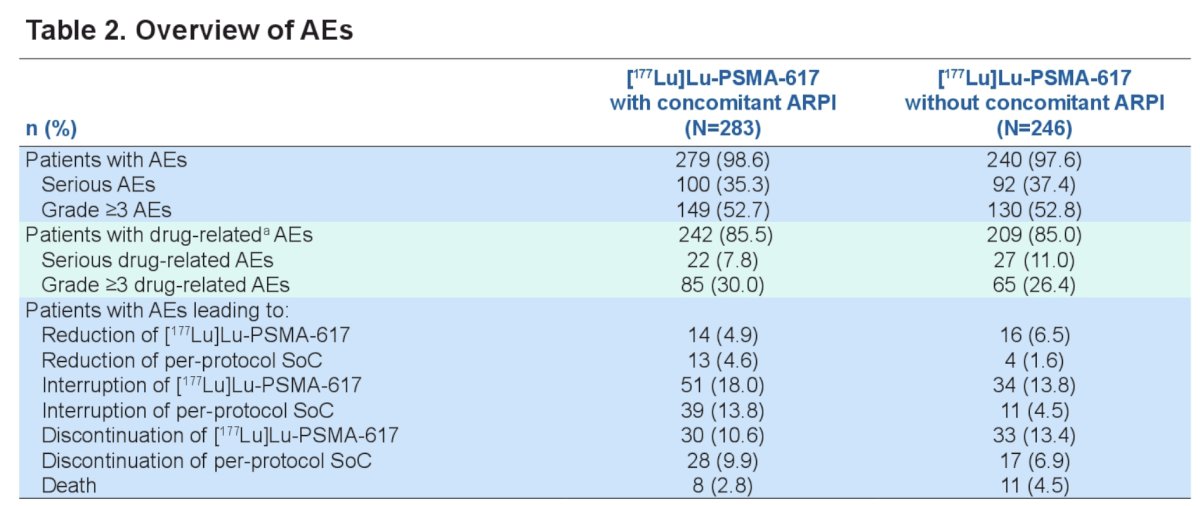
Dr. Yazdanpanah concluded his presentation discussing a secondary analysis of the VISION trial assessing the efficacy of 177Lu-PSMA-617 with or without androgen receptor pathway inhibitors for the treatment of mCRPC with the following take-home points:
- Overall survival was significantly different in patients treated with concomitant androgen receptor pathway inhibitors versus those without, while other efficacy endpoints were not
- No new safety signals were observed for 177Lu-PSMA-617 with concomitant androgen receptor pathway inhibitor
- These findings may be confounded by varied exposure to androgen receptor pathway inhibitors, or differing patient characteristics given that patients who received concomitant androgen receptor pathway inhibitors may represent a more favorable treatment population than those who did not
- These findings should be considered as hypothesis-generating, and a multivariate analysis has been planned to ascertain the influence of these potential biases
Presented by: Omid Yazdanpanah, MD, University of California Irvine, Irvine, CA
Written by: Zachary Klaassen, MD, MSc – Urologic Oncologist, Associate Professor of Urology, Georgia Cancer Center, Wellstar MCG Health, @zklaassen_md on Twitter during the 2025 Genitourinary (GU) American Society of Clinical Oncology (ASCO) Annual Meeting, San Francisco, CA, Thurs, Feb 13 – Sat, Feb 15, 2025.
Reference: