

(UroToday.com) The 2025 GU ASCO annual meeting featured a prostate cancer session and a presentation by Dr. Daniel Spratt discussing risk stratification using the Decipher® 22-gene genomic classifier and digital pathology artificial intelligence in nearly 10,000 localized prostate cancer patients. Digital pathology artificial intelligence models have recently demonstrated the potential to improve risk stratification beyond routine clinical and pathologic variables. However, it is not known whether integrating digital pathology artificial intelligence information will enhance the prognostic accuracy of validated gene expression tests. In this study, Dr. Spratt and colleagues assessed the prognostic performance of novel digital pathology artificial intelligence algorithms in context to the genomic classifier.
A prospectively collected cohort of 9,874 patients with localized prostate cancer was retrieved from the Veracyte GRID registry. Scans at 40X magnification were obtained for 17,701 H&E slides using an Aperio GT450 scanner: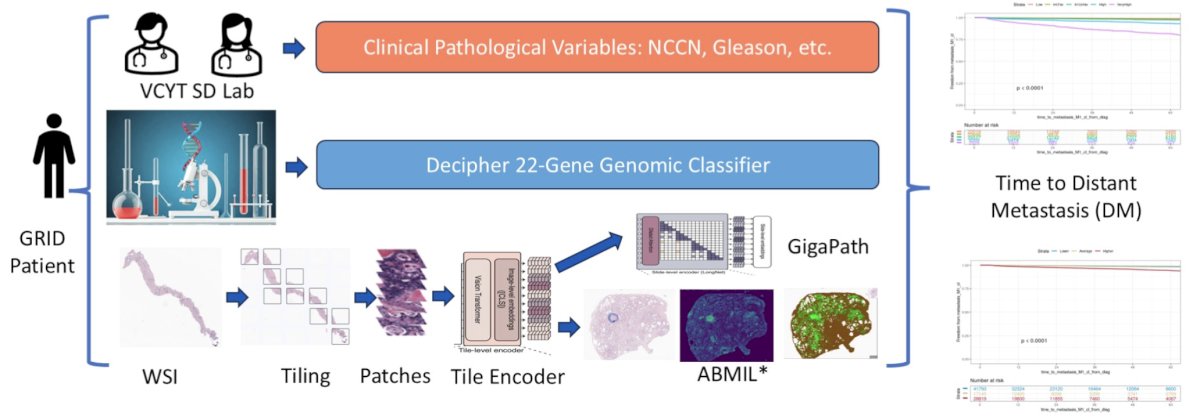
An open-source whole-slide pathology foundation model was used to encode whole slide image patches into digital pathology image features. Attention-based multiple instance learning approach was used to develop separate models to predict distant metastasis in the biopsy and radical prostatectomy training subsets. Whole slide image, baseline clinical variables, and genomic classifier scores were linked using tokenization to real-world data. The primary endpoint of this study was distant metastasis. Adjusted hazard ratio from multivariable Cox regression modeling and 5-year area-under curve (AUC) estimates were used to compare models using digital pathology image features.
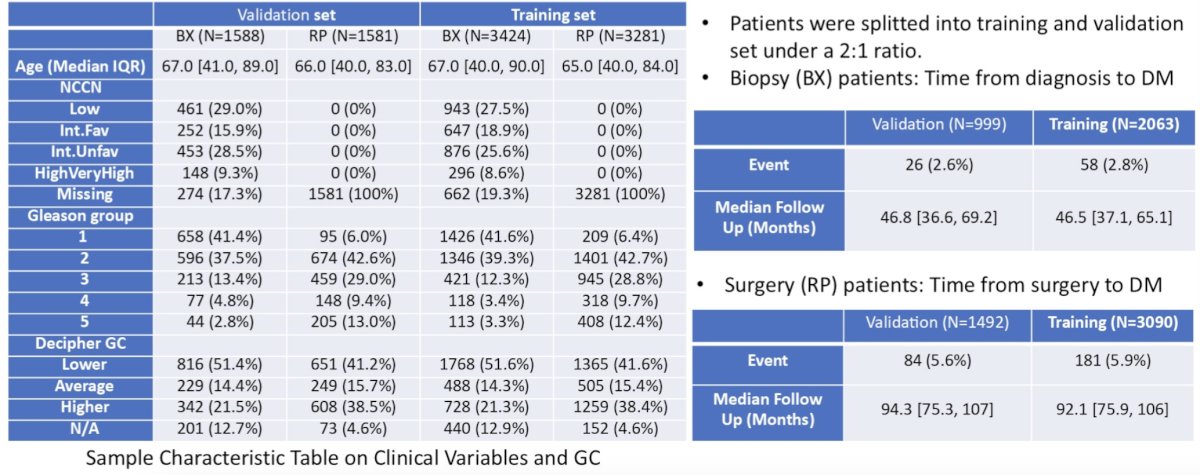
The median follow-up for the training cohort (n=6,705; 239 distant metastasis events) and validation (n = 3,169; 110 distant metastasis events) cohorts were 6.5 years:
In the biopsy validation cohort of 999 patients, the genomic classifier predicted distant metastasis with an AUC of 0.804 (95% CI, 0.704-0.904), which exceeded NCCN risk group alone (AUC 0.678, 0.560-0.795) and digital pathology artificial intelligence (AUC 0.76, 0.66-0.86):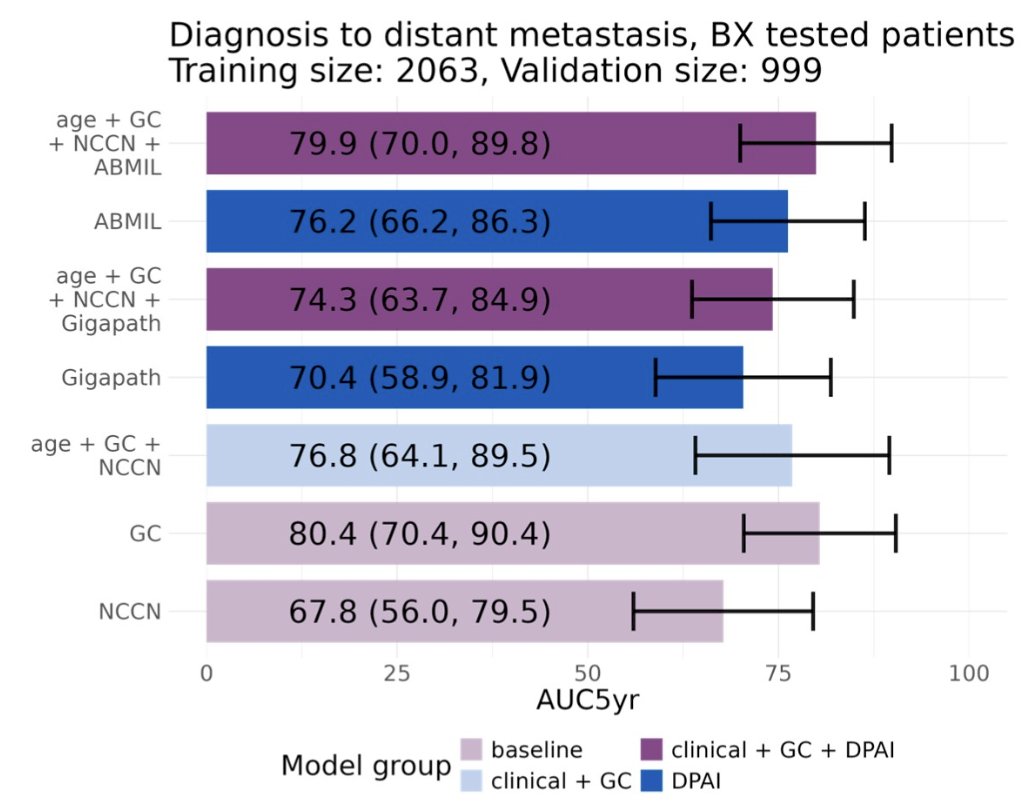
In the radical prostatectomy validation cohort of 1,492 patients, genomic classifier predicted distant metastasis with an AUC of 0.806 (95% CI, 0.730-0.882). An integrated model with clinicopathologic features, digital pathology artificial intelligence, and genomic classifier improved the AUC to 0.838 (0.767- 0.909):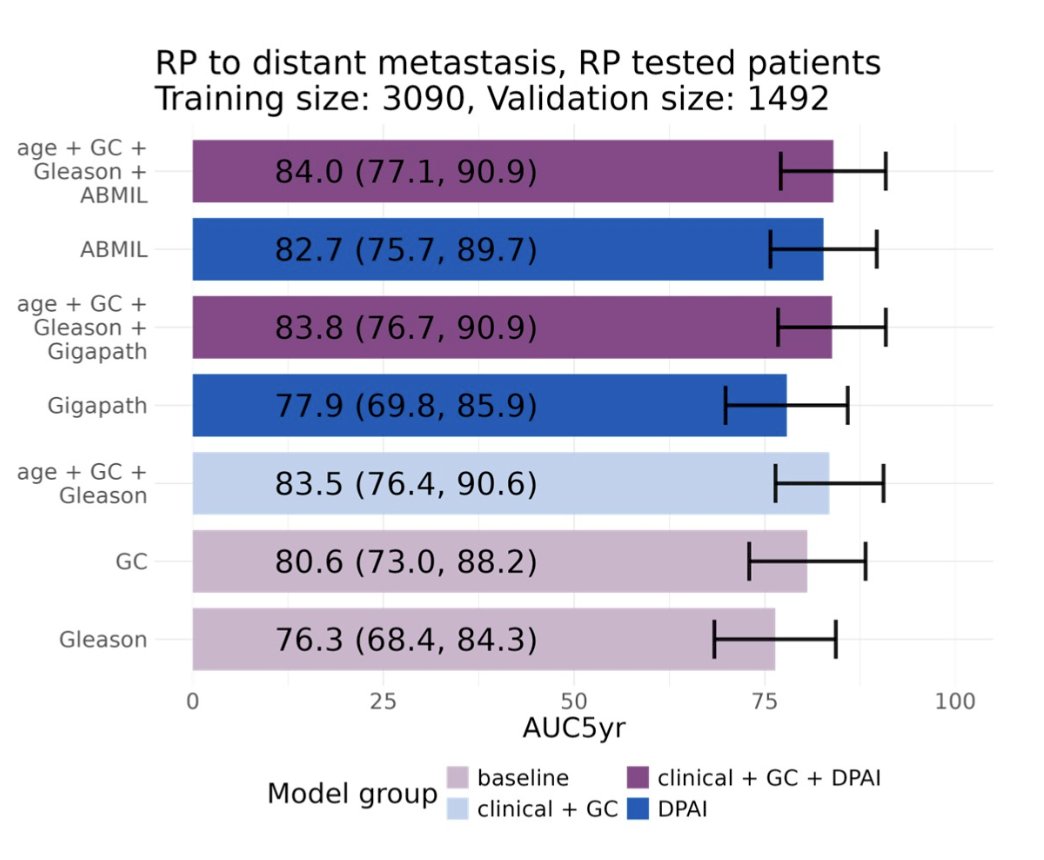
Among biopsy patients, multivariable Cox regression including age, NCCN, genomic classifier score, and digital pathology artificial intelligence, only showed genomic classifier (adjusted HR 1.23 [1.03, 1.47]) and digital pathology artificial intelligence (adjusted HR 1.22 [1.04, 1.43]) to be significantly associated with risk of distant metastasis (adjusted HR per 10%, both p < 0.05):![Among biopsy patients, multivariable Cox regression including age, NCCN, genomic classifier score, and digital pathology artificial intelligence, only showed genomic classifier (adjusted HR 1.23 [1.03, 1.47]) and digital pathology artificial intelligence (adjusted HR 1.22 [1.04, 1.43]) to be significantly associated with risk of distant metastasis (adjusted HR per 10%, both p < 0.05):](/images/com-doc-importer/189-asco-gu-2025/asco-gu-2025-risk-stratification-using-the-decipher-22-gene-genomic-classifier-and-digital-pathology-artificial-intelligence-in-nearly-10-000-localized-prostate-cancer-patients/image-4.jpg)
For the radical prostatectomy patients, using multivariable Cox regression, only radical prostatectomy genomic classifier (adjusted HR 1.27 [1.13, 1.43]) and digital pathology artificial intelligence (adjusted HR 1.44 [1.23, 1.69]) were significant predictors for distant metastasis (both p < 0.001):![For the radical prostatectomy patients, using multivariable Cox regression, only radical prostatectomy genomic classifier (adjusted HR 1.27 [1.13, 1.43]) and digital pathology artificial intelligence (adjusted HR 1.44 [1.23, 1.69]) were significant predictors for distant metastasis (both p < 0.001)](/images/com-doc-importer/189-asco-gu-2025/asco-gu-2025-risk-stratification-using-the-decipher-22-gene-genomic-classifier-and-digital-pathology-artificial-intelligence-in-nearly-10-000-localized-prostate-cancer-patients/image-5.jpg)
Dr. Spratt concluded his presentation discussing risk stratification using the Decipher 22-gene genomic classifier and digital pathology artificial intelligence in nearly 10,000 localized prostate cancer patients with the following take-home points:
- This is the largest study assessing the prognostic value of adding digital pathology artificial intelligence to improve performance above and beyond a clinical-genomic model
- The results from this study suggest that the combination of these data sources may further improve prognostication, and use of both digital pathology artificial intelligence and genomics negated information from routine clinical variables.
- Ongoing efforts in larger cohorts are underway to identify optimal scenarios in which genomic classifier and digital pathology artificial intelligence information enhance clinical utility for decision making.
Presented by: Daniel E. Spratt, MD, University Hospitals Seidman Cancer Center, Case Western Reserve University, Cleveland, OH
Related content: Combining Genomic Classifier and Digital Pathology Artificial Intelligence in Prostate Cancer Risk Stratification - Daniel Spratt
Written by: Zachary Klaassen, MD, MSc – Urologic Oncologist, Associate Professor of Urology, Georgia Cancer Center, Wellstar MCG Health, @zklaassen_md on Twitter during the 2025 Genitourinary (GU) American Society of Clinical Oncology (ASCO) Annual Meeting, San Francisco, CA, Thurs, Feb 13 – Sat, Feb 15, 2025.