

(UroToday.com) The 2025 American Society of Clinical Oncology Genitourinary (ASCO GU) cancers symposium held in San Francisco, CA was host to the Trials in Progress Poster Session A: Prostate Cancer. Dr. Megan Crumbaker presented the trial in progress poster 298: Bipolar androgen therapy (BAT) for nonmetastatic castration-resistant prostate cancer (nmCRPC) progressing on darolutamide: Working Out M0 BAT (WOMBAT; ANZUP 2201).
Dr. Crumbaker opened her presentation by highlighting that androgen deprivation therapy (ADT) combined with androgen receptor pathway inhibitors (ARPIs) like darolutamide is an effective treatment for metastatic prostate cancer.1 However, prolonged ADT has been associated with significant metabolic consequences, and resistance to androgen blockade inevitably develops, leading to disease progression. The mechanisms of resistance are well-documented and include androgen receptor (AR) amplification, AR variant overexpression, aberrant AR signaling, and autocrine/paracrine androgen synthesis within tumor cells.2
Bipolar androgen therapy (BAT) involves cycling between supraphysiologic and castrate levels of testosterone. This approach is hypothesized to restore prostate cancer sensitivity to ARPIs. Studies, including the TRANSFORMER trial, suggest that BAT can re-sensitize tumors that have become castration-resistant to subsequent antiandrogen therapy. (3) The investigators hypothesize that combining intermittent darolutamide with BAT will enhance oscillations between high and low testosterone levels while mitigating some of the adverse metabolic effects associated with androgen blockade.
This is a single arm, multi-centre, phase 2 clinical trial aiming to determine the utility of adding BAT to ADT and intermittent darolutamide in people with M0 castration resistant prostate cancer (CRPC) progressing on ADT and continuous darolutamide.
The Target population consists of patients with:
- M0 CRPC on conventional imaging
- Previous PET-only M1 HSPC that is M0 at CRPC; study screening permitted if >18 months from initiation of darolutamide
- SBRT to PET-only metastases permitted prior to screening if lesions are no longer visible on baseline imaging for study
For the sample size calculation, based on outcomes from the ARAMIS trial, 69 participants will be required to assess whether treatment can increase the proportion of participants who are alive and metastasis-free at 6 months from 61.3% to 71.7%. This corresponds to a median metastasis-free survival (MFS) increase from 8.5 to 12.5 months and a hazard ratio of ~0.68, with a one-sided type I error of α=10% and 80% power. A futility analysis is planned after 41 participants have been enrolled in the study.
The study schema is illustrated below. Briefly, patients with M0 CRPC experiencing PSA progression while on darolutamide and with a PSA >1 ng/mL will be enrolled. The intervention consists of six-week cycles, with testosterone enanthate administered on Day 1, followed by darolutamide from Days 29 to 56, while ongoing ADT is maintained. The primary outcome is metastasis-free survival assessed by conventional imaging.
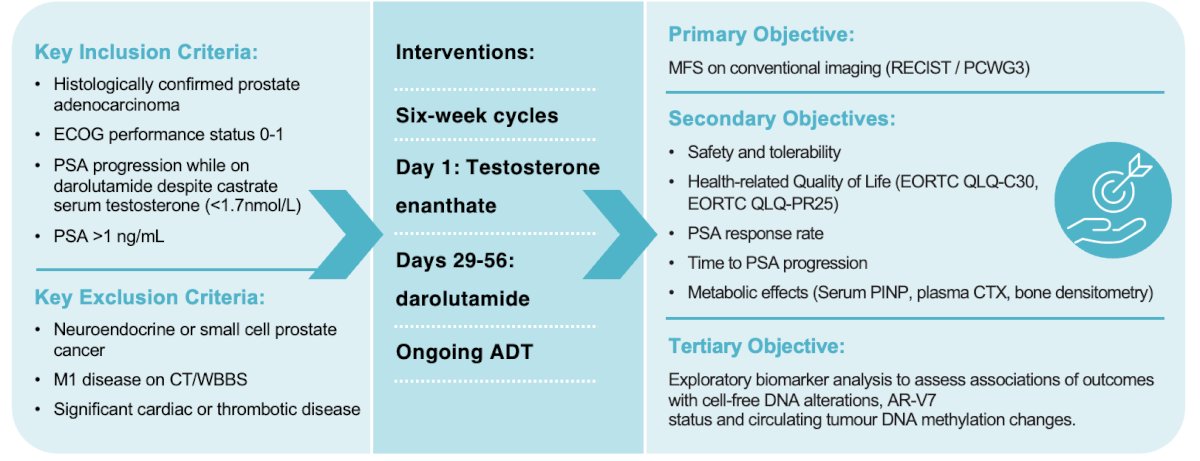
The tertiary objective of the study includes exploratory biomarker analysis to assess associations of outcomes with cell-free DNA alterations, AR-V7 status, and circulating tumour DNA (ctDNA) methylation changes.
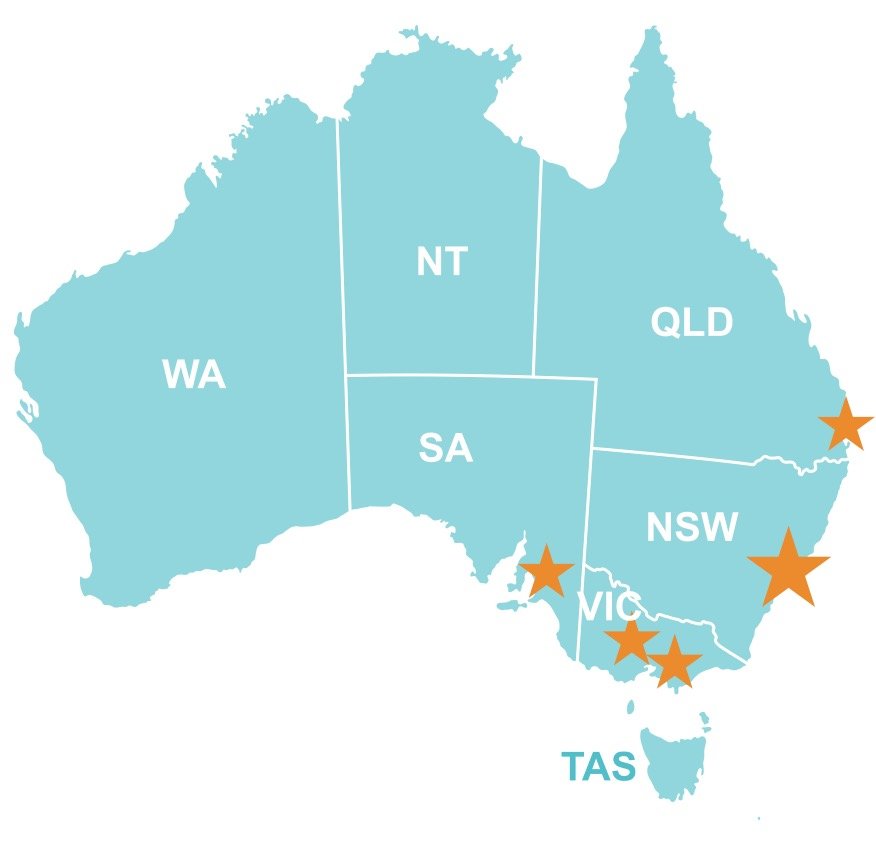
Currently, eight centers are enrolling patients, with one active participant, one participant in screening, and ongoing recruitment. The Center’s locations are highlighted in the map below:
Presented by: Megan Crumbaker, MBBS (Hons), PhD, FRACP, Medical Oncologist specialising in GU cancers at the Kinghorn Cancer Centre and St. Vincent’s, Sydney, Australia.
Written by: Julian Chavarriaga, MD – Urologic Oncologist at Cancer Treatment and Research Center (CTIC) via Society of Urologic Oncology (SUO) Fellow at The University of Toronto. @chavarriagaj on Twitter during the 2025 Genitourinary (GU) American Society of Clinical Oncology (ASCO) Annual Meeting, San Francisco, CA, Thurs, Feb 13 – Sat, Feb 15, 2025.
References:- Fizazi K, Shore N, Tammela TL, Ulys A, Vjaters E, Polyakov S, Jievaltas M, Luz M, Alekseev B, Kuss I, Kappeler C, Snapir A, Sarapohja T, Smith MR; ARAMIS Investigators. Darolutamide in Nonmetastatic, Castration-Resistant Prostate Cancer. N Engl J Med. 2019 Mar 28;380(13):1235-1246. doi: 10.1056/NEJMoa1815671. Epub 2019 Feb 14. Erratum in: N Engl J Med. 2022 Sep 1;387(9):860. doi: 10.1056/NEJMx220007. PMID: 30763142.
- Watson PA, Arora VK, Sawyers CL. Emerging mechanisms of resistance to androgen receptor inhibitors in prostate cancer. Nat Rev Cancer. 2015 Dec;15(12):701-11. doi: 10.1038/nrc4016. Epub 2015 Nov 13. PMID: 26563462; PMCID: PMC4771416.
- Denmeade SR, Wang H, Agarwal N, Smith DC, Schweizer MT, Stein MN, Assikis V, Twardowski PW, Flaig TW, Szmulewitz RZ, Holzbeierlein JM, Hauke RJ, Sonpavde G, Garcia JA, Hussain A, Sartor O, Mao S, Cao H, Fu W, Wang T, Abdallah R, Lim SJ, Bolejack V, Paller CJ, Carducci MA, Markowski MC, Eisenberger MA, Antonarakis ES. TRANSFORMER: A Randomized Phase II Study Comparing Bipolar Androgen Therapy Versus Enzalutamide in Asymptomatic Men With Castration-Resistant Metastatic Prostate Cancer. J Clin Oncol. 2021 Apr 20;39(12):1371-1382. doi: 10.1200/JCO.20.02759. Epub 2021 Feb 22. PMID: 33617303; PMCID: PMC8274807.