

(UroToday.com) The 2025 American Society of Clinical Oncology (ASCO) Genitourinary (GU) Annual Symposium held in San Francisco, CA between February 13–15, 2025 was host to prostate cancer poster session. Dr. Daniel Keizman presented the results of a comparative study of Decipher® Genomic Classifier scores and underlying transcriptomic profiles in American versus non-American early prostate cancer patients.
Dr. Keizman noted that data on Decipher Genomic Classifier (GC) in early prostate cancer predominantly originates from American patients, and previous studies have demonstrated that use of this GC is associated with significant risk re-classification, compared to the classical NCCN risk stratification system. Despite the global use of Decipher GC testing, data on its performance in non-Americans remains limited. The aim of this study was to analyze Decipher GC results and compare transcriptomic profiles among American versus non-American early prostate cancer patients.
Using the Decipher GC database (Decipher Biosciences Inc), the study investigators identified Israeli (non-American) versus matched American patients with early prostate cancer. Matching was performed using common NCCN clinicopathologic features (T and N stage, Gleason grade, number of adverse pathologic features).
This study included 103,108 American patients with a biopsy Decipher GC and 40,906 with a prostatectomy Decipher GC available. Conversely, there were 692 and 115 non-American patients, respectively. The median Decipher GC scores were as follows:
- Non-American:
- Biopsy: 0.47
- Prostatectomy: 0.78
- American:
- Biopsy: 0.43
- Prostatectomy: 0.65
- Differences between American and Non-American Decipher GC scores were significant for both biopsy and prostatectomy specimen comparisons
Among non-American patients, Decipher GC re-classification was observed as follows:
- NCCN low risk: 41%
- Favorable intermediate: 79%
- Unfavorable intermediate: 84%
- High: 55%
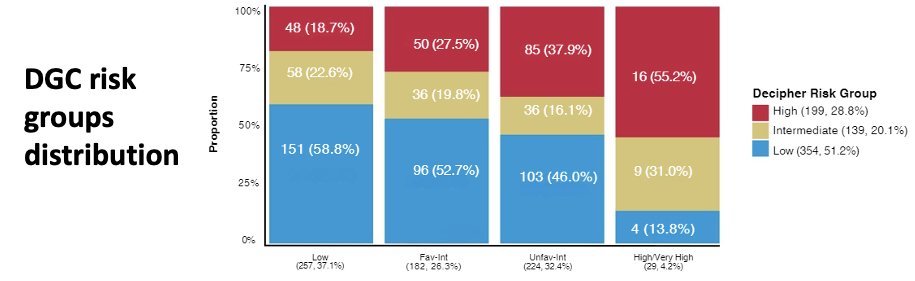
A correlative transcriptomic profile analysis revealed greater overall differences in non-American patients, compared to American patients. Significant differences in biopsy Decipher GC included:
- AR status (intact vs deficient)
- Prostate subtype classifier (PSC, luminal differentiated, luminal proliferating, basal immune, basal neuroendocrine)
- PAM50 (Luminal A,, Luminal B, Basal
- RSI
- Cell cycle progression
- Activated CD8
- T regulatory cells
- Angiogenesis
- Myeloid derived suppressor cells
- Interferon response alpha hallmark
- Immune 190
Significant differences in prostatectomy Decipher GC included:
- AR activity
- p53 mutation
- PSC
- PAM50
- SC/NE (adenocarcinoma, neuroendocrine carcinoma; Beltran 2016)
- RSI
- Activated CD4 and CD8
- T regulatory cells
- Angiogenesis
- Tertiary lymphoid structure
- PDL2 signature
- Myeloid derived suppressor cells
- Interferon response alpha.
Dr. Keizman concluded as follows:
- In early prostate cancer, as previously reported among American patients, Decipher Genomic Classifier may be an important tool for accurate risk assessment in non-Americans, leading to NCCN risk reclassification in a significant proportion of early prostate cancer patients
- Furthermore, the present study suggests that geographic variation in Decipher Genomic Classifier Scores may exist and correlate with differences in transcriptomic profiling.
Presented by: Daniel Keizman, MD, Head, Genitourinary Oncology Unit, Tel-Aviv Sourasky Medical Center, Israel
Written by: Rashid K. Sayyid, MD, MSc – Robotic Urologic Oncology Fellow at The University of Southern California, @rksayyid on Twitter during the 2025 Genitourinary (GU) American Society of Clinical Oncology (ASCO) Annual Meeting, San Francisco, CA, Thurs, Feb 13 – Sat, Feb 15, 2025.