

(UroToday.com) The 2025 American Society of Clinical Oncology (ASCO) Genitourinary (GU) Annual Symposium held in San Francisco, CA between February 13–15, 2025 was host to prostate cancer poster session. Dr. Syed Naqvi presented the updated results of a living systematic review that is evaluating the choice of androgen receptor pathway inhibitors (ARPI) by disease volume and timing of metastases in metastatic hormone sensitive prostate cancer (mHSPC).
Dr. Naqvi began his presentation by noting that his team has been maintaining a living systematic review to assess the efficacy of contemporary treatment regimens in mHSPC patients. Previously, they have shown that the addition of ARPIs to androgen deprivation therapy (ADT) may be preferred over triplet therapy in patients with low volume, metachronous disease.1 The objective of this study was to assess the comparative efficacy of different ARPI agents by volume of disease and timing of metastatic presentation.
This living systematic review was conducted using the living interactive evidence (LIvE) synthesis framework. Phase III randomized controlled trials that have assessed treatment intensification with ARPIs, including abiraterone acetate, apalutamide, darolutamide, and enzalutamide, in mHSPC patients were included in the analysis.1-7 Mixed treatment comparisons were made at the level of individual treatment regimens and by class of agents using a network-meta-analysis. P-scores, measuring the mean extent of certainty that a treatment is better than the competing treatments, were computed. A higher score indicated better efficacy.
The baseline patient characteristics are summarized below: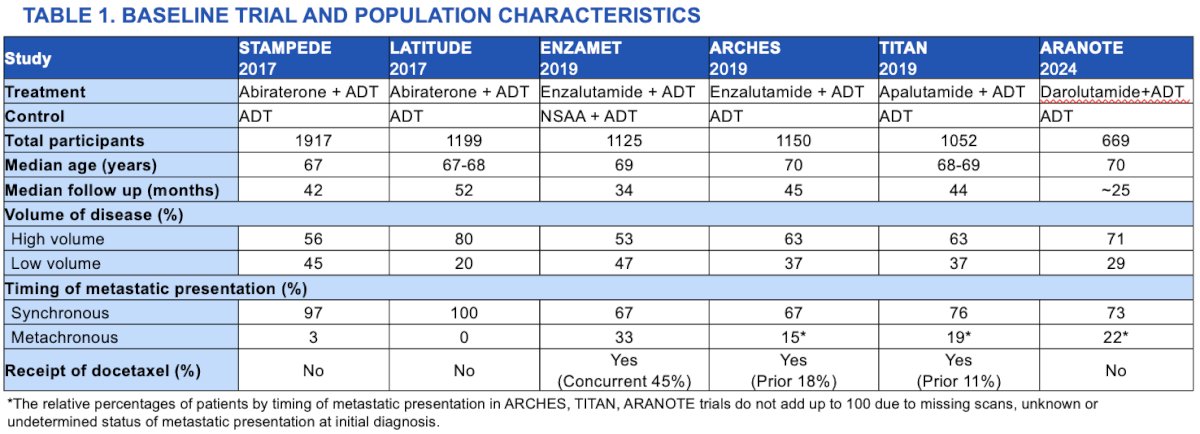
Overall, the most recent update of the living systematic review included a total of 11 trials with 12,628 patients and 12 unique treatment options. The results were consistent with prior updates. This analysis reports data from six trials with 7,112 patients and four unique ARPI agents. Two trials evaluated abiraterone acetate + prednisone (STAMPEDE, LATITUDE), two assessed enzalutamide (ENZAMET, ARCHES), and one trial each investigated apalutamide (TITAN) and darolutamide (ARANOTE).
A higher proportion of patients had high-volume disease (range: 53–80%), compared to low-volume disease (range: 20–47%) across the included trials. Most patients presented with synchronous metastases (67–100%), versus metachronous disease (0–33%) across the included trials.
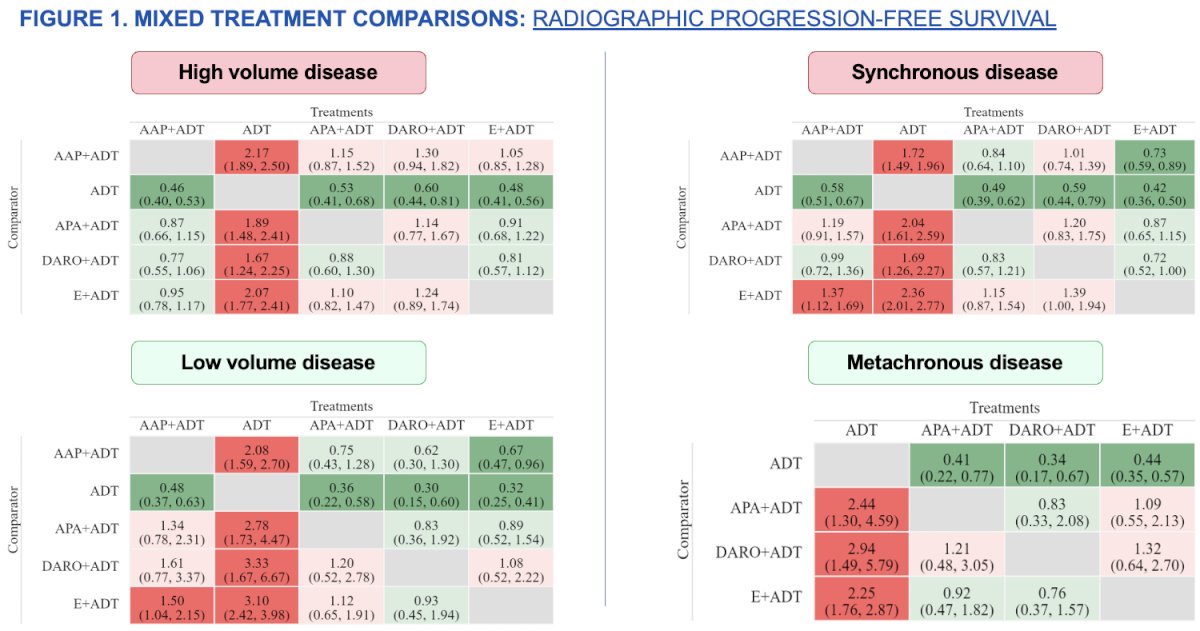
In patients with high-volume disease, the following ARPI doublets, compared to ADT alone were associated with the following rPFS survival benefits (in decreasing order):
- Rank 1: Abiraterone acetate (HR: 0.46)
- Rank 2: Enzalutamide (HR: 0.48)
- Rank 3: Apalutamide (HR: 0.53)
- Rank 4: Darolutamide (HR: 0.60)
- No statistically significant differences were observed between the ARPIs
In patients with low-volume disease, rPFS benefits by ARPI were as follows:
- Rank 1: Darolutamide (HR: 0.30)
- Rank 2: Enzalutamide (HR: 0.32)
- Rank 3: Apalutamide (HR: 0.36)
- Rank 4: Abiraterone acetate (HR: 0.48)
- Enzalutamide doublet significantly improved rPFS compared to abiraterone acetate doublet (HR: 0.67, 95% CI: 0.47–0.96)
In patients with synchronous disease, ARPI efficacy for rPFS was as follows:
- Rank 1: Enzalutamide (HR: 0.42)
- Rank 2: Apalutamide (HR: 0.49)
- Rank 3: Darolutamide (HR: 0.59)
- Rank 4: Abiraterone acetate (HR: 0.58)
- Enzalutamide significantly improved rPFS compared to abiraterone acetate (0.73; 95% CI: 0.59-0.89) in synchronous disease
In patients with metachronous disease, ARPI efficacy for rPFS was as follows:
- Rank 1: Darolutamide (HR: 0.34)
- Rank 2: Apalutamide (HR: 0.41)
- Rank 3: Enzalutamide (HR: 0.44)
- No statistically significant differences were observed between the ARPIs
Dr. Naqvi concluded as follows:
- The current evidence suggests that there are no significant rPFS differences among mixed treatment comparisons of ARPI agents based on disease volume and timing of metastatic presentation
- The addition of darolutamide to ADT does not demonstrate superiority over other ARPI agents.
- Overall survival data from the ARANOTE trial, with longer follow-up, will provide further insights.
- Enzalutamide may be preferred over abiraterone acetate plus prednisone in low-volume and/or synchronous disease.
- Given the similar efficacy observed, the choice of ARPI requires careful consideration of patient-specific factors including cost, accessibility and toxicity
- The findings should be interpreted while considering limitations, including reliance on trial-level data, lack of adjustment for covariates and trial differences, and applicability only to patients assessed using conventional imaging
Presented by: Syed Naqvi, MD, Research Fellow, Mayo Clinic, Phoenix, AZ, USA
Written by: Rashid K. Sayyid, MD, MSc – Robotic Urologic Oncology Fellow at The University of Southern California, @rksayyid on Twitter during the 2025 Genitourinary (GU) American Society of Clinical Oncology (ASCO) Annual Meeting, San Francisco, CA, Thurs, Feb 13 – Sat, Feb 15, 2025.
Related content: Apalutamide vs Enzalutamide: Racial Disparities in mCSPC Treatment Outcomes - Benjamin Lowentritt
- Riaz IB, Naqvi SAA, He H, et al. First-line Systemic Treatment Options for Metastatic Castration-Sensitive Prostate Cancer: A Living Systematic Review and Network Meta-analysis. JAMA Oncol. 2023; 9(5):635-45.
- James ND, de Bono JS, Spears MR, et al. Abiraterone for Prostate Cancer Not Previously Treated with Hormone Therapy. N Engl J Med. 2017; 377(4):338-351.
- Fizazi K, Tran N, Fein L, et al. Abiraterone plus Prednisone in Metastatic, Castration-Sensitive Prostate Cancer. N Engl J Med. 2017;377(4):352-360.
- Davis ID, Martin AJ, Stockler MR, et al. Enzalutamide with Standard First-Line Therapy in Metastatic Prostate Cancer. N Engl J Med. 2019; 381(2):121-131.
- Armstrong AJ, Szmulewitz RZ, Petrylak DP, et al. ARCHES: A Randomized, Phase III Study of Androgen Deprivation Therapy with Enzalutamide or Placebo in Men with Metastatic Hormone-Sensitive Prostate Cancer. J Clin Oncol. 2019; 37(32):2974-2986.
- Chi KN, Agarwal N, Bjartell A, et al. Apalutamide for metastatic, castration-sensitive prostate cancer. N Engl J Med. 2019; 381(1):13-24.
- Saad F, Vjaters E, Shore N, et al. Darolutamide in Combination With Androgen-Deprivation Therapy in Patients With Metastatic Hormone-Sensitive Prostate Cancer From the Phase III ARANOTE Trial. J Clin Oncol. 2024; 42(36):4271-81.