

(UroToday.com) The 2025 American Society of Clinical Oncology (ASCO) Genitourinary (GU) Annual Symposium held in San Francisco, CA between February 13–15, 2025 was host to prostate cancer poster session. Dr. Sean Miller presented the results of an emulated randomized controlled trial assessing the impact of PSMA PET staging on initial treatment decisions in newly diagnosed prostate cancer.
There has been a rapid uptake of PSMA PET staging since the FDA approval in 2020, with 70% of unfavorable intermediate risk or higher patients undergoing PSMA PET in the Veteran’s Health Administration (VHA) in June 2023. In the VHA, 8.2% of unfavorable intermediate risk (UIR), 14% of high risk (HR), and 34% of very high risk (VHR) patients are upstaged by PSMA PET to N1 or M1 disease.1 The impact of staging with PSMA PET on treatment decision making remains unclear.
This study included men with newly diagnosed, biopsy-proven prostate cancer, who had UIR, HR, or VHR disease (by NCCN criteria) and who had no evidence of node-positive or metastatic disease on conventional imaging. Patients had no PSMA PET/CT scan or bone scan performed prior to the biopsy. Between January 2022 and December 2023, eligible patients underwent emulated randomization to either conventional imaging (CT A/P or MRI + bone scan) versus PSMA PET (+/- CT A/P or MRI). Patients underwent imaging within 120 days of biopsy and had received no treatment prior to the staging studies. Cloning, censoring, and weighting techniques were used to estimate the causal effect.2
The primary outcome was used of ADT within 1 year of diagnosis. Secondary outcomes included use of androgen receptor pathway inhibitors, radiotherapy, and radical prostatectomy. The study investigators also assessed the impact of PSMA findings (i.e, PSMA N0M0, N1M0, or M1) on ADT, androgen receptor pathway inhibitors, radiotherapy, and radical prostatectomy utilization.
The study flow chart is illustrated below. The final cohort included 9,049 prostate cancer patients, of whom 3,199 underwent PSMA staging, 4,130 underwent a bone scan, and 1,720 underwent neither.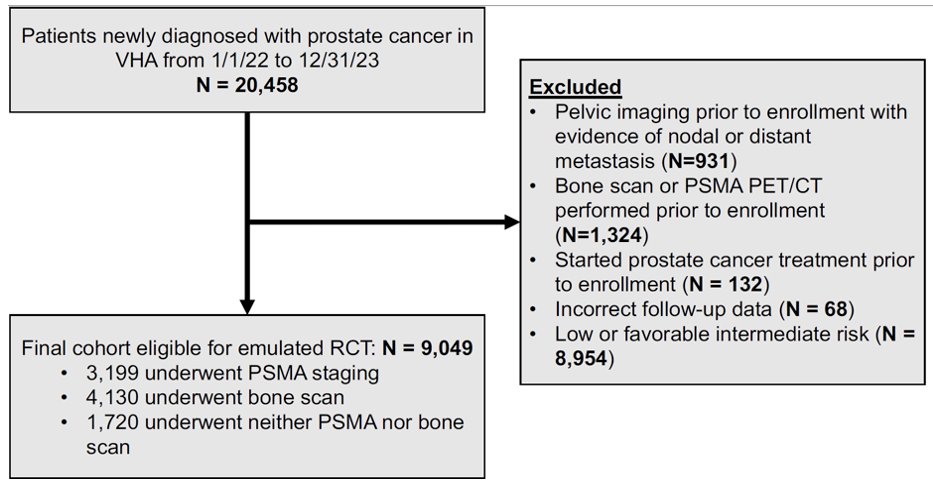
The patient demographics are summarized in the table below. In the PSMA group, 35%, 44%, and 22% had unfavorable intermediate, high, and very high-risk disease, respectively. The median PSA at diagnosis was 10 ng/ml.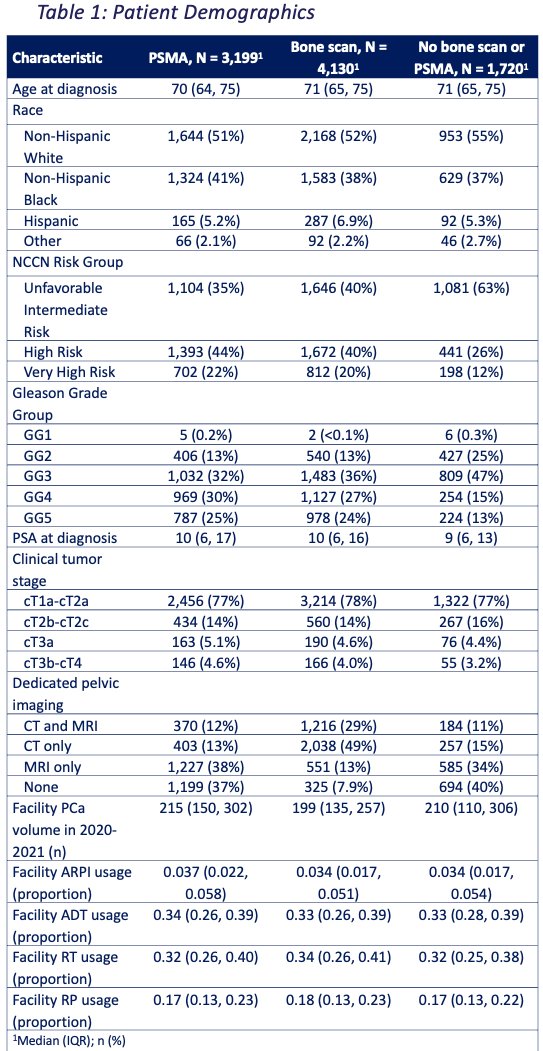
How did the performance of upfront PSMA staging for these patients impact initial prostate cancer treatment decision-making? Those who underwent PSMA PET/CT staging were significantly more likely to receive ADT (aHR: 1.26, 95% CI: 1.19–1.44) and an androgen receptor pathway inhibitor (aHR: 1.52, 95% CI: 1.33–1.78). There was a trend towards higher radiotherapy usage (aHR: 1.10, 95% CI: 0.99–1.25). Significantly, these patients were less likely to receive a radical prostatectomy (aHR: 0.69. 95% CI: 0.56–0.83).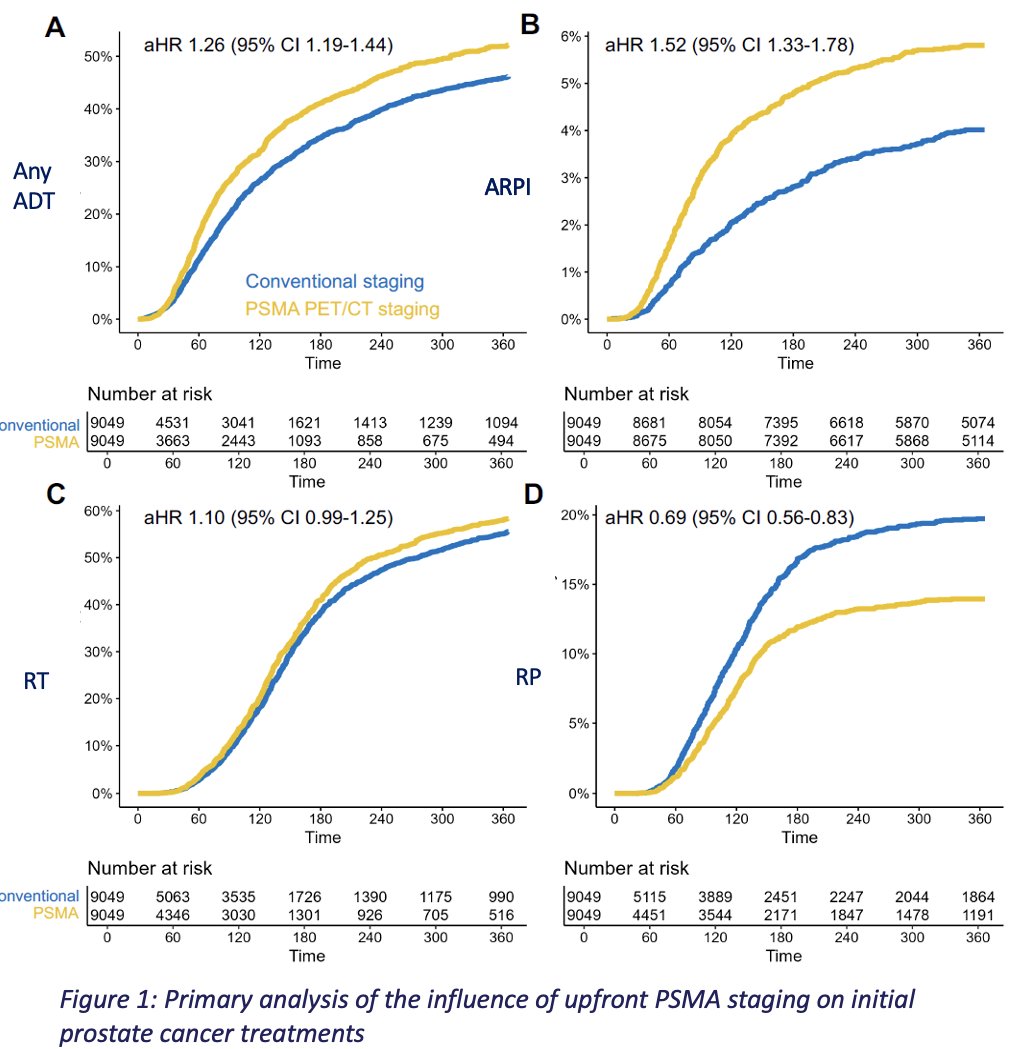
When stratified by PSMA PET findings (i.e., N0M0, N1M0, M1), the study investigators noted that utilization of any ADT was highest among those with N1M0 or M1 disease, an androgen receptor pathway inhibitor N1M0 or M1 disease, radiotherapy among those with N1M0 disease, and radical prostatectomy among those with N0M0 disease.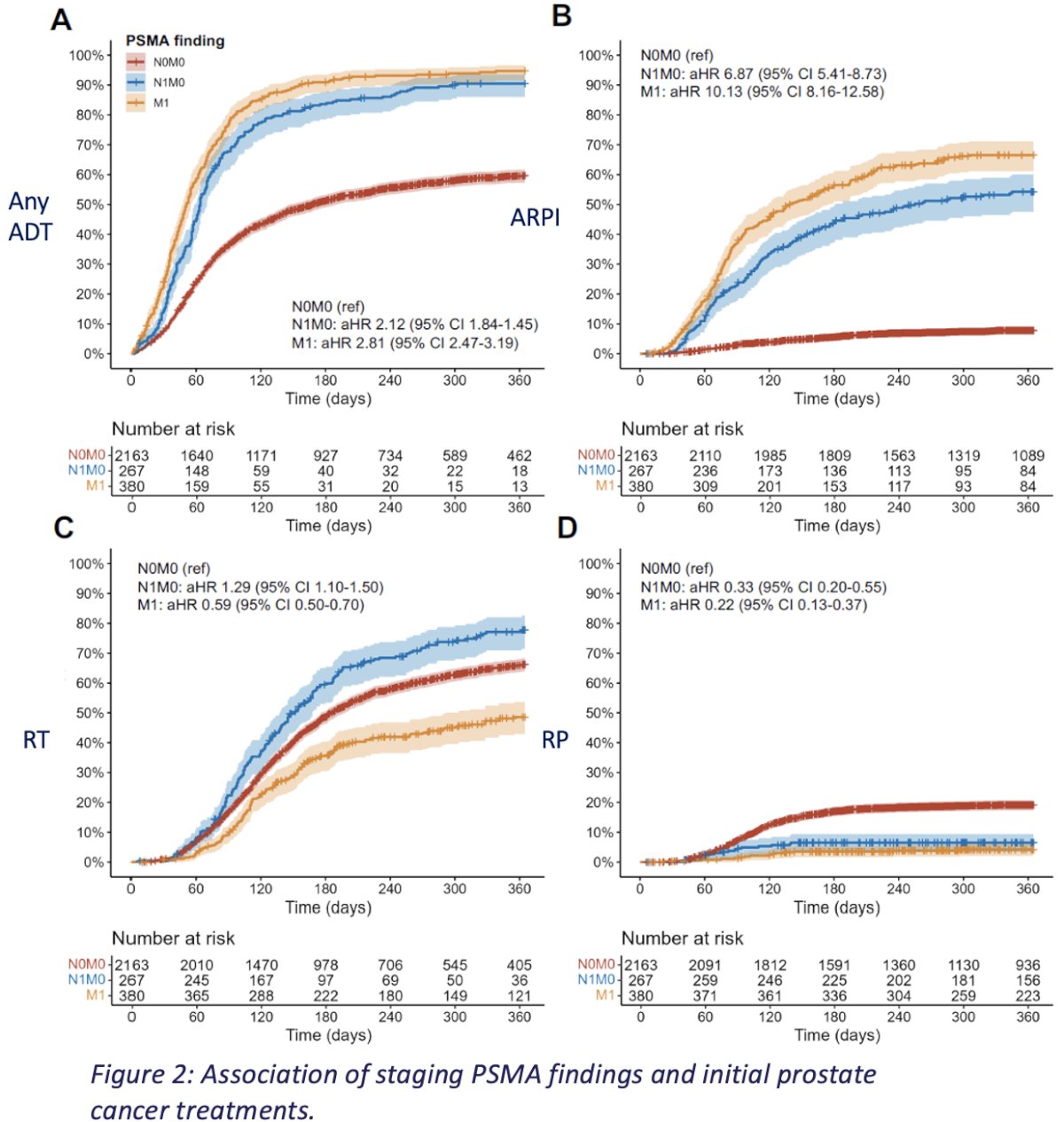
Dr. Miller concluded as follows:
- PSMA staging was associated with higher rates of any ADT usage relative to conventional staging
- PSMA staging also was associated with higher androgen receptor pathway use, lower prostatectomy usage, and no significant impact on radiotherapy usage
- Compared to patients with PSMA N0M0, ADT and androgen receptor pathway inhibitor usage was higher if patients had PSMA N1M0 or M1 disease
- If PSMA N1M0 or M1, there were lower rates of radical prostatectomy
- Rates of radiotherapy increased if PSMA N1M0 but decreased if M1.
- PSMA PET staging resulted in intensification of systemic therapy and de-intensified local surgical therapy.
Presented by: Sean Miller, MD, Department of Radiation Oncology, Veterans Affairs Ann Arbor Healthcare System, Ann Arbor, Michigan
Written by: Rashid K. Sayyid, MD, MSc – Robotic Urologic Oncology Fellow at The University of Southern California, @rksayyid on Twitter during the 2025 Genitourinary (GU) American Society of Clinical Oncology (ASCO) Annual Meeting, San Francisco, CA, Thurs, Feb 13 – Sat, Feb 15, 2025.
References:- Miller S, Gonzalez R, Jackson W, et al. Rates of PSMA PET Staging and Positivity in Newly Diagnosed Prostate Cancer in a National Health Care System. JNM. 66 (1) 75-83, 2025.
- Maringe C, Benitez Majano S, Exarchakou A, et al. Reflection on modern methods: trial emulation in the presence of immortal-time bias. Assessing the benefit of major surgery for elderly lung cancer patients using observational data. Int J Epidemiol. 2020;49(5):1719-1729