

(UroToday.com) The 2025 American Society of Clinical Oncology (ASCO) Genitourinary (GU) Annual Symposium held in San Francisco, CA, between February 13–15, 2025, was host to prostate cancer poster session. Dr. Soumyajit Roy, MBBS, MSc, presented the results of an individual patient data meta-analysis of early PSA nadir in the ARASENS, LATITUDE, and TITAN trials.
An early PSA nadir of ≤0.2 ng/mL within 6 months of treatment initiation is a known prognostic biomarker of improved overall survival outcomes in metastatic hormone sensitive prostate cancer (mHSPC) receiving ADT +/- an androgen receptor pathway inhibitor (ARPI).1,2,3 Common risk stratification methods in mHSPC, such as volume of metastatic disease burden, are currently unable to predict early PSA response with optimal accuracy. Therefore, there is an unmet need for an easily deployable clinical tool, which could predict favorable early PSA nadir responses to optimize treatment decisions and guide monitoring strategies.
The study investigators obtained individual patient data (IPD) from 3 phase III randomized clinical trials (ARASENS, LATITUDE, and TITAN).4=6 Patients who received ADT plus an ARPI (+/- docetaxel) were pooled and randomly split into training (60%) and testing (40%) cohorts. Patients who received ADT +/- docetaxel as standard of care were used as a validation cohort. Included variables were age, performance status, body mass index (BMI), Gleason score, metastatic stage at diagnosis, presence/absence of visceral metastasis, PSA and hemoglobin at baseline, use of docetaxel, and receipt of prior local therapy (radical prostatectomy and/or radiotherapy).
A random forest classifier model was constructed in the training cohort with 10-fold cross-validation for hyperparameter tuning. After internal validation in the testing cohort, the locked model was applied to the validation cohort, and performance was assessed using the area under curve (AUC) and Brier score.
Overall, 1,718 patients received ADT plus ARPI (+/- docetaxel) and 1,716 patients received ADT +/- docetaxel. The training cohort consisted of 1,030 patients, while the testing cohort and validation cohorts consisted of 688 and 1,716 patients, respectively. The performances of the testing and validation cohorts is demonstrated below: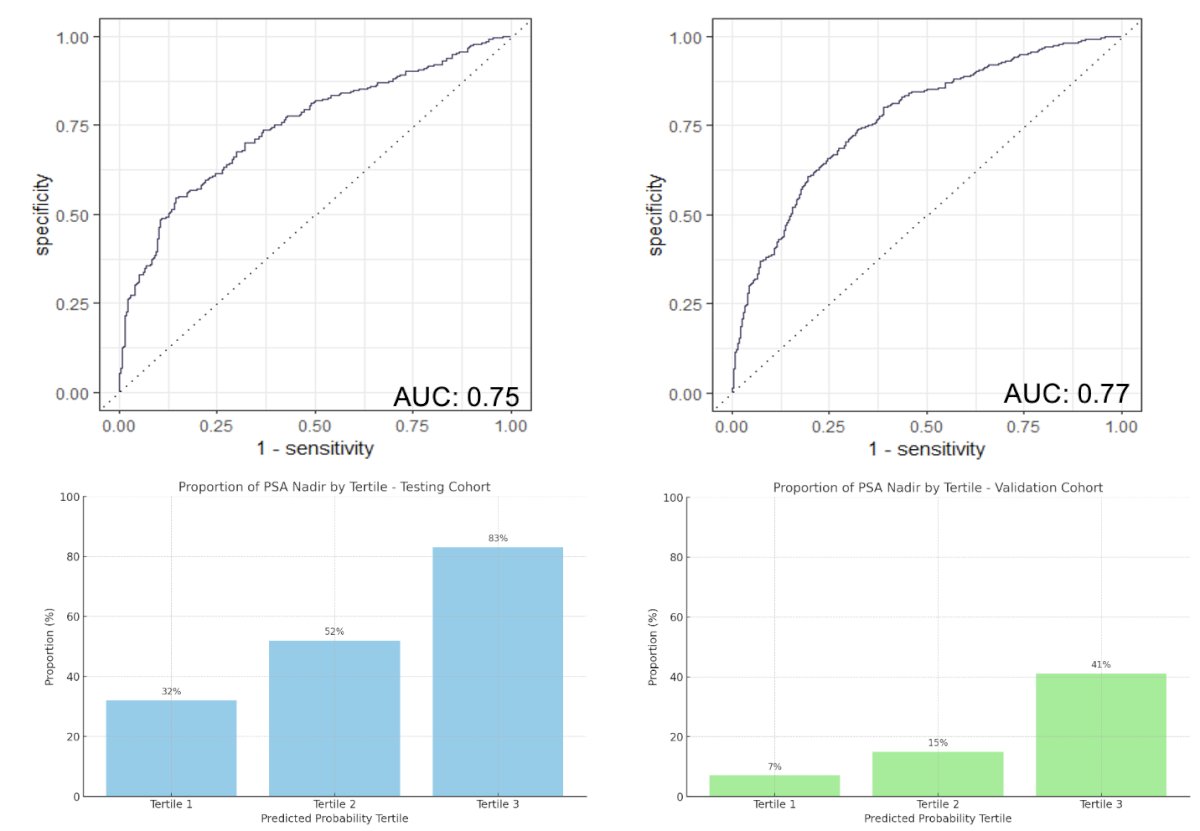
The Brier score in the testing and validation cohorts were 0.19 and 0.24, respectively. The modest calibration in the validation cohort (ADT +/- docetaxel) could be attributed to slight overprediction of early PSA nadir probability by a model trained in ARPI group.
Dr. Roy concluded as follows:
- Using readily available clinical and laboratory variables from 3 phase III randomized trials, the study investigators have successfully trained and validated a model that predicts favorable early PSA nadir in mHSPC patients being treated with ADT + ARPI +/- chemotherapy
- This tool is simple to utilize in routine clinical practice and may aid in patient selection for future clinical trials.
Presented by: Soumyajit Roy, MBBS, MSc, Resident Physician, Department of Radiation Oncology, Rush University Medical Center, Chicago, IL
Written by: Rashid K. Sayyid, MD, MSc – Robotic Urologic Oncology Fellow at The University of Southern California, @rksayyid on Twitter during the 2025 Genitourinary (GU) American Society of Clinical Oncology (ASCO) Annual Meeting, San Francisco, CA, Thurs, Feb 13 – Sat, Feb 15, 2025.
References:- Hussain M, Tangen CM, Higano C, et al. Absolute prostate-specific antigen value after androgen deprivation is a strong independent predictor of survival in new metastatic prostate cancer: data from Southwest Oncology Group Trial 9346 (INT-0162). J Clin Oncol 2006;2 4:3984–90.
- Matsubara N, Chi KN, Özgüroğlu M, et al. Correlation of Prostate-specific Antigen Kinetics with Overall Survival and Radiological Progression-free Survival in Metastatic Castration-sensitive Prostate Cancer Treated with Abiraterone Acetate plus Prednisone or Placebos Added to Androgen Deprivation Therapy: Post Hoc Analysis of Phase 3 LATITUDE Study. Eur Urol 2020; 77:494–500.
- Roy S, Sun Y, Chi KN, et al. Early Prostate-Specific Antigen Response by 6 Months Is Predictive of Treatment Effect in Metastatic Hormone Sensitive Prostate Cancer: An Exploratory Analysis of the TITAN Trial. J Urol 2024. https://doi.org/10.1097/JU.0000000000004158.
- Smith MR, Hussain M, Saad F, et al. Darolutamide and Survival in Metastatic, Hormone-Sensitive Prostate Cancer. N Engl J Med 2022; 386(12):1132-1142.
- Fizazi K, Tran N, Fein L, et al. Abiraterone plus Prednisone in Metastatic, Castration-Sensitive Prostate Cancer. N Engl J Med 2017; 377(4):352-360.
- Chi KN, Agarwal N, Bjartell A, et al. Apalutamide for metastatic, castration-sensitive prostate cancer. N Engl J Med 2019; 381(1):13-24.