

(UroToday.com) The 2025 American Society of Clinical Oncology (ASCO) Genitourinary (GU) Annual Symposium held in San Francisco, CA, between February 13–15, 2025, was host to a trials-in-progress prostate cancer session. Dr. Ramy Saleh presented ACCEL, a phase Ia Ia/Ib/II clinical trial to characterize the efficacy, safety, tolerability, and dosimetry of [Ac-225]-PSMA-62 in oligometastatic hormone-sensitive and metastatic castration-resistant prostate cancer (mCRPC).
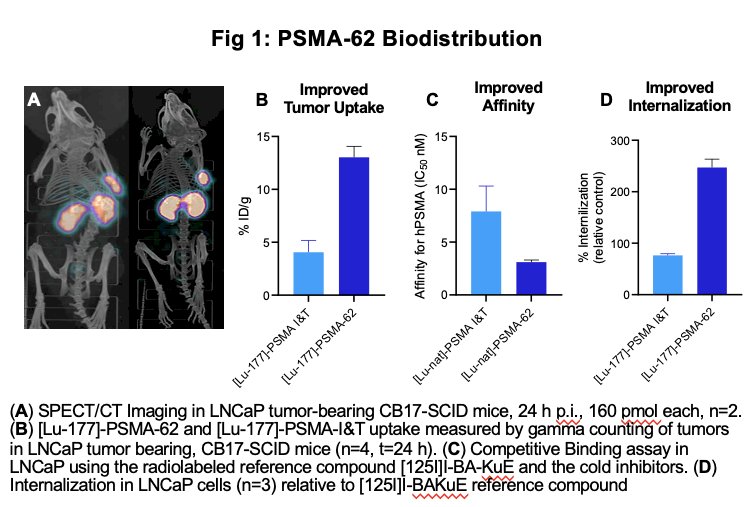
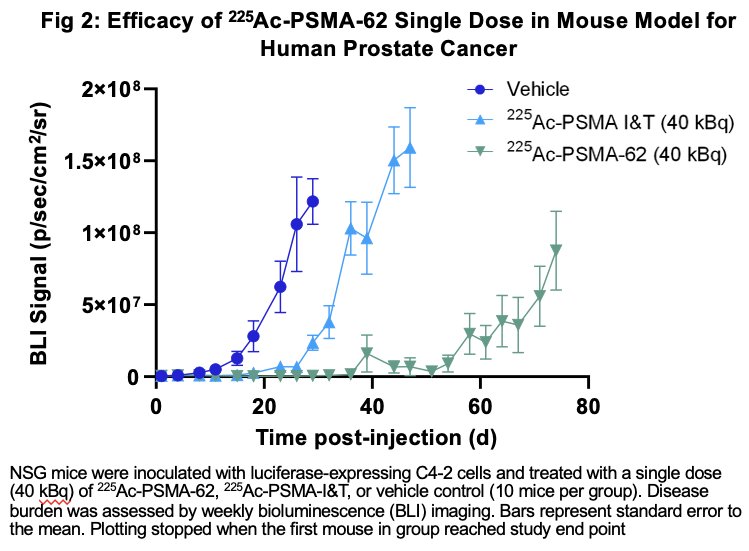
Actinium-225 (225Ac) prostate-specific membrane antigen (PSMA) radioligand therapy (RLT) uses the alpha emitter 225Ac to potentially enhance the therapeutic efficacy of PSMA-targeted RLT for prostate cancer patients. First-generation PSMA-targeting ligands (e.g., PSMA-617 and PSMA-I&T) labeled with 225Ac have been associated with high rates and potentially dose-limiting xerostomia, as well as myelosuppression and renal toxicity.1225Ac-PSMA-62 (LY4181530, previously PNT2001) pairs 225Ac with PSMA-62, a next-generation PSMA ligand designed to address these limitations. PSMA-62 utilizes a novel linker technology that enhances cellular internalization, resulting in improved biodistribution, tumor delivery of 225Ac, and efficacy in preclinical models.2
The study design is illustrated below. In Phase 1a, 225Ac-PSMA-62 will be administered intravenously:
- mCRPC: Patients will receive 4 doses, Q6W
- OmHSPC: Patients will receive 2 doses, Q8W
Dose limiting toxicities (DLTs) will be evaluated during a 4-week period post initial dose. The dose escalation scheme follows the Bayesian Optimal Interval (BOIN) model-assisted dose-finding method. Enrolment of the OmHSPC cohort will open upon safety review of initial dosing with mCRPC patients.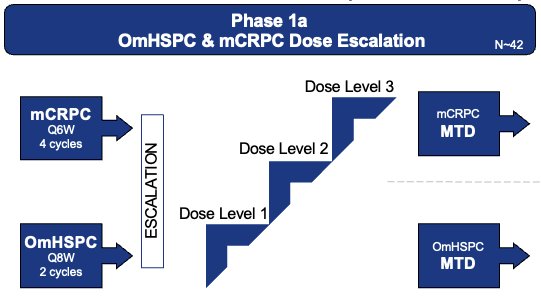
In phase 1b, mCRPC patients will be randomized to one of 3 arms to receive 225Ac-PSMA-62 at MTD Q6W, MTD Q4W, or MTD-1 Q4W. OmHSPC patients will be randomized to one of 2 arms to receive 225Ac-PSMA-62 at MTD Q8W or MTD-1 Q8W. After RP2D is determined, approximately 20 additional patients will be treated in the expansion parts. Phase 2 will aim to evaluate the efficacy of 225Ac-PSMA-62 compared to best standard of care in patients with mCRPC.
The study objectives are summarized in the table below. The primary endpoint of the phase 1a portion is to determine the MTD of 225Ac-PSMA-62 in patients with mCRPC and OmHSPC. The primary endpoint of phase 1b is to determine the RP2D of 225Ac-PSMA-62 in patients with mCRPC and OmHSPC.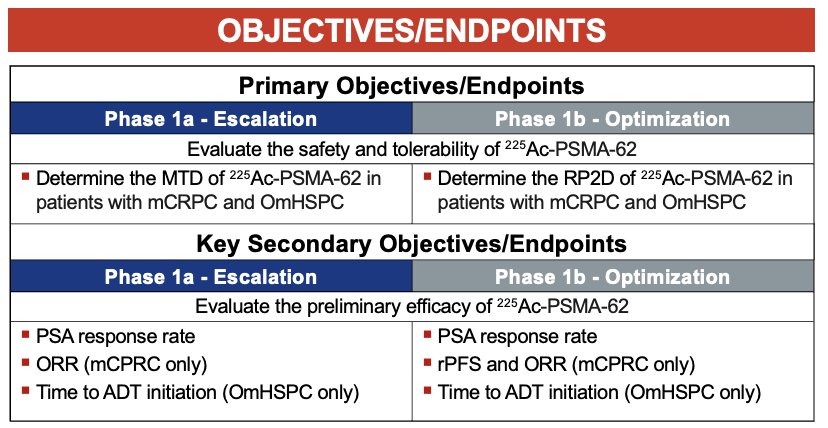
The key eligibility criteria are as follows:
- All cohorts
- Adequate marrow, hepatic and renal function, ECOG PS 0-1
- Prior PSMA-targeted radioligand therapy, untreated urinary tract obstruction, baseline grade ≥1 xerostomia, and grade ≥1 xerophthalmia are not permitted
- mCRPC cohort
- Received (any setting) ≥ 1 ARPI and taxane-based chemotherapy (unless ineligible/refused taxane); and ≤3 systemic therapies for mCRPC
- Progressive disease (by PSA, RECIST or PCWG3 criteria for bone)
- ≥1 PSMA-PET positive lesion(s)
- OmHSPC cohort
- PSA recurrence after definitive local therapy
- 1–5 PSMA-PET positive lesions outside the prostate bed
- Have not initiated life-long ADT for metastatic prostate cancer
- Serum testosterone levels ≥5.2 nmol/L (≥150 ng/dL)
The study is currently enrolling patients in Canada, and is opening in USA, Europe, Asia, and Australia.
Presented by: Ramy Saleh, MD, MSc, Medical Oncologist, Medical Director, Oncology Research Program, McGill University Health Centre, Montréal, Québec, Canada
Written by: Rashid K. Sayyid, MD, MSc – Robotic Urologic Oncology Fellow at The University of Southern California, @rksayyid on Twitter during the 2025 Genitourinary (GU) American Society of Clinical Oncology (ASCO) Annual Meeting, San Francisco, CA, Thurs, Feb 13 – Sat, Feb 15, 2025.
References:- Sathekge MM, Lawal IO, Bal C, et al. Actinium-225-PSMA radioligand therapy of metastatic castration-resistant prostate cancer (WARMTH Act): a multicentre, retrospective study. Lancet Oncol. 2024; 25(2):175-183
- Vito A, et al. Presented at the 12th International Symposium on Targeted Alpha Therapy (TAT 12) 2023.