

(UroToday.com) The 2025 GU ASCO annual meeting featured a prostate cancer session and a presentation by David Fisher discussing a STOPCAP meta-analyses of individual participant data assessing which patients with metastatic hormone-sensitive prostate cancer (mHSPC) benefit more from androgen receptor pathway inhibitors. There is clear evidence from large, high quality trials that adding an androgen receptor pathway inhibitor to standard of care substantially improves outcomes.
However, clinical features of people with mHSPC may affect their outcomes from the addition of androgen receptor pathway inhibitors to ADT. The STOPCAP Collaboration sought individual participant data to reliably investigate potential androgen receptor pathway inhibitor effect modifiers and determine who benefits more from an androgen receptor pathway inhibitor versus docetaxel plus ADT doublet.
This study used individual participant data for completed trials examining effects of androgen receptor pathway inhibitors for mHSPC. Initially, the investigators examined androgen receptor pathway inhibitor effects using intention-to-treat, two-stage, common-effect meta-analysis of hazard ratios (HRs), adjusted for a core set of covariates (age, PSA, performance status, Gleason, timing of diagnosis) and use of concomitant docetaxel. The main effects were based on overall survival. Interaction effects were based on progression-free survival to maximize power, then overall survival whenever progression-free survival interactions were found (p < 0.10).
There were 11 eligible androgen receptor pathway inhibitor trials, including 11,154 patients, with available data for 7 trials (7,778 patients; 70%). Four trials used androgen biosynthesis inhibitors (4,685 patients; STAMPEDE-Abi, LATITUDE, PEACE-1, SWOG 1216), and 3 trials used “amides” +/- abiraterone (3,093 patients; ENZAMET, TITAN, STAMPEDE-Abi + Enza). Key patient characteristics among these 7 trials are highlighted as follows: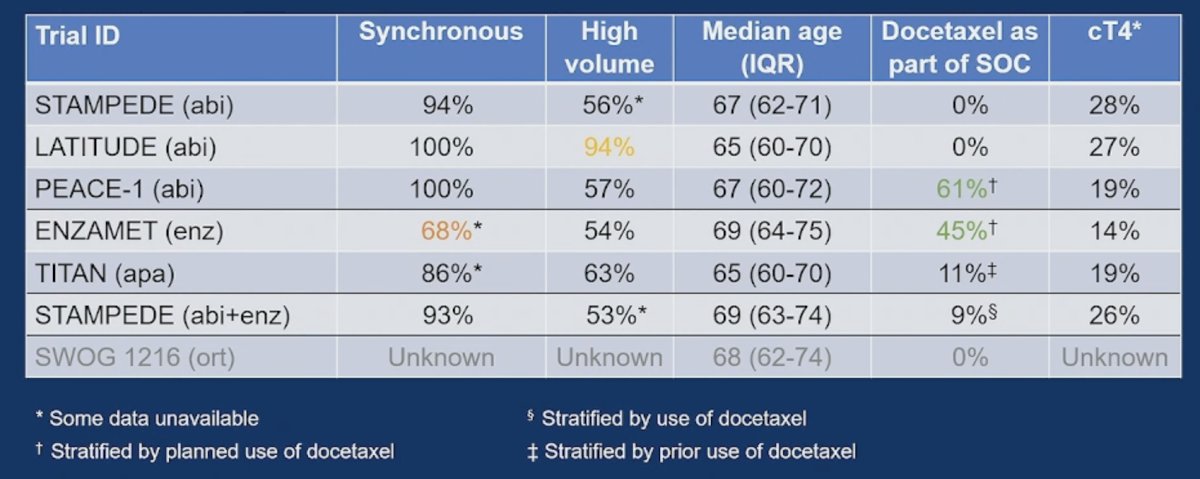
The median follow-up and control arm survival are noted in the following table:

Based on this data, adding an androgen receptor pathway inhibitor to ADT improved overall survival (HR 0.66, 95% CI 0.62-0.71), with a 13% absolute improvement at 5 years. Moreover, there was also a clear benefit for androgen receptor pathway inhibitors improving progression-free survival (HR 0.51, 95% CI 0.48-0.55), with a 21% absolute improvement at 5 years. Based on 48% “amide” data, there was no clear difference by class of agent. When assessing the effect of androgen receptor pathway inhibitors on progression free survival by patient and tumor characteristics, there was no clear difference noted for:
- Volume of metastases
- Timing of metastatic diagnosis
- Clinical T-stage
- Gleason sum score
- Nodal involvement
- Location of metastases
- WHO performance status
- BMI at randomization
Age was not prognostic: progression free survival decreased with increasing age (interaction HR 1.15, 95% CI 1.06-1.24) and overall survival effect also decreased with increasing age (interaction HR 1.11, 95% CI 1.01-1.21). The effects of androgen receptor pathway inhibitors by age group are highlighted as follows: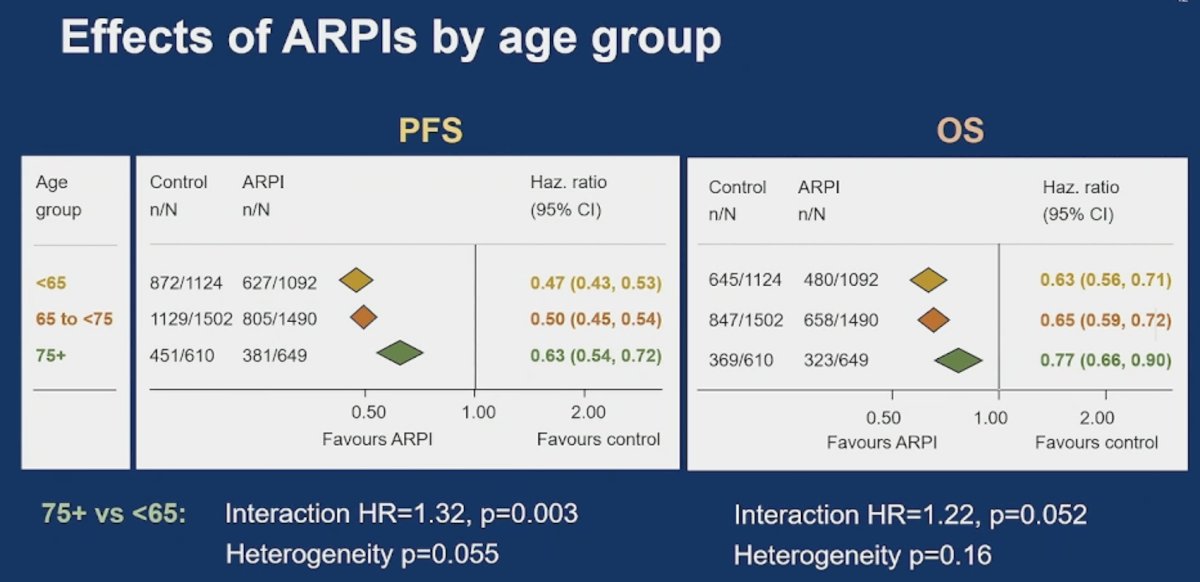
Specific to the abiraterone trials, the interaction for 75+ versus < 65 years was statistically significant (HR 1.64, p < 0.001):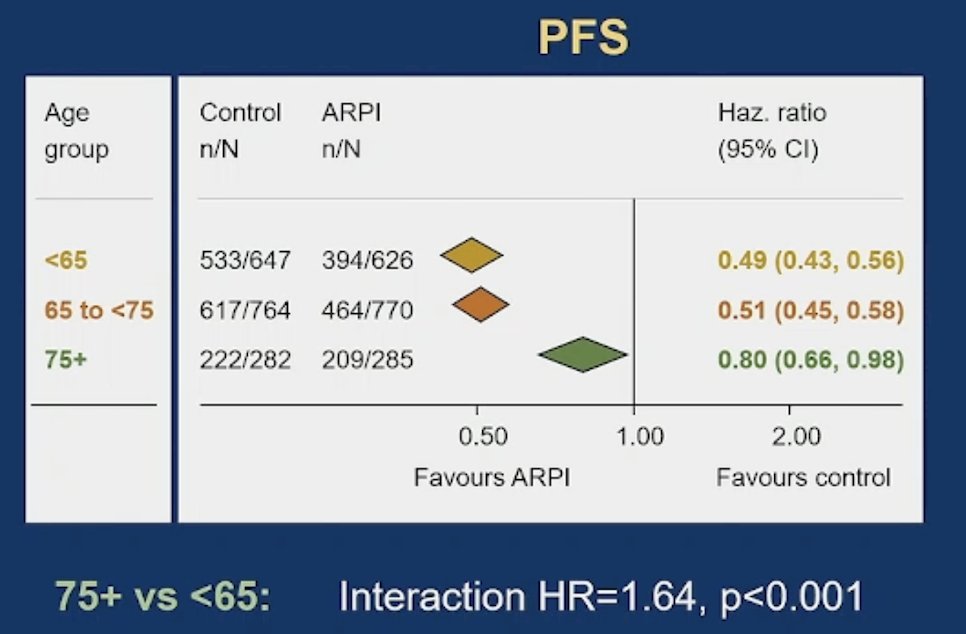
Similar results were also seen in the abiraterone trials by age for overall survival and prostate cancer specific survival, albeit without a significant interaction for prostate cancer specific survival: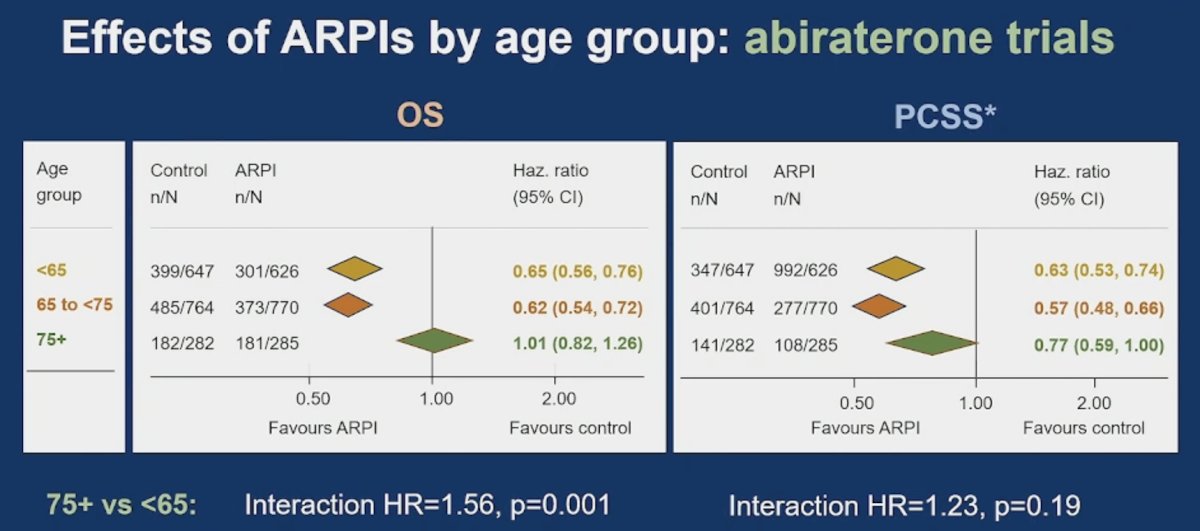
For the amide trials, for both progression free survival and overall survival by age, both had a statistically insignificant interaction (HR 1.02, p = 0.88 progression free survival; HR 0.93, p = 0.61 overall survival):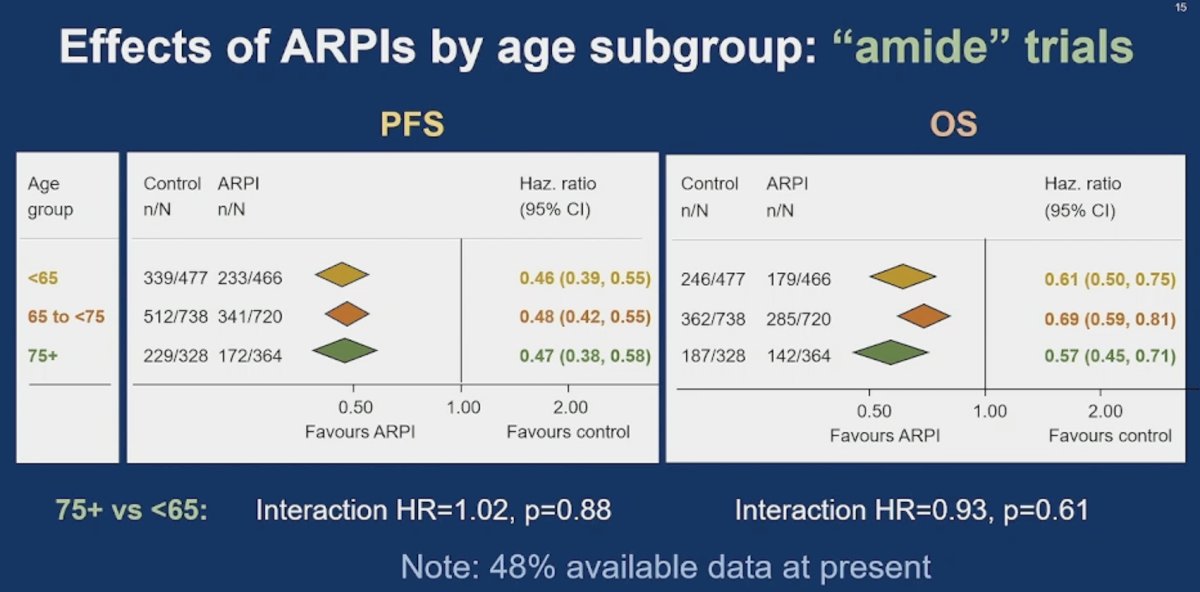
A summary of the 5-year absolute effects of androgen receptor pathway inhibitors by age group are summarized in the following table highlighting progression free survival, prostate cancer specific survival, and overall survival: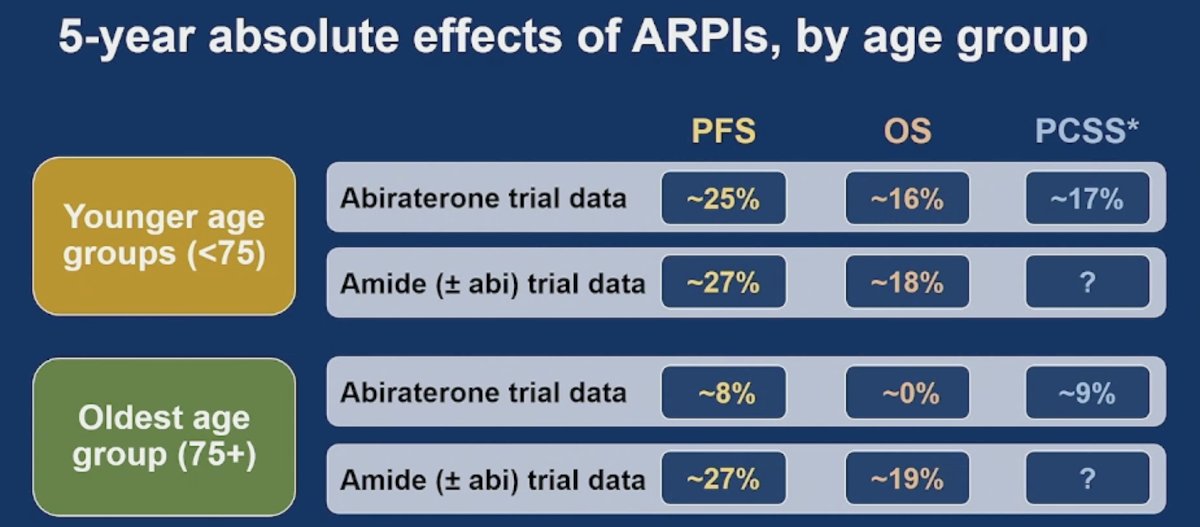
Next steps for this work include (i) obtaining better data (individual participant data from ARCHES, ARASENS, and ARANOTE trials; longer follow-up including complete cause of death data), (ii) for thorough analysis of how agent and patient factors inter-relate, and (iii) to better understand the results in order to maximize clinical insight. The strengths of the current analysis are the (i) STOPCAP international collaborative effort, (ii) 70% of individual participant data was accessed across all eligible trials, (iii) 100% of individual participant data was accessed across abiraterone trials (48% for androgen receptor pathway inhibitor trials), and (iv) this analysis is more reliable and thorough than a meta-analysis based on summary data.
David Fisher concluded his presentation discussing a STOPCAP meta-analyses of individual participant data assessing which patients with mHSPC benefit more from androgen receptor pathway inhibitors with the following take-home points:
- There is a clear benefit of androgen receptor pathway inhibitors on overall survival and progression free survival for the majority of mHSPC patients
- For young patients, there is a clear benefit from all androgen receptor pathway inhibitor
- For older patients, there should be a consideration of the benefits and risks of abiraterone and “amides”
- This is the first meta-analysis of individual participant data from the androgen receptor pathway inhibitor trials
Presented by: David J. Fisher, Principal Research Fellow, MRC Clinical Trials Unit at UCL, London, UK
Written by: Zachary Klaassen, MD, MSc – Urologic Oncologist, Associate Professor of Urology, Georgia Cancer Center, Wellstar MCG Health, @zklaassen_md on Twitter during the 2025 Genitourinary (GU) American Society of Clinical Oncology (ASCO) Annual Meeting, San Francisco, CA, Thurs, Feb 13 – Sat, Feb 15, 2025.
Related content: Patient-Level Data Confirms ARPI Value in mHSPC Treatment in Meta-Analysis - David Fisher