

(UroToday.com) The 2025 American Society of Clinical Oncology (ASCO) Genitourinary (GU) Annual Symposium held in San Francisco, CA was host to a renal cell cancer rapid oral abstract session. Dr. Toni K. Choueiri presented the safety, efficacy and subgroup analyses from ARC-20, a phase I open-label study of casdatifan monotherapy in patients with previously treated clear cell renal cell carcinoma (ccRCC).
ccRCC, the most common histologic subtype of renal cancer, is universally associated with dysregulation of the VHL pathway, leading to HIF-2α accumulation and upregulation of multiple oncogenic pathways. Casdatifan is an orally bioavailable, small-molecule HIF-2α inhibitor that potently inhibits transcription of HIF-2α-dependent genes.
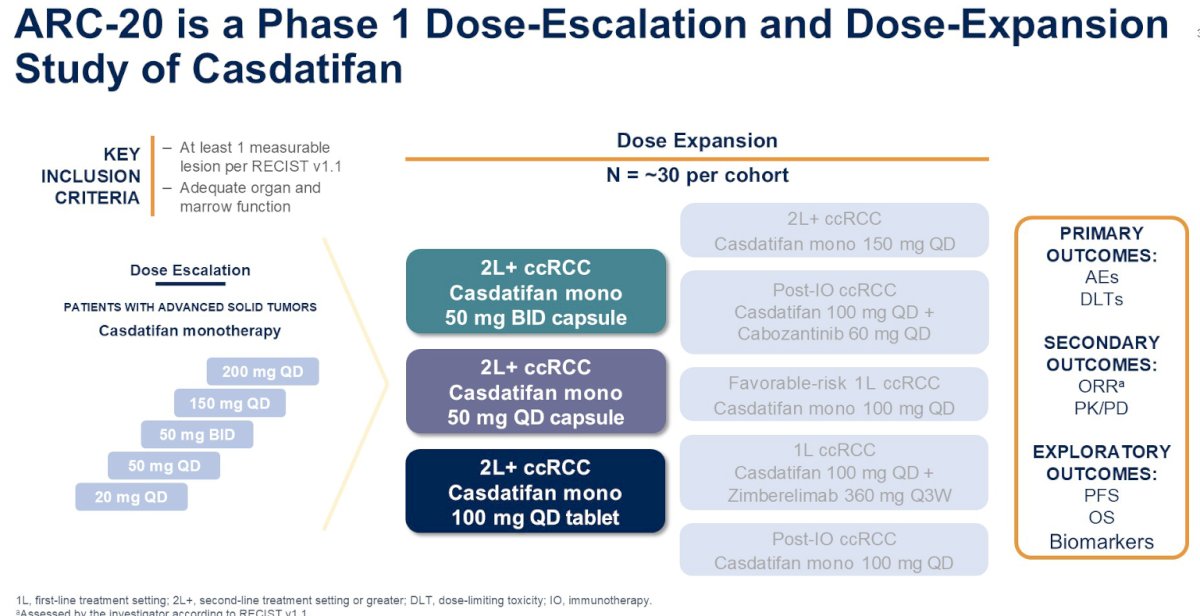
ARC-20 (NCT05536141) is a phase I, open-label dose-escalation and dose-expansion study evaluating casdatifan monotherapy in patients (age ≥18) with ccRCC who are HIF-2α inhibitor naïve and previously treated with anti-PD-(L)1 and VEGFR-TKI therapies. In the phase I dose escalation portion, patients with advanced solid tumors containing an RCC component received various doses of casdatifan monotherapy at doses of 20 mg to 200 mg once daily. In the dose expansion cohort, casdatifan combination therapies will be tested.
The primary outcomes are adverse events and dose-limiting toxicities. Secondary outcomes were objective response rate (ORR) and pharmacokinetics/pharmacodynamics. Exploratory outcomes were progression-free survival (PFS), overall survival (OS), and biomarker analyses.
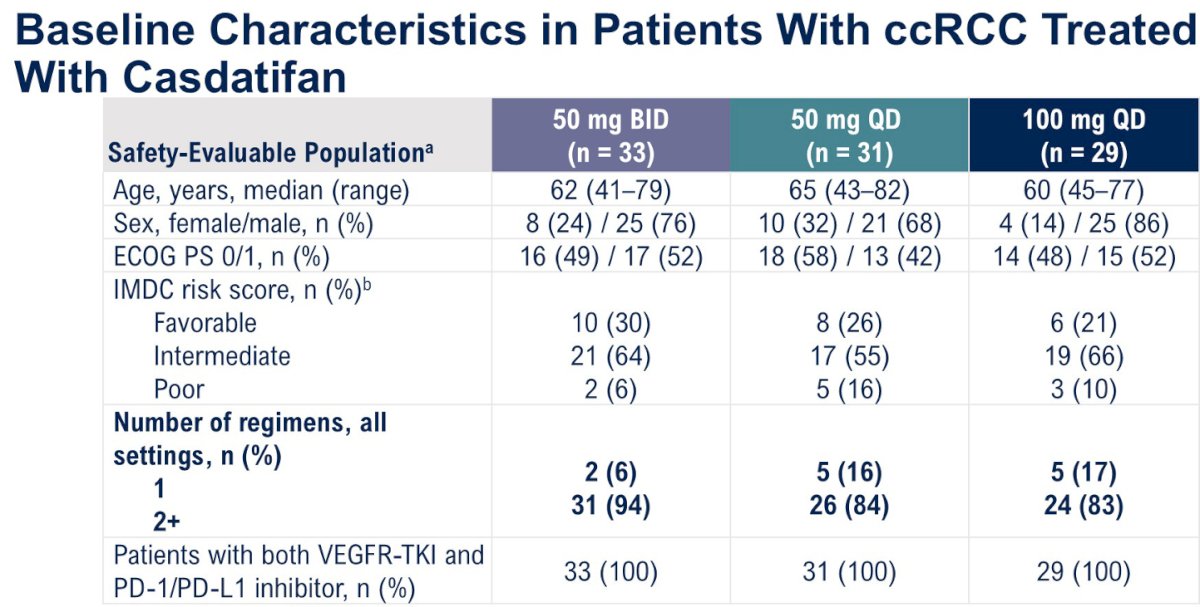
In this presentation, Dr. Choueiri focused on the outcomes of patients receiving 50 mg BID, 50 mg QD, and 100 mg QD. The baseline patient characteristics are summarized below. The median patient age was 60–65 years, 70–80% had IMDC intermediate-poor risk disease, and 83–94% had received ≥2 prior lines of systemic therapy.
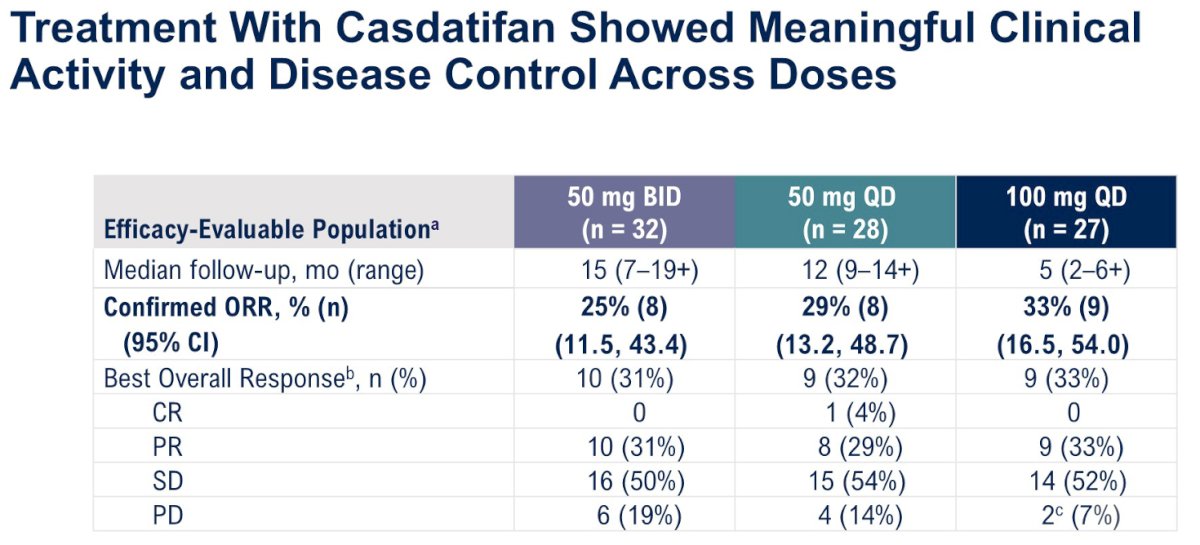
At a median follow-up of 5–15 months, the confirmed ORR was highest in the 100 mg once daily group (33%) versus 25% and 29% in the 50 mg twice daily and once daily groups, respectively. One complete response was observed in the 50 mg once daily group.
The casdatifan 100 mg once daily group showed a rapid response and a trend of decreasing sum of target lesion diameters.

Casdatifan was well-tolerated with a comparable safety profile across doses. Grade ≥3 treatment-emergent adverse events (TEAEs) were observed in 41% of patients in the 100 mg QD group, versus 52% in the 50 mg QD and BID groups. Anemia was observed in 80-90% of patients. Grade ≥3 anemia was observed in 17% of patients in the 100 mg QD group, compared to 32% and 42% in the 50 mg QD and BID groups, respectively. Another notable TEAE was hypoxia, with grade ≥3 events observed in 7–10% of patients.

Dr. Choueiri concluded as follows:
- Across doses (N = 93), casdatifan demonstrated promising clinical activity in patients with previously treated ccRCC
- 50 mg BID (median f/u 15 months): 25% ORR
- 50 mg QD (median f/u 12 months): 29% ORR
- 100 mg QD (median f/u 5 months): 33% ORR
- Casdatifan was well tolerated, with a comparable safety profile across various doses (50 mg BID, 50 mg QD, and 100 mg QD), and only two patients had therapy-related discontinuations among 93 treated patients
- These data support further development of casdatifan in ccRCC
- The phase 3 PEAK-1 study will evaluate casdatifan (100 mg QD) + cabozantinib (60 mg) in patients with metastatic ccRCC and prior PD-1 therapy
Presented by: Toni K. Choueiri, MD, Jerome and Nancy Kohlberg Professor of Medicine, Dana-Farber Cancer Institute and Harvard Medical School, Boston, MA
Written by: Rashid K. Sayyid, MD, MSc – Robotic Urologic Oncology Fellow at The University of Southern California, @rksayyid on Twitter during the 2025 Genitourinary (GU) American Society of Clinical Oncology (ASCO) Annual Meeting, San Francisco, CA, Thurs, Feb 13 – Sat, Feb 15, 2025.