

(UroToday.com) The 2025 American Society of Clinical Oncology Genitourinary (ASCO GU) cancers symposium held in San Francisco, CA was host to the Rapid Oral Abstract Session C: Renal Cell Cancer. Dr. Xiaofan Lu presented the Abstract 442: Racial disparities in renal cell carcinoma histology and outcomes: Insights from the French Kidney Cancer Research Network (UroCCR-191).
Racial disparities in RCC are well-documented in U.S. populations, with differences in incidence and outcomes between Black and non-Black patients, impacting healthcare systems. However, these disparities remain underexplored in European universal healthcare systems. Addressing this gap is crucial for improving global cancer care equity. This study aimed to investigate racial disparities in RCC histologies and outcomes among Black and non-Black patients in France.
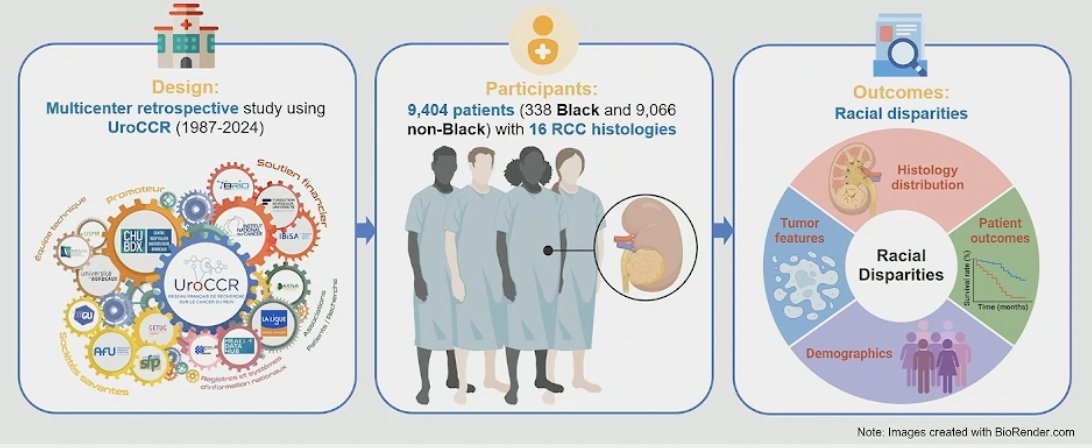
This multicenter retrospective study utilized data from the French Kidney Cancer Research Network (UroCCR-191) spanning from March 1957 to May 2024. It included 30 tertiary centers in France and analyzed 9,404 patients (338 Black and 9,066 non-Black) with confirmed RCC histology. Patients with unknown racial backgrounds or unidentified/multiple histologies were excluded. The study compared histological distribution, demographics, clinical presentations, tumor characteristics, and patient outcomes between Black and non-Black patients.
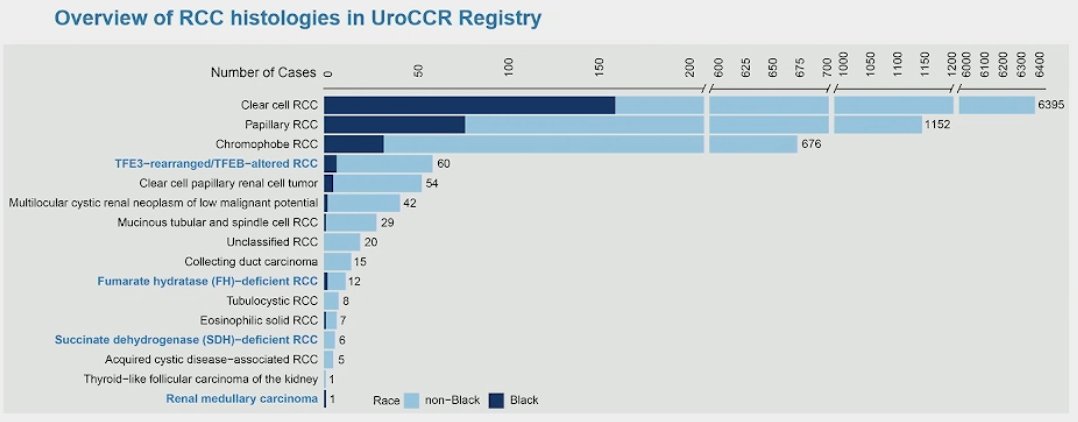
A total of 6,395 cases of clear cell RCC (ccRCC) were documented, followed by papillary RCC (1,152) and chromophobe RCC (676). Notably, there were only 12 cases of FH-deficient RCC.
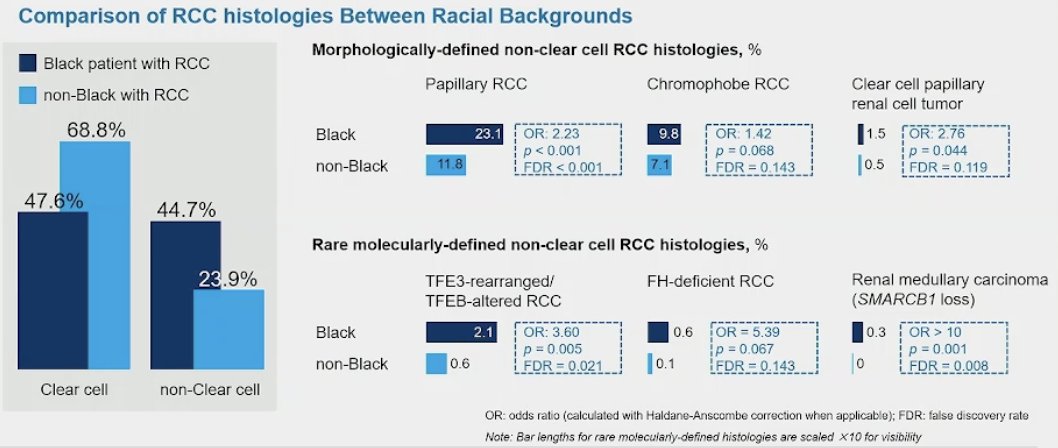
Clear cell RCC (ccRCC) was significantly more prevalent among non-Black patients (68.8% vs. 47.6%; OR: 2.4, p < 0.001). In contrast, non-clear cell histologies were more common in Black patients, including papillary RCC (23.1% vs. 11.8%, p < 0.001), clear cell papillary renal cell tumor (1.5% vs. 0.5%, p = 0.044), and several rare molecularly defined subtypes. Notably, translocation RCC was three times more prevalent in Black patients (2.1% vs. 0.6%), FH-deficient RCC was six times more prevalent (0.6% vs. 0.1%, p = 0.067), and renal medullary carcinoma was exclusively observed in Black patients (0.3% vs. 0, p = 0.001). All these associations had an OR ≥2 and a false discovery rate <0.15.
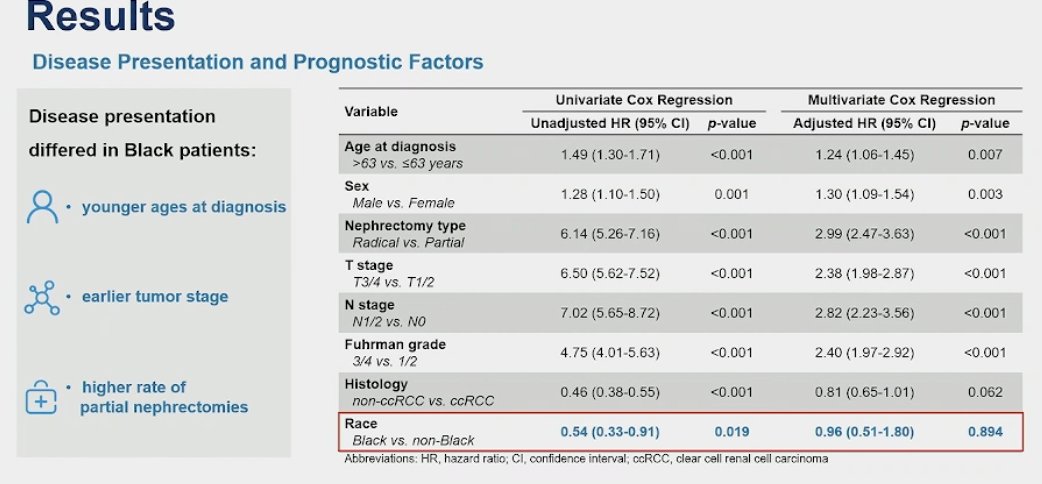
Disease presentation differed in Black patients, who were diagnosed at a younger age and with earlier tumor stages. They also had higher rates of partial nephrectomies. However, on multivariable analysis, race was not an independent prognostic factor when accounting for other clinical variables as shown below.
Dr. Lu acknowledged the limitations of the study, including the limited number of rare non-clear cell RCC cases, which restricted the statistical power to demonstrate disparities. The binary racial categorization (Black vs. non-Black) may have masked potential differences between Black patients and other racial groups. Additionally, the short median follow-up of 28.5 months limited the assessment of long-term survival outcomes.
Dr. Lu concluded his presentation with the following key takeaway points:
- In France, non-clear cell RCC histologies, particularly molecularly-defined subtypes, were more prevalent among Black patients compared to non-Black patients.
- In a universal healthcare system, race was not an independent predictor of clinical outcomes for patients with RCC.
Presented by: Xiaofan Lu, MD, Genitourinary Medical Oncologist. Head of Section, Kidney Cancer, Genitourinary Oncology Service, Jack and Dorothy Byrne Chair of Clinical Oncology at Memorial Sloan Kettering Cancer Center (MSKCC). New York, NY, United States.
Written by: Julian Chavarriaga, MD – Urologic Oncologist at Cancer Treatment and Research Center (CTIC) via Society of Urologic Oncology (SUO) Fellow at The University of Toronto. @chavarriagaj on Twitter during the 2025 Genitourinary (GU) American Society of Clinical Oncology (ASCO) Annual Meeting, San Francisco, CA, Thurs, Feb 13 – Sat, Feb 15, 2025.