

(UroToday.com) The 2025 GU ASCO annual meeting featured a kidney cancer session and a presentation by Dr. Michael Staehler discussing 18F-PSMA-1007 PET/CT for response assessment in patients with metastatic renal cell carcinoma (mRCC) undergoing first line tyrosine kinase or checkpoint inhibitor therapy. Evaluating the effectiveness of systemic therapy in patients with mRCC is crucial for timely treatment adjustments.
In an earlier preliminary study on a subset of mRCC patients, Dr. Staehler and colleagues compared responses to systemic therapy using 18F-PSMA-1007 PET and conventional imaging methods. In this study, the aim was to compare response assessments using PSMA PET versus CT scans in a larger cohort of mRCC patients undergoing systemic therapy. Additionally, they investigated the potential of using PSMA-PET-derived responses to predict outcomes.
This was a retrospective single-center analysis of patients with mRCC who underwent 18F-PSMA-1007 PET/CT in the context of tyrosine kinase or checkpoint inhibition and had at least one PET avid metastatic RCC lesion at baseline. All patients were treated with IO combination therapy either in combination with a TKI or immune checkpoint inhibitor. Early treatment response at a mean of 9.5 weeks after the start of systemic therapy was compared to baseline scans. PET responses and measurements were correlated with CT results, progression free survival and overall survival.
There were 25 patients with mRCC enrolled, with a median age of 65.2 years (range 24-87). Response was seen in lesions otherwise not easy to assess like bone metastases:
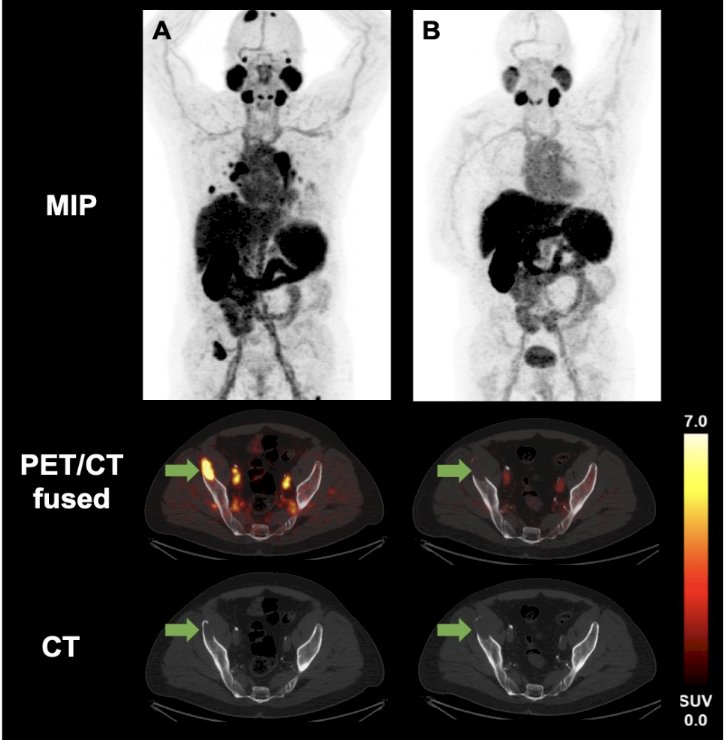
The median progression free survival was 16.6 months (range 1.38 - 58.69) and the median overall survival was 28.8 months (range 3.6 - 65.16). Median SUV, TTV, CT or PET response were not correlated with progression free survival or overall survival. Details of tissue related SUV are provided in the following table: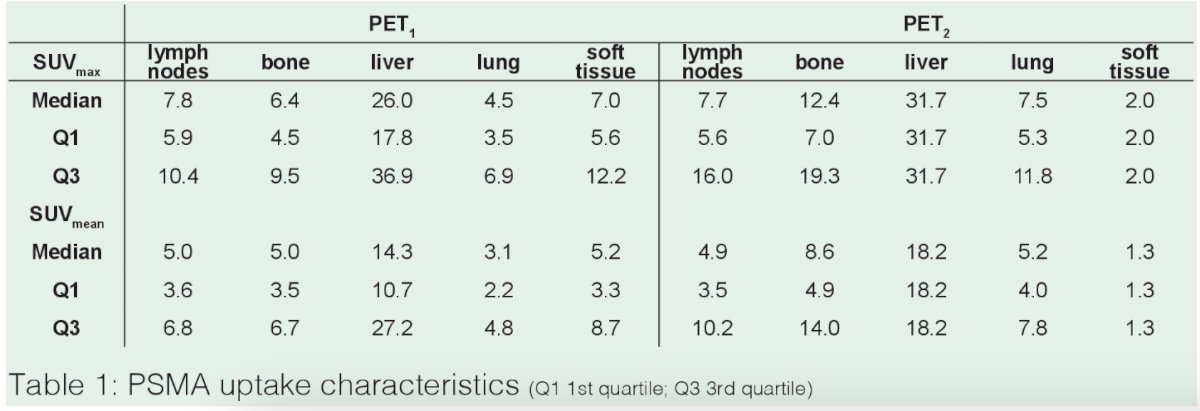
Patients with a >10% reduction in SUVmax had a significantly longer progression free survival with 23.1 months (95% CI 13.8-32.3) versus 3.6 (95% CI 1.4 – 5.9) months and overall survival of 36.2 months (95% CI 17.5 – 70.6) versus 11.1 months (95% CI 5.604 – 16.8) than patients without SUVmax response (p < 0.001):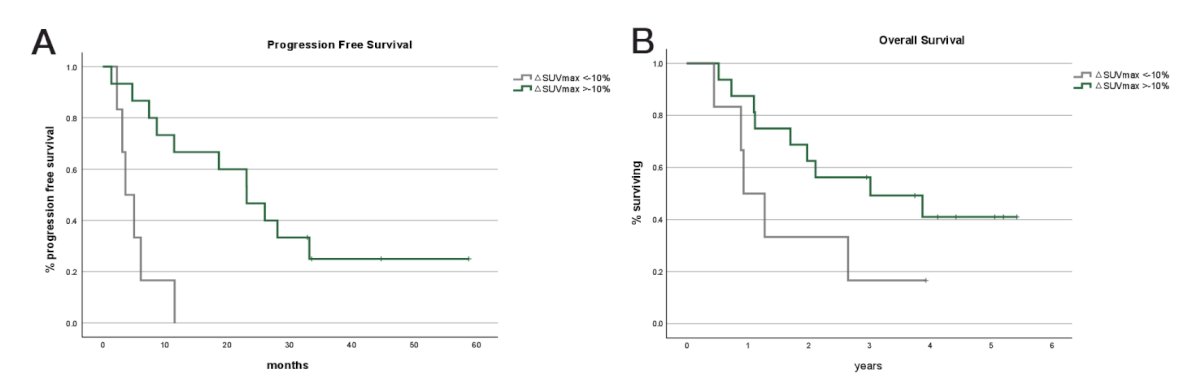
SUVmax response was independent of administration of tyrosine kinase inhibitors or checkpoint inhibitors. Repeat PSMA-analysis at time of progression could help differentiate general from local failure of systemic therapy, but data are still pending.
Dr. Staehler concluded his presentation discussing 18F-PSMA-1007 PET/CT for response assessment in patients with metastatic renal cell carcinoma undergoing first line tyrosine kinase or checkpoint inhibitor therapy with the following statements:
- Reduction of PSMA uptake on PET scans may be an independent biomarker beyond CT findings and warrants further investigation in mRCC
- PSMA PET could be used for a better understanding of drug efficacy
- Changes in PSMA PET are independent of the mechanism of action of systemic therapy in early prediction of therapy response and, therefore, might be considered a clinical biomarker.
Presented by: Michael D. Staehler, MD, PhD, University Hospital of Munich, Munich, Germany
Written by: Zachary Klaassen, MD, MSc – Urologic Oncologist, Associate Professor of Urology, Georgia Cancer Center, Wellstar MCG Health, @zklaassen_md on Twitter during the 2025 Genitourinary (GU) American Society of Clinical Oncology (ASCO) Annual Meeting, San Francisco, CA, Thurs, Feb 13 – Sat, Feb 15, 2025.