

(UroToday.com) The 2025 GU ASCO annual meeting featured a urothelial carcinoma session and a presentation by Dr. Yijun Shen discussing a prospective, open label, single-center study assessing preliminary efficacy and safety of disitamab vedotin combined with BCG in the treatment of high-risk non-muscle invasive bladder cancer with HER2 expression. Current treatment for high-risk non-muscle invasive bladder cancer involves BCG therapy, or radical cystectomy, especially for patients with very-high-risk features. However, 40%-60% high-risk non-muscle invasive bladder cancer patients will relapse after BCG treatment. Moreover, there is a high incidence of postoperative complications and a negative impact on health-related quality of life after radical cystectomy. Disitamab vedotin is a novel antibody drug conjugate that targets the HER2 protein, however its efficacy and safety in high-risk non-muscle invasive bladder cancer is limited. As such, Dr. Shen and colleagues conducted a prospective, open label, single-center study to evaluate the value of disitamab vedotin combined with BCG in high-risk non-muscle invasive bladder cancer patients.
In this study, two cohorts of BCG-naive patients with very-high-risk features who refused to undergo radical cystectomy or did not meet the requirements of radical cystectomy with HER2 expression (IHC 1+/2+/3+) were enrolled in two cohorts:
- Cohort A: patients were unable to undergo complete tumor resection or have CIS
- Cohort B: patients underwent complete tumor resection
All patients will receive eight cycles of IV injection of disitamab vedotin (2mg/kg, once every three weeks) and at least one year of BCG intravesical instillation:
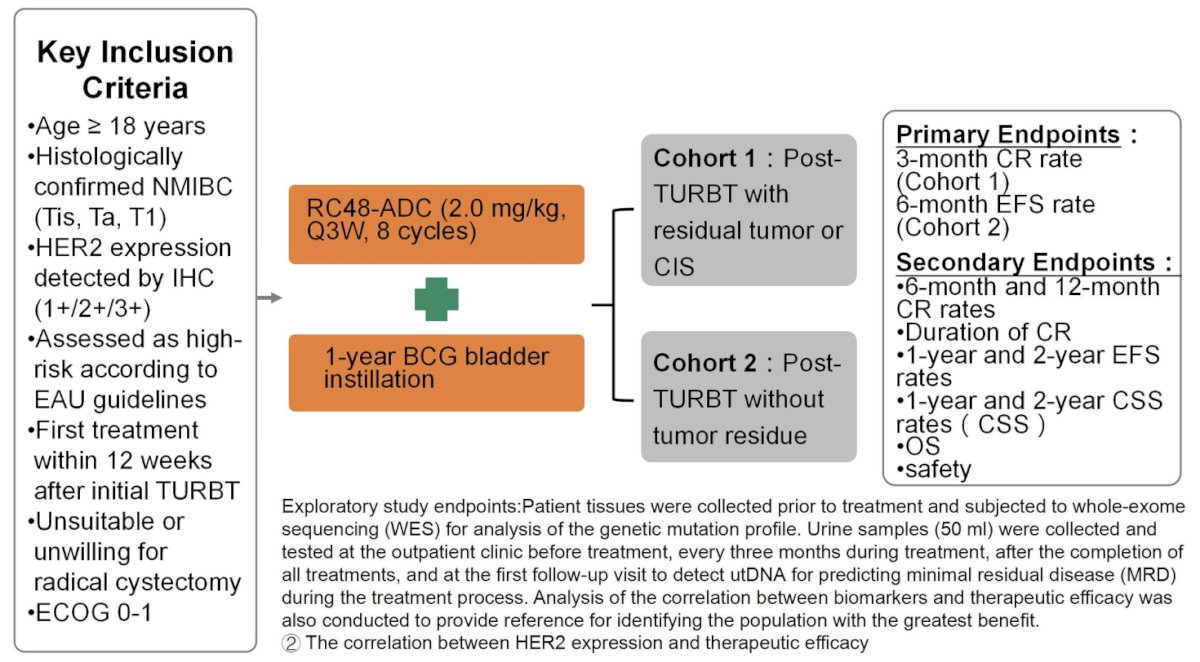
The primary endpoints included the 3-month clinical complete response rate in Cohort A and the 6-month event free survival rate in Cohort B. The secondary endpoints were to evaluate additional efficacy end points and safety.
From December 2023 to August 2024, 20 eligible patients (16 male; 4 female) were enrolled, with 15 patients in Cohort A and 5 patients in Cohort B. Overall, 17 patients had HER2 high expression (2+ or 3+), and 3 had HER2 low expression (1+). At the cut-off date (September 12, 2024), the clinical complete response rate at 3 months and 6 months were both 100% in 11 and 5 patients of Cohort A and the event free survival rate at 6 months was also 100% in 3 patients of Cohort B. There were 13 of 20 patients (65%) that experienced treatment-related adverse events. The most common treatment-related adverse events included AST/ALT increase 40% (8/20), alopecia 45% (9/20), peripheral sensory neuropathy 35% (7/20), anorexia 10% (2/20), and rash 5% (1/20). Grade 3 treatment-related adverse events occurred in 10% (2/20) patients with one peripheral sensory neuropathy caused by disitamab vedotin and one hematuria caused by BCG. There were 12 of 20 patients (60%) that had BCG-related adverse events including bladder irritation, fever, arthralgia, conjunctivitis and hematuria.
Dr. Shen concluded this presentation discussing a prospective, open label, single-center study assessing preliminary efficacy and safety of disitamab vedotin combined with BCG in the treatment of high-risk non-muscle invasive bladder cancer with HER2 expression with the following take-home points:
- This was the first study to evaluate disitamab vedotin in combination with BCG in the treatment for high-risk non-muscle invasive bladder cancer
- Preliminary results showed the combination had promising efficacy with a manageable safety profile
- This may potentially provide a new bladder-sparing therapy for very high-risk non-muscle invasive bladder cancer patients with HER2 expression who refused radical cystectomy or did not meet the requirements of radical cystectomy
Presented by: Yijun Shen, MD, Department of Urology, Fudan University Shanghai Cancer Center, Shanghai, China
Written by: Zachary Klaassen, MD, MSc – Urologic Oncologist, Associate Professor of Urology, Georgia Cancer Center, Wellstar MCG Health, @zklaassen_md on Twitter during the 2025 Genitourinary (GU) American Society of Clinical Oncology (ASCO) Annual Meeting, San Francisco, CA, Thurs, Feb 13 – Sat, Feb 15, 2025.