

(UroToday.com) The 2025 GU ASCO annual meeting featured a urothelial carcinoma session and a presentation by Dr. Nataliya Mar discussing real world toxicity profile of enfortumab vedotin with or without pembrolizumab in ultra elderly urothelial carcinoma patients. Enfortumab vedotin is an antibody drug conjugate that was approved in the United States as monotherapy for pretreated advanced urothelial carcinoma and, then, in combination with pembrolizumab in untreated patients.
However, enfortumab vedotin is associated with multiple toxicities, which are mostly non-overlapping with those of pembrolizumab. In the EV-302 study,1 grade 3 or higher treatment-related adverse events occurred in 55.9% of patients and led to treatment discontinuation in 35.0% of those on enfortumab vedotin + pembrolizumab. Patients aged 80 years or older (ie. the ultra elderly) are a special population, who may be particularly vulnerable to enfortumab vedotin toxicity.
This is a retrospective analysis of urothelial carcinoma patients, who received enfortumab vedotin monotherapy or enfortumab vedotin + pembrolizumab at two academic institutions in Southern California from December 2019 to September 2024. Patients had to be aged 80 years or older at enfortumab vedotin start to qualify and must have received at least one enfortumab vedotin dose. Toxicity was graded using the CTCAE version 5 criteria.
A total of 26 patients were included, with 83.6% being male. The median age was 86.5 years (range: 80 to 97), with 38.5% of patients aged 80-84 years (group 1), 46.2% aged 85-89 years (group 2), and 15.4% aged over 90 years (group 3). Overall, 53.8% identified as Caucasian, 23.1% as Asian, 15.4% as Hispanic, and 7.7% as “other”. There were 69.2% of patients that received enfortumab vedotin monotherapy and 30.8% enfortumab vedotin + pembrolizumab. In those on enfortumab vedotin alone, 88.9% had a prior PD-1/PD-L1 inhibitor. At time of data cut off, 27.0% of patients were still receiving enfortumab vedotin. The median number of enfortumab vedotin infusions given was 10.5 (range: 2 to 25), while the median number of weeks on enfortumab vedotin was 19.5 (range: 1 to 52). In group 1, the starting enfortumab vedotin dose was 1.25 mg/kg in 30% of patients and 1.0 mg/kg in 70%. In group 2, the starting enfortumab vedotin dose was 1.25 mg/kg in 16.7% of patients, 1.0 mg/kg in 25.0%, 0.75 mg/kg in 41.7%, and 0.5 mg/kg in 16.7%. In group 3, the starting enfortumab vedotin dose was 1.25 mg/kg in 25% of patients, 1.0 mg/kg in 50%, and 0.5 mg/kg in 25%: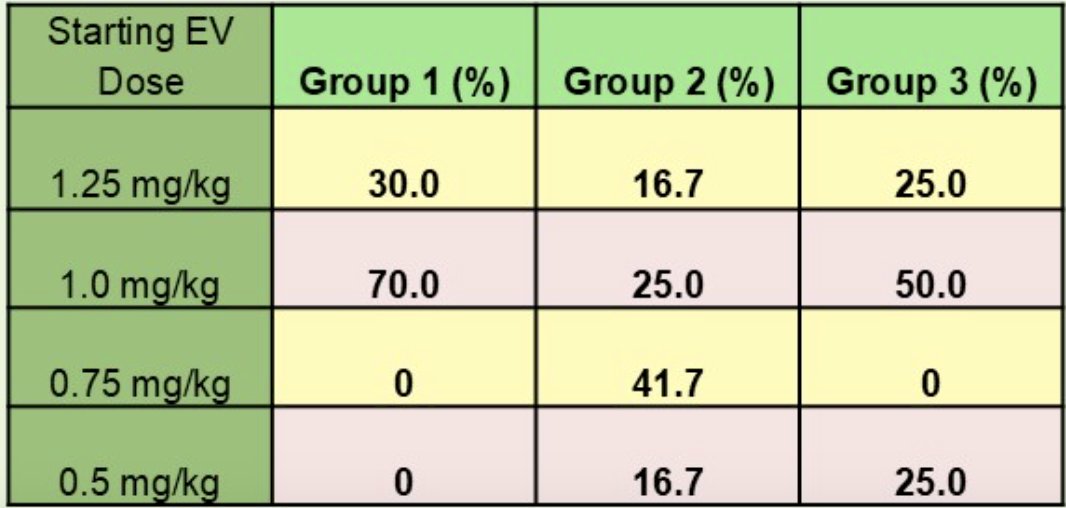
After enfortumab vedotin start, 50.0% had at least one enfortumab vedotin dose reduction, 42.3% had at least one dose delay, and 30.8% had enfortumab vedotin discontinued due to treatment-related adverse events. Toxicity severity in the overall study population was as follows:
- Grade 0 in 26.9%
- Grade 1 in 30.8%
- Grade 2 in 26.9%
- Grade 3 in 15.4%
- Grade 4/5 in 0%
The starting dose of enfortumab and associated treatment related adverse events in the study population are as follows: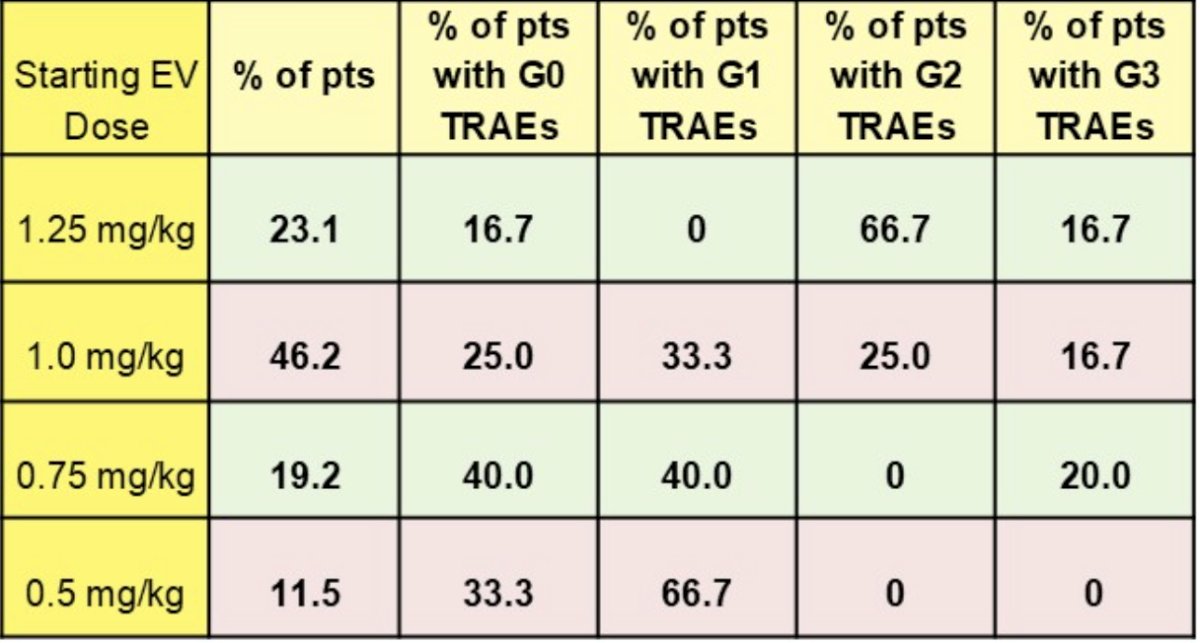
Specific treatment-related adverse events included neuropathy in 34.6% of patients, ocular symptoms in 19.2%, rash/pruritus/fatigue/abnormal electrolytes in 15.4% each, nausea and diarrhea in 3.8% each.
Dr. Mar concluded her presentation discussing real world toxicity profile of enfortumab vedotin with or without pembrolizumab in ultra elderly urothelial carcinoma patients with the following take-home points:
- Despite its small sample size and retrospective nature, this dataset did not identify any excessive or unexpected toxicity in the ultra elderly population
- More patients in groups 2 and 3 received up-front enfortumab vedotin dose reduction, with less grade 2/3 treatment-related adverse events noted at lower starting enfortumab vedotin doses
- Up-front dose reduction of enfortumab vedotin may be a good strategy to mitigate treatment-related adverse event risk
Presented by: Nataliya Mar, MD, University of California Irvine, Irvine, CA
Written by: Zachary Klaassen, MD, MSc – Urologic Oncologist, Associate Professor of Urology, Georgia Cancer Center, Wellstar MCG Health, @zklaassen_md on Twitter during the 2025 Genitourinary (GU) American Society of Clinical Oncology (ASCO) Annual Meeting, San Francisco, CA, Thurs, Feb 13 – Sat, Feb 15, 2025.
Reference: