

(UroToday.com) The 2025 GU ASCO annual meeting featured a urothelial carcinoma session and a presentation by Dr. Prateek Jain discussing clinical efficacy of enfortumab vedotin-pembrolizumab in locally advanced or metastatic urothelial carcinoma. The combination of enfortumab vedotin + pembrolizumab therapy has recently been approved as first line therapy for patients with locally advanced or metastatic urothelial carcinoma based on the results of the EV-302 trial.1
This trial demonstrated significant efficacy and survival benefits. However, real world data on the combination use outside of clinical trials remains limited. At the GU ASCO 2025 annual meeting, Dr. Jain and colleagues reported updated results from a cohort of patients with locally advanced or metastatic urothelial carcinoma who received enfortumab vedotin + pembrolizumab in a real world clinical setting.
This retrospective study included patients with locally advanced or metastatic urothelial carcinoma (July 2022 to August 2024) at the Mayo Clinic who completed at least one cycle of enfortumab vedotin + pembrolizumab. The best overall response was evaluated using radiographic imaging and was adjudicated as complete response, partial response, stable disease, mixed response, or progressive disease. The median progression free survival, defined as the time from treatment initiation to disease progression or death, was estimated using the Kaplan-Meier method. Patients who had not experienced disease progression by their last follow-up were censored for the progression free survival analysis. The median overall survival was defined as the time from treatment initiation to death from any cause. The analysis cut off date was October 11, 2024.
A total of 120 patients were included: 79 (65.8%) were males, 41 (34.1%) females, 109 (91%) White, and 119 (99%) were non-Hispanic/Latino. The median age was 72 years (IQR: 65-77). Of these patients, only 22 (18.3%) had locally advanced disease while the remaining had metastatic urothelial carcinoma. This included 62 (51.6%) patients that had lower tract urothelial carcinoma and 36 (30%) with upper tract urothelial carcinoma: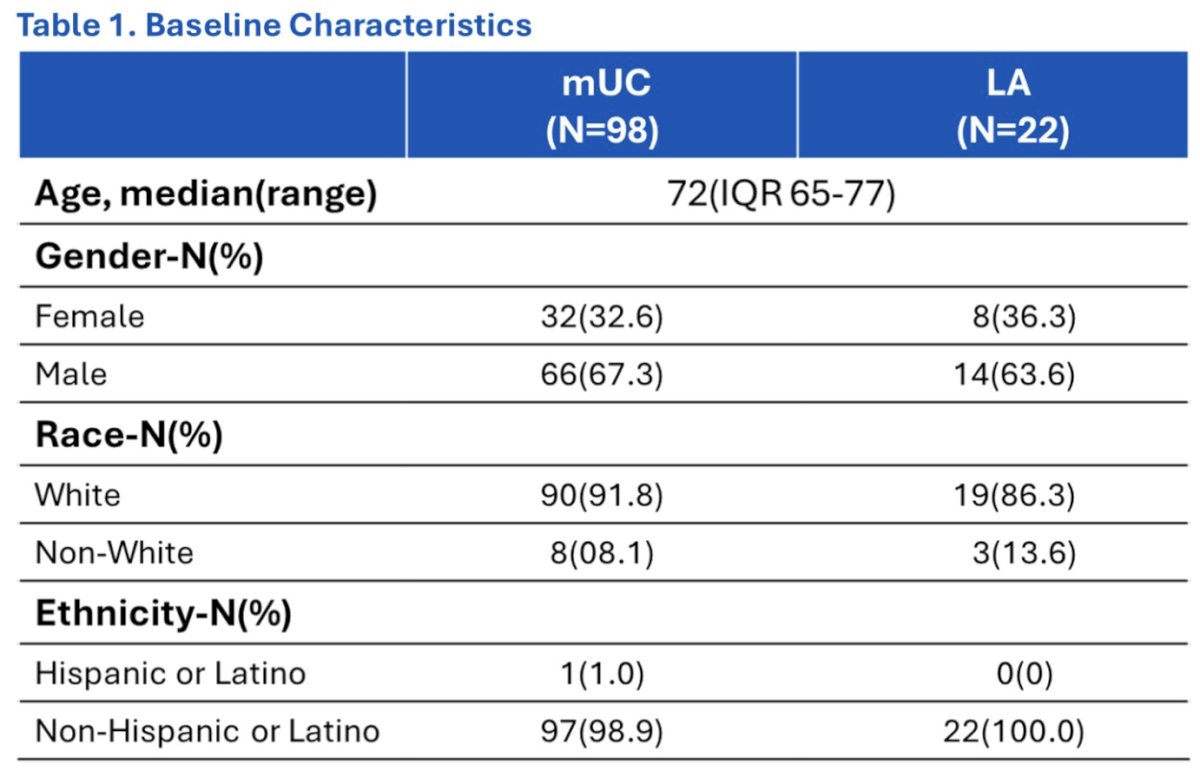
The median follow-up time was 7.1 months (IQR: 4.93-9.26). For best overall response, 56 patients (46.6%) experienced partial response, 34 (28.3%) complete response, 12 (10%) progressive disease, 7 (5.8%) mixed response, and 8 (6.6%) experienced stable disease (3 patients were not evaluable). The best overall response across subgroups, locally advanced and metastatic urothelial carcinoma, including lower tract urothelial carcinoma and upper tract urothelial carcinoma, is summarized as follows: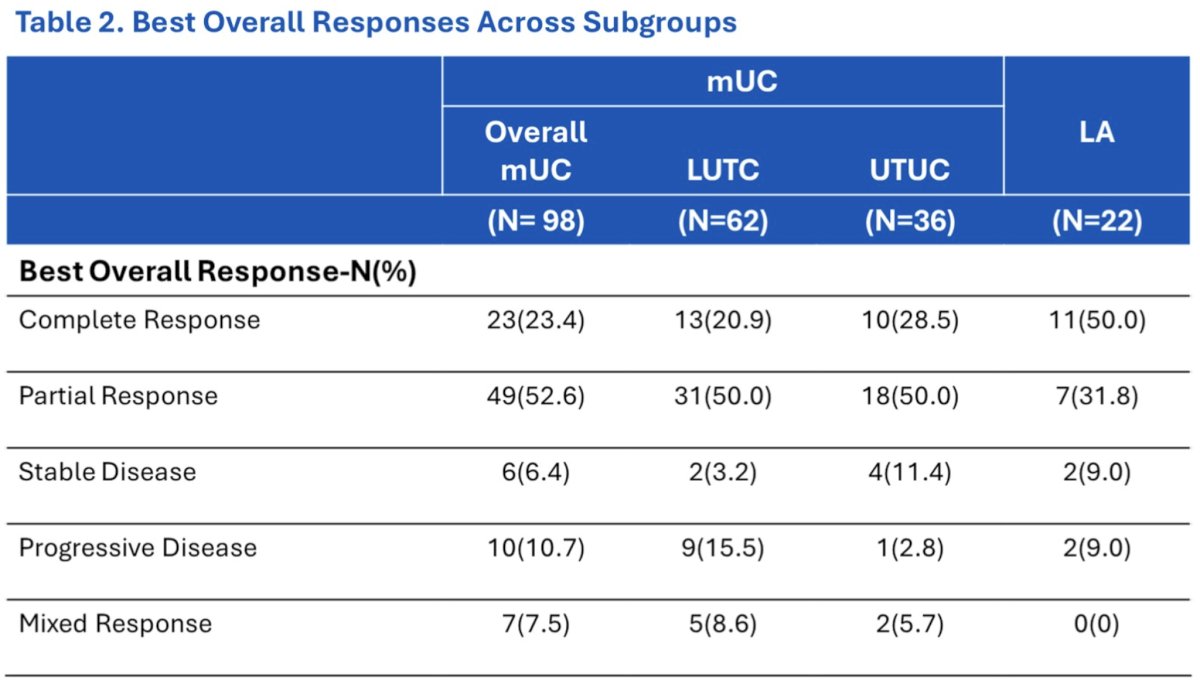
Among the responders, the median number of treatment cycles to first response was 3 (IQR: 2.25–4). Within the follow-up, 28 patients (23.3%) experienced eventual radiographic disease progression, with death being observed in 25 patients (20.8%). The median progression free survival was 12.7 months (95% CI: 9.8-NE):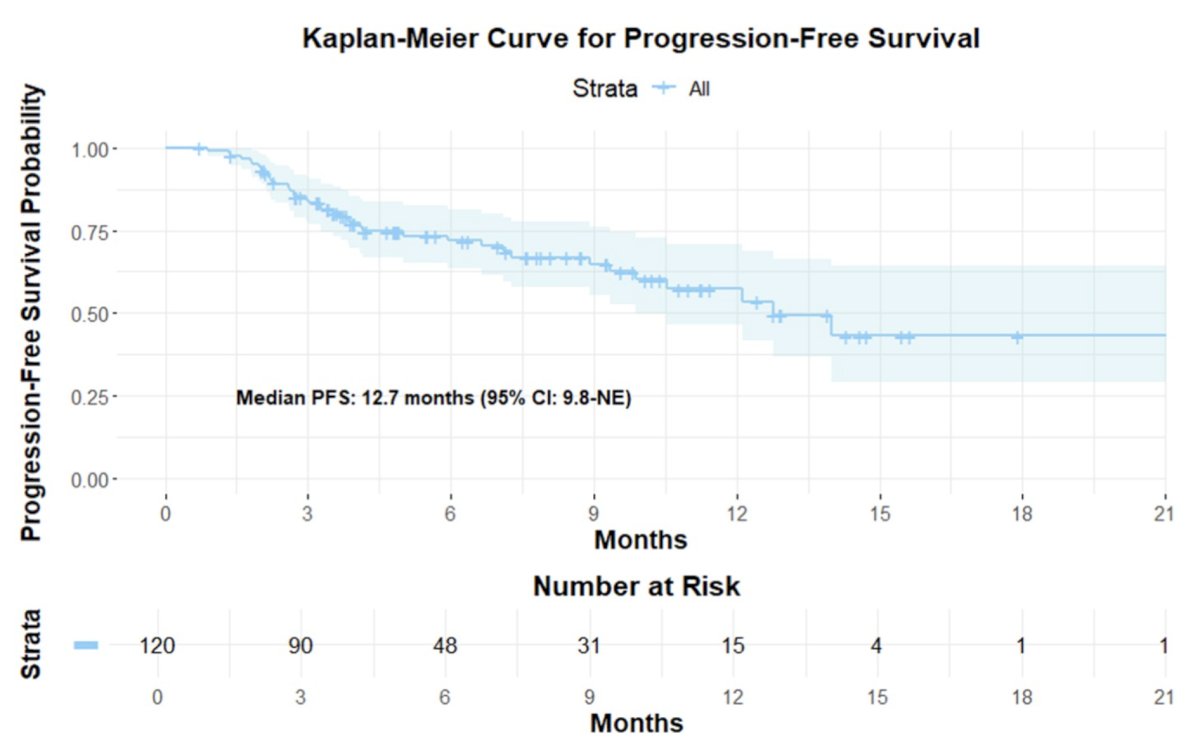
The median overall survival was 25.1 months (16.3-NE):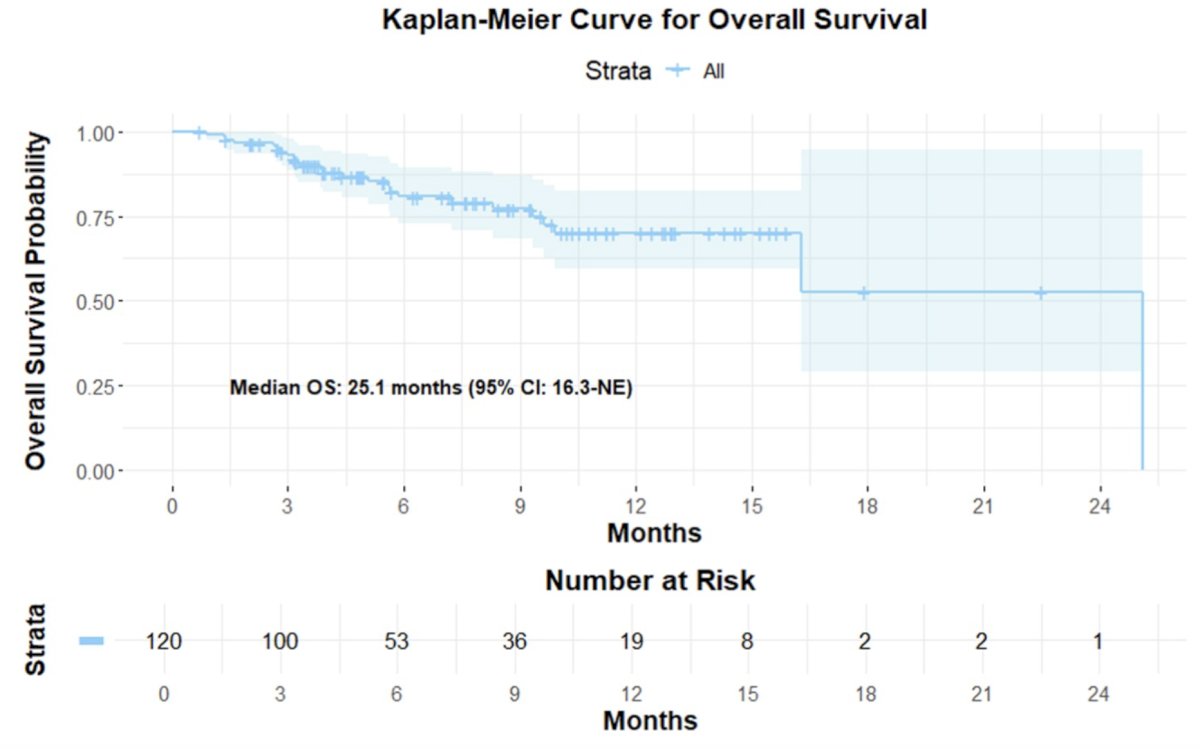
Dr. Jain concluded his presentation discussing clinical efficacy of enfortumab vedotin-pembrolizumab in locally advanced or metastatic urothelial carcinoma with the following take-home points:
- In a real world setting, the combination of enfortumab vedotin + pembrolizumab in locally advanced or metastatic urothelial carcinoma demonstrated clinical efficacy compatible with the findings from the EV-302 trial, with consistent and favorable outcomes across both upper tract urothelial carcinoma and lower tract urothelial carcinoma subgroups
- These findings underscore the broad therapeutic potential of enfortumab vedotin + pembrolizumab for patients with locally advanced or metastatic urothelial carcinoma
- Despite these promising results, further investigation with extended follow-up is essential to fully assess overall survival and the durability of response, which will provide a clearer understanding of the long term benefits and the sustainability of treatment efficacy
Presented by: Prateek A. Jain, MD, MS, Mayo Clinic, Phoenix, AZ
Written by: Zachary Klaassen, MD, MSc – Urologic Oncologist, Associate Professor of Urology, Georgia Cancer Center, Wellstar MCG Health, @zklaassen_md on Twitter during the 2025 Genitourinary (GU) American Society of Clinical Oncology (ASCO) Annual Meeting, San Francisco, CA, Thurs, Feb 13 – Sat, Feb 15, 2025.
Reference: