

(UroToday.com) The 2025 American Society of Clinical Oncology (ASCO) Genitourinary (GU) Annual Symposium held in San Francisco, CA between February 13–15, 2025 was host to a urothelial carcinoma poster session. Dr. Philippe Barthelemy presented the results of an observational, multicenter, real-world study, the STATES-Bladder study, of treatment sequences and overall survival in metastatic urothelial carcinoma (mUC) patients.
mUC remains a challenging disease with a poor prognosis despite the approval/availability of several therapeutic options, including first-line platinum-based chemotherapy (PBC), immune checkpoint inhibitors (ICI; avelumab maintenance, pembrolizumab 2nd line), enfortumab vedotin (EV) and erdafitinib in later lines.
However, only a subset of patients will be able to receive the full treatment sequence due to attrition. Large randomized clinical trials enrolled a select population of patients, based on strict inclusion/exclusion criteria. Some patients are excluded based on comorbidities (e.g., renal insufficiency, recent cardiovascular event), sites of metastatic disease (e.g., brain), or a poor performance status (PS), such as ECOG PS 2-3. This population is often underrepresented in clinical trials, and this is exemplified in the pivotal EV-302 study, whereby only 3.4% of enrolled patients were ECOG PS 2.1
The STATES-Bladder study aims to assess OS and treatment outcomes in real-world practice, with particular attention to attrition rates and outcomes in patients with poor PS.
This was a retrospective, multicenter, observational study at 5 French centers, including 180 patients with mUC treated with first-line platinum-based chemotherapy between January 2020 and December 2023. The primary outcome was OS in the overall population. Secondary outcomes included:
- OS by treatment sequence
- Attrition rates
- Comparison of outcomes between ECOG 0-1 and ECOG 2-3 patients
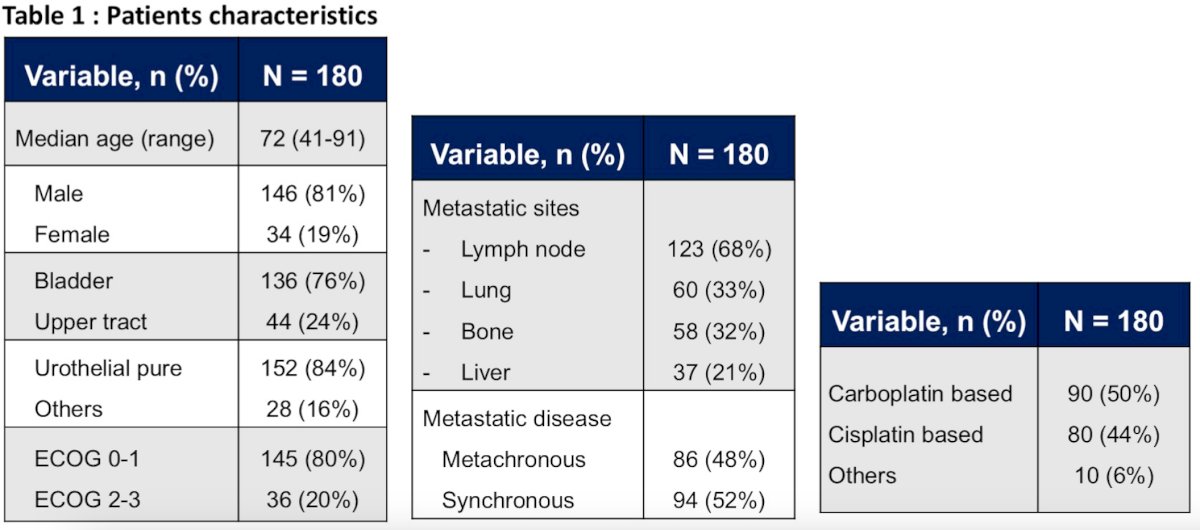
The baseline patient characteristics are summarized below. The median patient age was 72 years. 81% were male. 20% had ECOG PS 2–3. The most common site of metastatic disease was the lymph nodes (68%), followed by lung (33%) and bone (32%). 50% of patients received carboplatin-based and 44% received cisplatin-based chemotherapy.
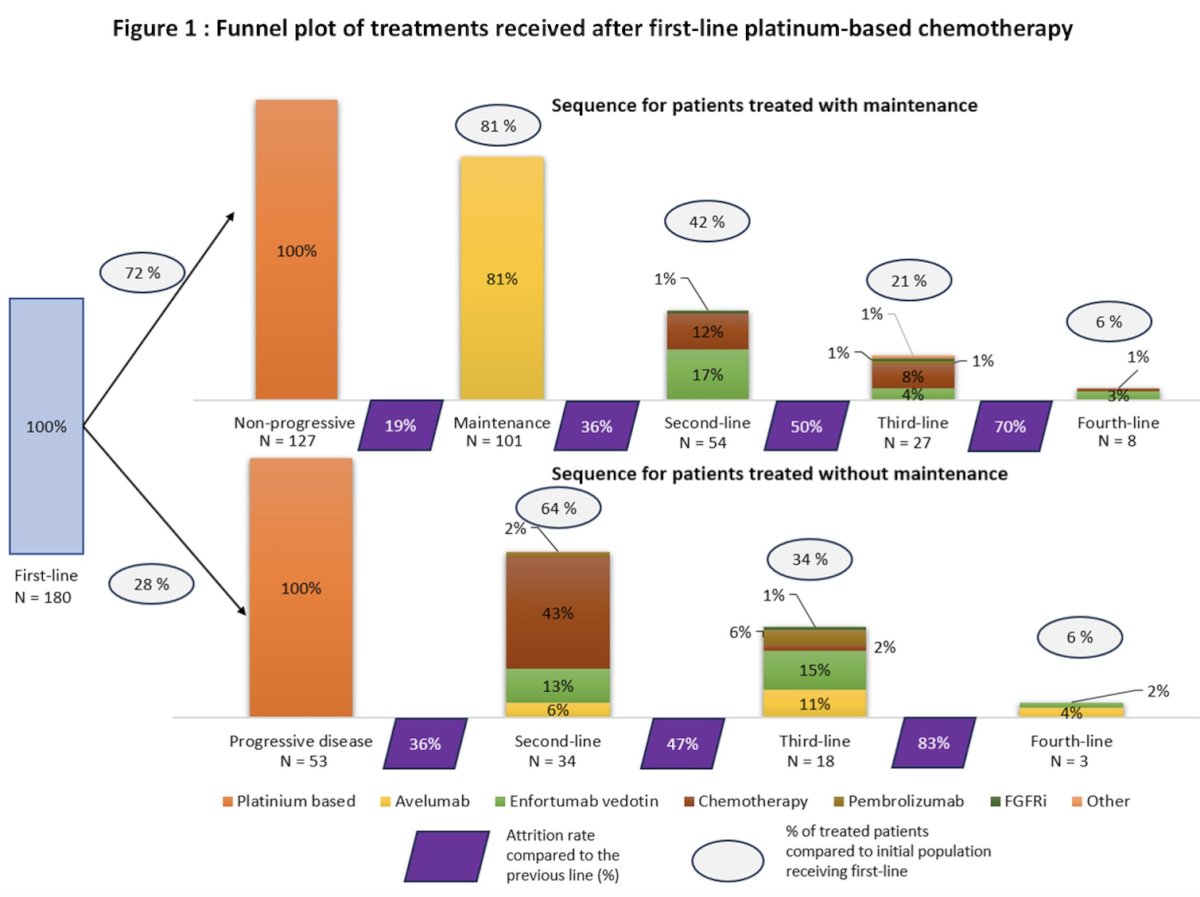
Illustrated below is a funnel plot of treatments received after 1st line platinum-based chemotherapy. Avelumab maintenance was given to 61% of patients initially treated with carboplatin-based chemotherapy and 65% of those receiving cisplatin-based chemotherapy. Attrition rates were 57% after first-, 37% after second-, and 9% after third-line therapy.
The median follow-up for the study cohort was 29.6 months. For the overall population, the median OS was 22.4 months. Patients receiving avelumab maintenance had a median OS of 29 months, while those progressing to second-line therapy showed a median OS of 15.6 months.
The median OS for patients treated with EV at any treatment line was 26.1 months. Patients with ECOG PS 0-1 had a significantly better median OS of 26.4 months, compared to 7.2 months for those with ECOG PS 2-3 (p<0.001).

Dr. Barthelemy concluded as follows:
- Real-world survival outcomes align with findings from large phase III trials.
- High attrition rates highlight the challenges of maintaining patients on treatment.
- Patients with ECOG PS 2-3 have a very poor prognosis and are often excluded from pivotal phase III trials, underscoring the need for innovative therapies. New treatment strategies are essential to improve outcomes for this subgroup of patients.
Presented by: Philippe Barthelemy, MD, Professor at the University of Bordeaux and Director of ARNA in Bordeaux, France.
Written by: Rashid K. Sayyid, MD, MSc – Robotic Urologic Oncology Fellow at The University of Southern California, @rksayyid on Twitter during the 2025 Genitourinary (GU) American Society of Clinical Oncology (ASCO) Annual Meeting, San Francisco, CA, Thurs, Feb 13 – Sat, Feb 15, 2025.
References: