

(UroToday.com) The 2025 American Society of Clinical Oncology (ASCO) Genitourinary (GU) Annual Symposium held in San Francisco, CA was host to a urothelial carcinoma poster session. Dr. Shingo Hatakeyama presented the results of a real-world, multicenter retrospective study evaluating the efficacy and safety of enfortumab vedotin (EV) in patients with locally advanced or metastatic urothelial carcinoma.
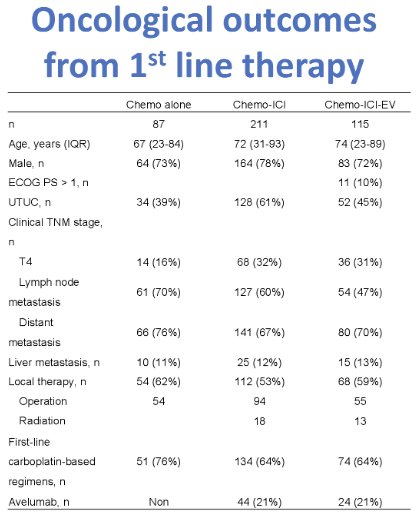
This multicenter retrospective study included 419 patients treated for locally advanced or metastatic urothelial carcinoma between April 2004 and April 2024. The patients were categorized into one of three groups:
- Patients who underwent first-line chemotherapy and sequential chemotherapy alone (chemo-alone group): n=87
- Patients who underwent maintenance immunotherapy or second-line immunotherapy after first-line chemotherapy (chemo-ICI group): n=217
- Patients who were treated with EV after first-line chemotherapy and immunotherapy (chemo-ICI-EV group): n=115
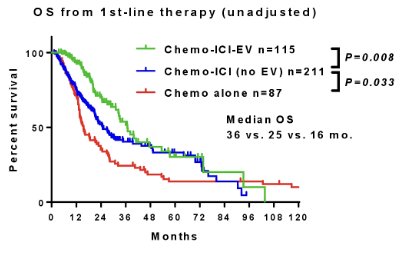
The primary objective was to compare progression-free survival (PFS) and overall survival (OS) between the three treatment groups, with the index date defined as the start of 1st line therapy. Secondary outcomes included the efficacy and safety in the chemo-ICI-EV group, focusing on skin adverse events (AEs).
The baseline patient characteristics by treatment group are summarized below:
The OS from start of first-line therapy was significantly longer in the chemo-ICI-EV group, compared to that in the other groups.
There was no significant difference in the first-line PFS of first-line therapy between the three groups. A multivariable Cox regression analysis showed the administration of EV was significantly associated with prolonged OS.
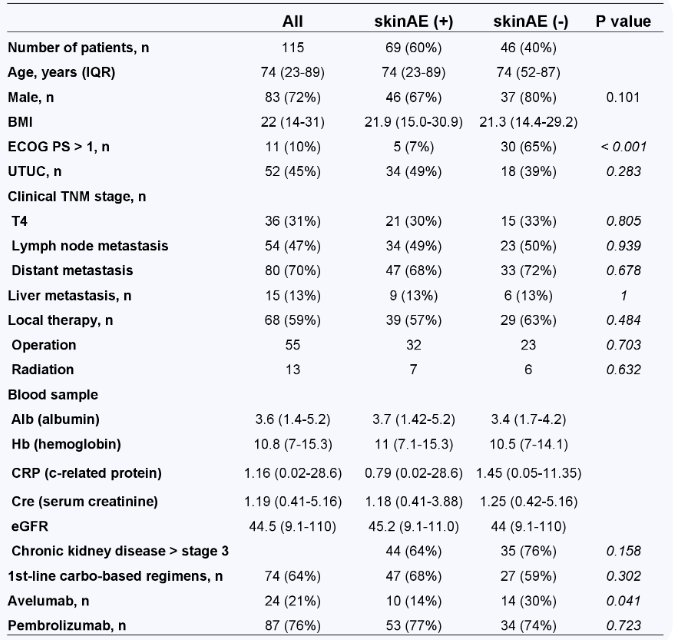
Skin AEs were observed in 69 (60%) as a major adverse event. The PFS and OS in the patients with skin AEs were significantly longer than in the patients without skin AEs, despite the reduced dose of EV. A multivariable Cox regression analysis showed that skin AEs were significantly associated with prolonged RFS and OS.
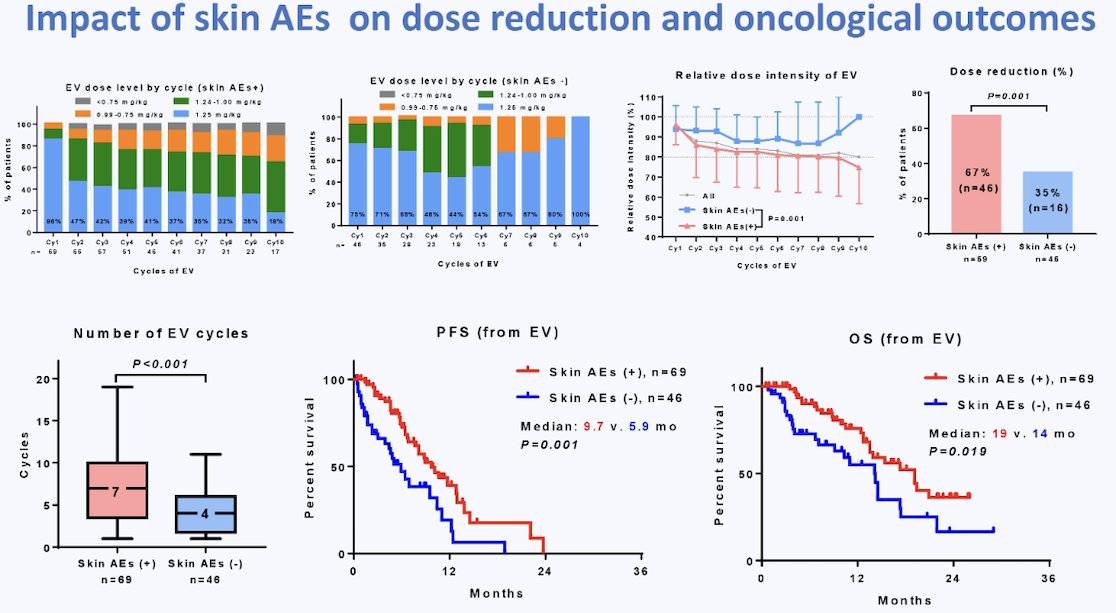
Dr. Hatakeyama concluded that the use of EV significantly improved outcomes. While skin AEs often lead to dose reductions, dose adjustment of EV may be key for long-term use and optimizing outcomes. The retrospective design of this study is a notable limitation.
Presented by: Shingo Hatakeyama, MD, Professor, Department of Urology, Hirosaki University Graduate School of Medicine, Hirosaki, Japan.
Written by: Rashid K. Sayyid, MD, MSc – Robotic Urologic Oncology Fellow at The University of Southern California, @rksayyid on Twitter during the 2025 Genitourinary (GU) American Society of Clinical Oncology (ASCO) Annual Meeting, San Francisco, CA, Thurs, Feb 13 – Sat, Feb 15, 2025.
Related content: Real-World Safety Profiles of First-Line Therapies for Advanced Urothelial Carcinoma - Amanda Nizam