

(UroToday.com) The 2022 Genitourinary American Society of Clinical Oncology (ASCO) Annual meeting included a prostate cancer session featuring work from Dr. Kim Chi and colleagues presenting results of the effect of prior docetaxel treatment on efficacy and safety of apalutamide plus ADT in patients with metastatic castration sensitive prostate cancer (mCSPC) from the phase 3 TITAN trial1. The addition of androgen receptor signaling inhibitors to ADT + docetaxel has been shown to improve clinical outcomes in patients with mCSPC. TITAN, a placebo-controlled phase 3 study, showed that apalutamide + ADT improved overall survival and other clinical outcomes in mCSPC2. This post hoc analysis of TITAN, presented at GU ASCO 2022, evaluated outcomes in patients who had received docetaxel prior to treatment with apalutamide + ADT versus those who did not.
In TITAN, 1,052 patients were randomized 1:1 to apalutamide (240 mg QD) or placebo added to ongoing ADT. This study assessed radiographic progression-free survival (rPFS), overall survival, and time to PSA progression in patients receiving docetaxel and ADT prior to adding apalutamide vs those receiving only ADT + apalutamide. Outcomes by prior docetaxel were also assessed in patients with high- or low-volume disease at randomization (baseline) per adapted CHAARTED criteria or those with matched baseline characteristics. A Cox proportional hazards model was used to derive hazard ratios and p values. rPFS was assessed using the first interim analysis cutoff (23-month median follow-up); overall survival and time to PSA progression were assessed using the final analysis cutoff (44-month median follow-up).
A total of 58/525 (11%) patients from the apalutamide + ADT group had received docetaxel prior to randomization:
- 76% (n = 44) had high-volume disease
- 62% (n = 36) had bone-only metastases
- 16% (n = 9) had visceral metastases
- 59% (n = 34) had > 10 bone lesions
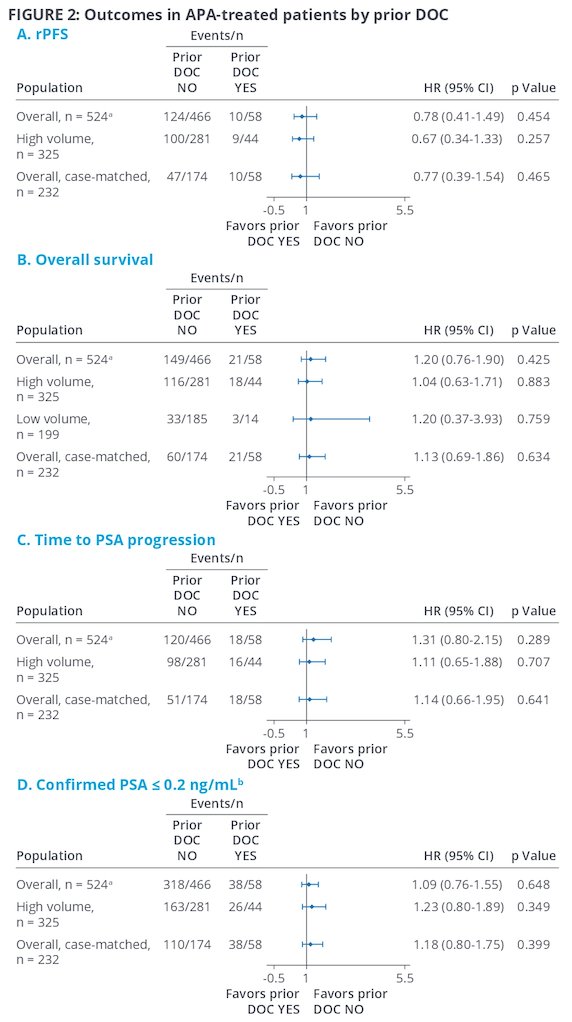
In the overall apalutamide-treated population and in the subset of patients with high-volume disease, overall survival, rPFS, and time to PSA progression were similar in those who received prior docetaxel and those who did not:
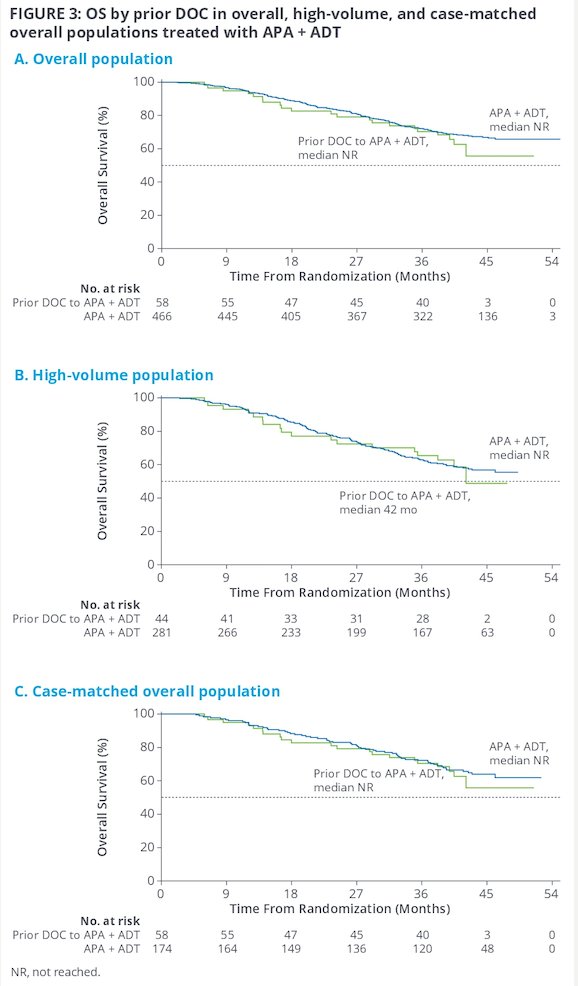
Patients with low-volume disease also had similar results, although the number of patients was small. Clinical outcomes in patients with matched baseline characteristics (including PSA and time from initial diagnosis to randomization, among others) were similar regardless of prior use of docetaxel:
The safety profile of apalutamide was not substantially different between patients with or without prior docetaxel. Limitations of this analysis include (i) lack of data on tumor volume and other disease characteristics at the initiation of prior docetaxel treatment, and (ii) interpretation was based on a small number of patients with prior docetaxel (only 11% of TITAN patients), most notably in the rPFS analysis.
Dr. Chi concluded this presentation assessing the effect of prior docetaxel treatment on efficacy and safety of apalutamide plus ADT in patients with mCSPC from the TITAN trial with the following concluding statements:
- This post hoc analysis of TITAN showed that prior use of docetaxel in patients with mCSPC, did not further improve rPFS, OS, time to PSA progression, or achievement of deep PSA response <= 0.2 ng/mL following initiation of treatment with apalutamide + ADT
- The use of docetaxel did not affect the safety profile of apalutamide
- Prospective studies are required to fully elucidate the effect of chemotherapy on the efficacy of apalutamide + ADT
Presented By: Kim N. Chi, MD, BC Cancer, and Vancouver Prostate Centre, Vancouver, BC, Canada
Written By: Zachary Klaassen, MD, MSc – Urologic Oncologist, Assistant Professor of Urology, Georgia Cancer Center, Augusta University/Medical College of Georgia, @zklaassen_md on Twitter during the 2022 Genitourinary (GU) American Society of Clinical Oncology (ASCO) Annual Meeting, San Francisco, Thurs, Feb 17 – Sat, Feb 19, 2022.
Co-Authors: Axel Merseburger, Mustafa Ozguroglu, Simon Chowdhury, Anders Bjartell, Byung Chung, Andrea Pereira de Santana Gomes, Robert Given, Álvaro Juárez, Hirotsugu Uemura, Dingwei Ye, Lawrence Ivan Karsh, Benjamin Adam Gartrell, Sabine D. Brookman-May, Suneel Mundle, Sharon Anne McCarthy, Florence Lefresne, Oliver Brendan Rooney, Amitabha Bhaumik, Neeraj Agarwal
Affiliations: BC Cancer and Vancouver Prostate Centre, Vancouver, BC, Canada, Universitätsklinikum Schleswig-Holstein, Campus Lüebeck, Istanbul University-Cerrahpaşa, Cerrahpaşa School of Medicine, Guy's, King's, and St. Thomas' Hospitals, and Sarah Cannon Research Institute, London, United Kingdom, Skåne University Hospital, Lund University, Yonsei University College of Medicine and Gangnam Severance Hospital, Seoul, South Korea, Liga Norte Riograndense Contra O Câncer, Urology of Virginia, Eastern Virginia Medical School, Norfolk, VA, Hospital Universitario de Jerez de la Frontera, Kindai University Hospital Faculty of Medicine, Osaka, Japan, Fudan University Shanghai Cancer Center, Shanghai, China, The Urology Center of Colorado, Denver, CO, Montefiore Medical Center, Bronx, NY, Ludwig-Maximilians-University (LMU), Munich, Germany, Janssen Research & Development, Los Angeles, CA, Janssen Research & Development, Raritan, NJ, Janssen Research & Development, Los Angeles, CA, Janssen Research & Development, High Wycombe, United Kingdom, Janssen Research & Development, Titusville, NJ, Huntsman Cancer Institute, University of Utah, Salt Lake City, UT
References:
- Chi KN, Agarwal N, Bjartell A, et al. Apalutamide for metastatic, castration-sensitive prostate cancer. N Engl J Med 2019 Jul 4;381(1):13-24.
- Chi KN, Chowdhury S, Bjartell A, et al. Apalutamide in patients with metastatic castration-sensitive prostate cancer: Final survival analysis of the randomized, double-blind, phase III TITAN study. J Clin Oncol. 2021 Jul 10;39(20):2294-2303.