

(UroToday.com) The 2026 American Society of Clinical Oncology (ASCO) Annual Meeting was host to a prostate, testicular, and penile cancers poster session. Dr. Xinglei Shen presented results evaluating image-only and multimodal artificial intelligence (MMAI) digital pathology biomarkers for risk stratification across standard localized prostate cancer management strategies.
Accurate risk stratification remains central to treatment selection and prognostication in localized prostate cancer, particularly as precision medicine approaches continue to evolve. Although clinicopathologic variables such as Gleason grade group, PSA, and tumor stage are routinely used to guide management decisions, there is growing interest in artificial intelligence-based pathology platforms capable of extracting additional prognostic information directly from routine hematoxylin and eosin (H&E) slides. The study investigators had previously developed and validated a multimodal artificial intelligence model integrating digitized H&E biopsy slides with clinical variables to predict distant metastasis (DM) and prostate cancer-specific mortality (PCSM). To better define the independent prognostic value of histopathology alone, the authors developed an image-only AI model that excluded clinical variables and evaluated both approaches across multiple standard treatment pathways.
The image-only model was trained to estimate 10-year DM risk using digitized prostate biopsy slides without clinical inputs. Both the image-only and MMAI models were subsequently evaluated in a multi-institutional cohort of men with non-metastatic prostate cancer treated with guideline-concordant active surveillance (AS), radical prostatectomy (RP), or radiation therapy (RT). The primary endpoint was 10-year DM risk, with PCSM evaluated as a secondary endpoint. Prognostic associations within each treatment subgroup were assessed using Fine–Gray competing risk models.

Among evaluable patients, 886 had image-only scores, and 911 had MMAI scores. Approximately 36% of patients underwent AS, 41% RP, and 23% RT.

The image-only model demonstrated consistent prognostic performance for DM across all treatment modalities. Using continuous raw scores, higher image-only scores were significantly associated with increased DM risk among patients managed with:
- AS (subdistribution hazard ratio [sHR] 2.38, p < 0.001)
- RP (sHR 1.99, p < 0.001)
- RT (sHR 2.84, p < 0.001).
Similarly, calibrated image-only scores maintained significant prognostic associations across all treatment groups.
The MMAI model likewise demonstrated robust and consistent prognostic performance across management strategies. Using raw MMAI scores, significant associations with DM risk were observed in patients treated with AS (sHR 2.87, p < 0.001), RP (sHR 2.12, p < 0.001), and RT (sHR 2.73, p < 0.001). Calibrated MMAI scores similarly maintained prognostic significance across treatment modalities.
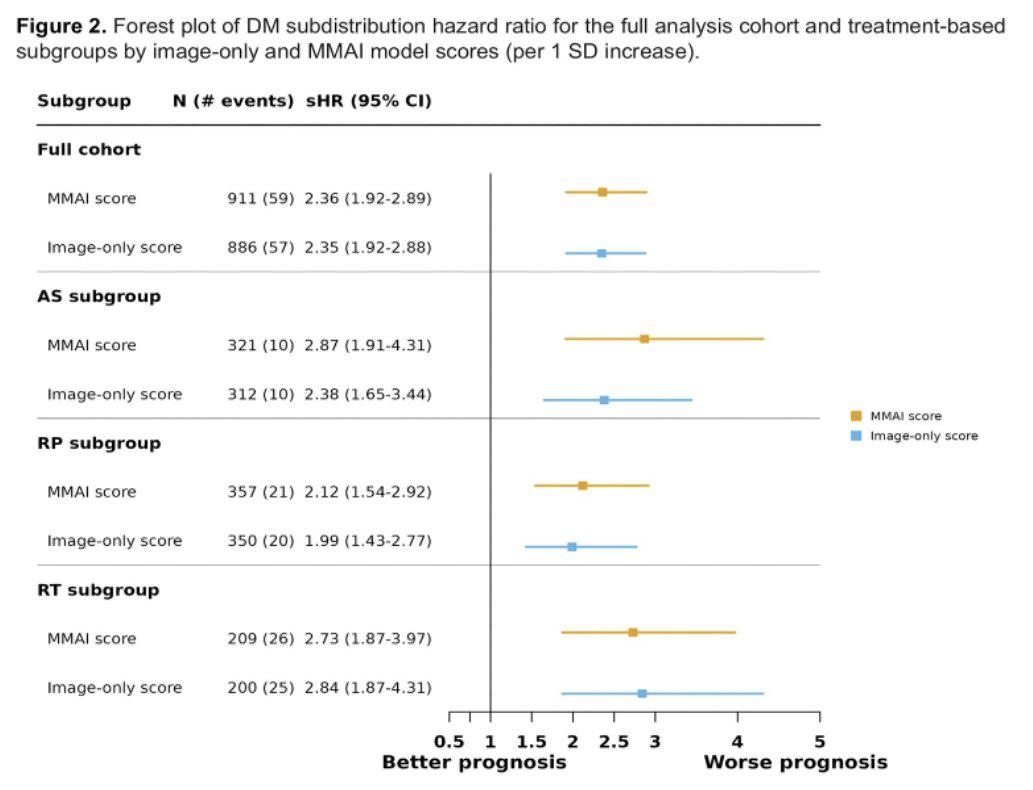
Both image-only and MMAI biomarkers were also significantly associated with PCSM despite relatively low event rates, further supporting the biologic and clinical relevance of AI-derived histopathologic features.
The investigators concluded that both image-only and MMAI digital pathology biomarkers demonstrated consistent prognostic performance across standard prostate cancer treatment strategies, including AS, RP, and RT. These findings suggest that routinely available H&E pathology contains substantial clinically meaningful prognostic information that can be extracted using AI-based approaches, even in the absence of additional clinical variables.
From a broader clinical perspective, these results are notable because they support the potential generalizability of AI-driven pathology biomarkers irrespective of eventual treatment selection. Unlike many prognostic tools developed within single-treatment cohorts, both the image-only and MMAI platforms maintained performance across surveillance, surgical, and radiation-based management strategies. This raises the possibility that AI-derived pathology biomarkers could eventually complement existing clinicopathologic risk stratification tools to improve individualized counseling, treatment selection, and long-term outcome prediction in localized prostate cancer.
Presented by: Xinglei Shen, MD, MS, Radiation Oncologist, University of Kansas Medical Center, Kansas City, KS, USA
Written by: Rashid K. Sayyid, MD, MSc, Assistant Professor, Urologic Oncologist, Department of Urology at The University of Arizona and Banner University Medical Center, Tucson, AZ – @rksayyid on X during the American Society of Clinical Oncology Genitourinary (ASCO) Annual Meeting held in Chicago, IL between May 29th and June 1st, 2026