

(UroToday.com) The 2026 ASCO annual meeting featured a kidney cancer rapid abstract session and a presentation by Dr. Darren Feldman discussing the final results of a phase 2 trial of cabozantinib + nivolumab in patients with non-clear cell renal cell carcinoma (RCC). Non-clear cell RCC accounts for ~25% of metastatic kidney tumors and is comprised of at least 20 distinct tumor histologies.
Although understudied, available evidence suggests patients with non-clear cell RCC experience inferior objective response rate, progression-free survival, and overall survival versus those with clear cell RCC, especially with single-agent VEGFR TKIs. Cabozantinib + nivolumab improved objective response rate, progression-free survival, and overall survival over sunitinib in a phase 3 trial for metastatic clear cell RCC.1 Dr. Feldman and colleagues previously reported on 47 patients treated on a phase 2 trial of cabozantinib + nivolumab for non-clear cell RCC,2 and at ASCO 2026, presented the final results on all 60 patients accrued to the study.
Patients had advanced non-clear cell RCC, 0 or 1 prior systemic therapies excluding prior immune checkpoint inhibitors, and measurable disease by RECIST. Cabozantinib 40 mg/day + nivolumab 240 mg every 2 weeks or 480 mg every 4 weeks was given across two cohorts:
- Cohort 1: papillary, unclassified, or translocation-associated RCC
- Cohort 2: chromophobe RCC
The primary endpoint was objective response rate by RECIST, and secondary endpoints included progression-free survival, overall survival, and safety. Cohort 1 was a single-stage design that met its primary endpoint and was expanded to produce more precise estimates of objective response rate. Cohort 2 was a Simon two-stage design that closed early for lack of efficacy and slow accrual.
Among 60 patients, 53 were included in Cohort 1, of whom 16 had papillary RCC, 16 unclassified RCC with papillary features, 8 FH-deficient, 8 unclassified without papillary features, and 5 translocation-associated RCC. In Cohort 1, 39 (74%) patients were previously untreated, and 14 (26%) patients had 1 prior line of therapy: 10 (19%) received prior VEGF-targeted therapy, and 8 (15%) received prior mTOR-targeted therapy: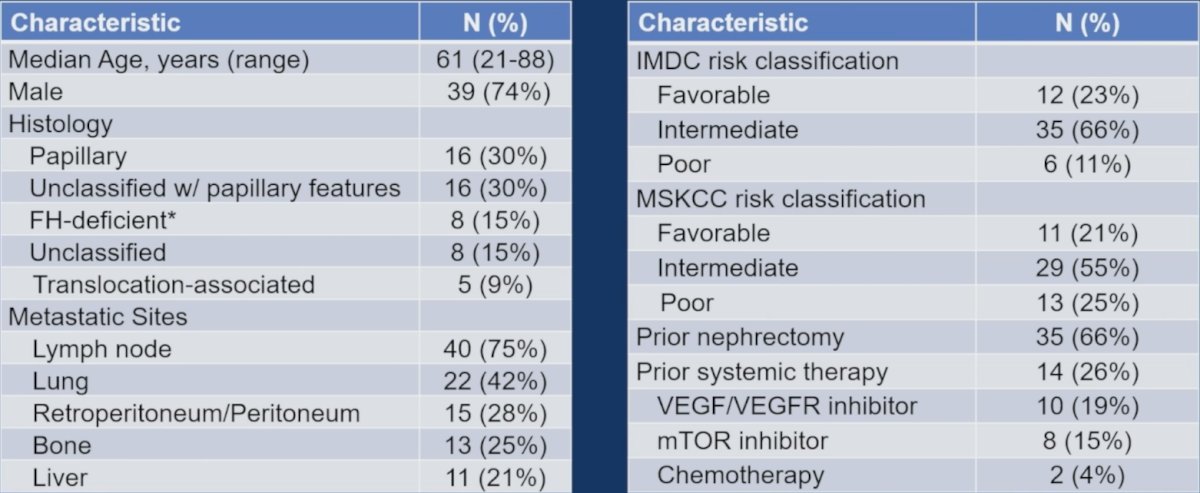
For Cohort 1, the objective response rate was 43% (95% CI 30-58), including 88% in patients with FH-deficient RCC: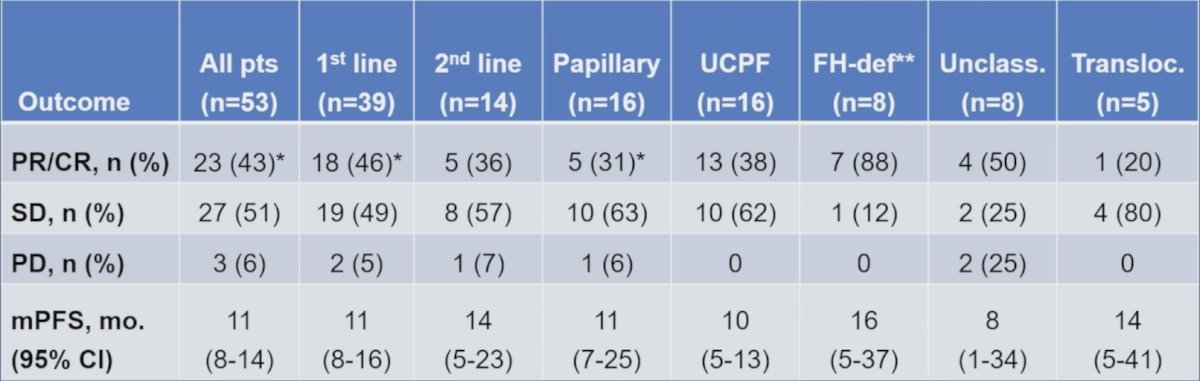
There were 81% of patients that had a tumor reduction per RECIST, and the median duration of response was 17 months (95% CI 10-26):
The median progression-free survival in Cohort 1 was 11 months (95% CI 8-14), the median overall survival was 28 months (95% CI 21-37), and there were 43 deaths after a median follow-up of 50 months for survivors: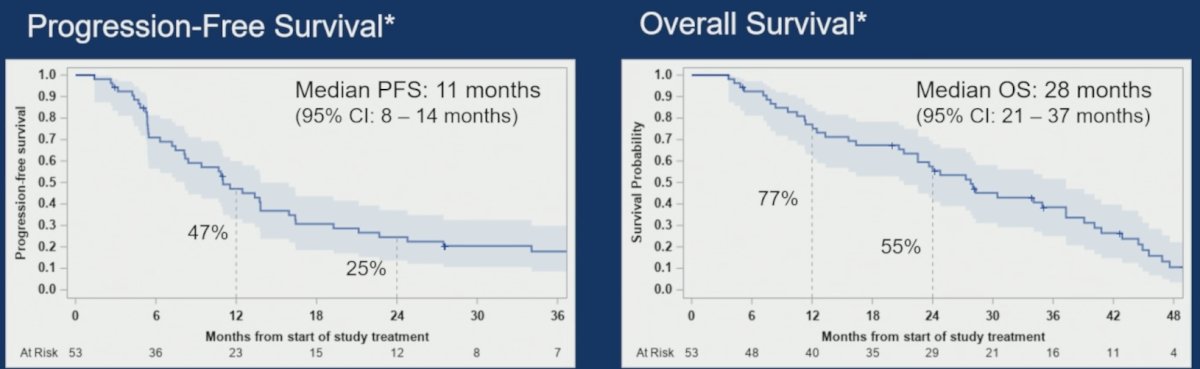
There were 7 patients with chromophobe RCC enrolled in Cohort 2, with 5 achieving stable disease, but no objective responses were observed. Adverse events were similar to the previously reported cohort and cabozantinib, and nivolumab were discontinued for toxicity in 22 (42%) and 20 (38%) patients, respectively: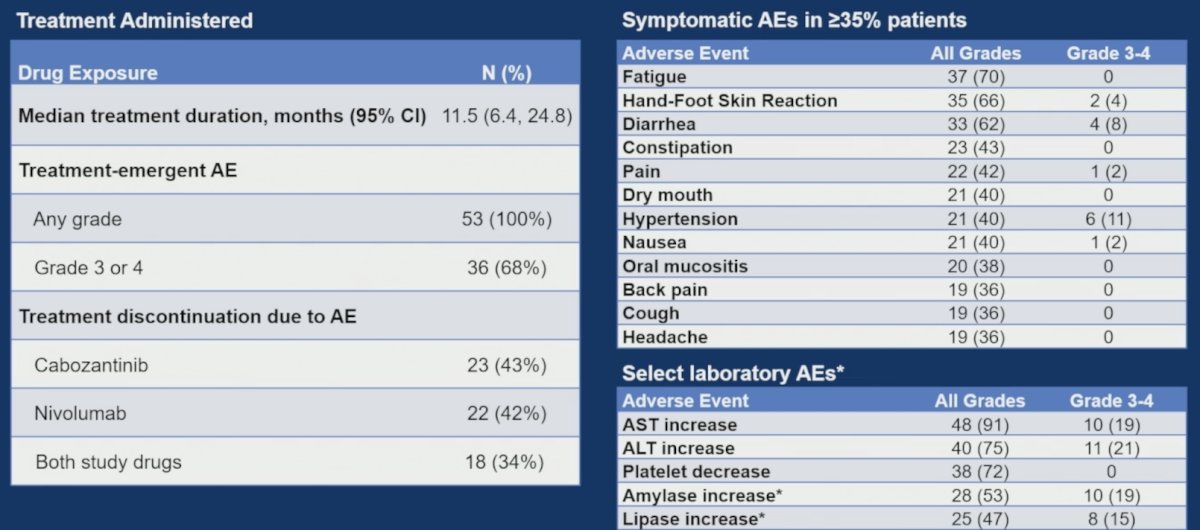
Dr. Feldman concluded his presentation discussing the final results of a phase 2 trial of cabozantinib + nivolumab in patients with non-clear cell RCC with the following take-home points:
- The final results with ~50 months follow-up and additional patients reaffirm antitumor activity for cabozantinib + nivolumab in non-clear cell RCC
- Responses were observed in treatment-naïve and previously treated patients, and across all histologies except chromophobe RCC; 7 of 8 patients with FH-deficient RCC achieved an objective response
- Adverse events were as previously reported, with no new safety signals
- The high response rate and safety profile support cabozantinib + nivolumab as a treatment option for patients with non-clear cell RCC histologies
Presented by: Darren R. Feldman, MD, Memorial Sloan Kettering Cancer Center, New York, NY
Written by: Zachary Klaassen, MD, MSc – Urologic Oncologist, Associate Professor of Urology, Georgia Cancer Center, Wellstar MCG Health, @zklaassen_md on Twitter during the American Society of Clinical Oncology Genitourinary (ASCO) Annual Meeting held in Chicago, IL between May 29th and June 1st, 2026
References:
- Choueiri TK, Powles T, Burotto M, et al. Nivolumab plus cabozantinib versus sunitinib for advanced renal-cell carcinoma. N Engl J Med. 2021 Mar 4;384(9):829-841.
- Lee CH, Voss MH, Carlo MI, et al. Phase II trial of cabozantinib plus nivolumab in patients with non-clear-cell renal cell carcinoma and genomic correlates. J Clin Oncol. 2022 Jul 20;40(21):2333-2341.