

(UroToday.com) The 2026 ASCO annual meeting featured a urothelial carcinoma session and a presentation by Dr. Petros Grivas discussing an updated subgroup analyses of JAVELIN Bladder Medley based on metastatic sites, assessing avelumab + sacituzumab govitecan versus avelumab monotherapy as first line maintenance treatment for advanced urothelial carcinoma. Avelumab first line maintenance is a recommended treatment option for patients with advanced urothelial carcinoma without progression after first line platinum based chemotherapy, based on results from the phase 3 JAVELIN Bladder 100 trial, which showed significantly improved efficacy with avelumab + best supportive care versus best supportive care alone.1 In the primary analysis of the JAVELIN Bladder Medley phase 2 trial, first line maintenance with avelumab + sacituzumab govitecan (Trop-2–directed antibody-drug conjugate) improved progression free survival versus avelumab monotherapy (primary endpoint: HR 0.54, 95% CI 0.36-0.81).2 In patients with advanced urothelial carcinoma, the presence of visceral metastases (including liver or lung) is associated with poorer prognosis. At the 2026 ASCO annual meeting, Dr. Grivas and colleagues reported updated subgroup analyses from the primary analysis of JAVELIN Bladder Medley based on metastatic site.
Patients with unresectable locally advanced or metastatic urothelial carcinoma without progression after 4-6 cycles of first line platinum based chemotherapy were randomized 2:1 to receive avelumab + sacituzumab govitecan or avelumab monotherapy, stratified by presence of visceral metastases at the start of first line platinum based chemotherapy. Non-visceral metastasis was defined as locally advanced disease or non-visceral metastases only, including lymph node only disease. Bone disease was considered non-visceral metastases:
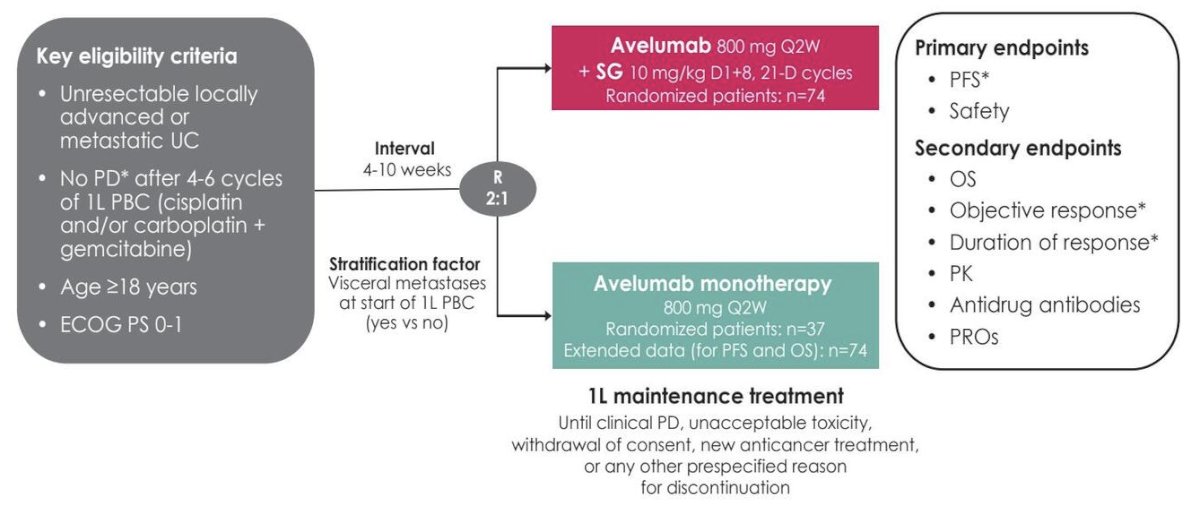
The primary endpoints were investigator-assessed progression free survival (measured from randomization) and safety, and overall survival was a secondary endpoint. For visceral and non-visceral subgroups, progression free survival and overall survival data in the avelumab monotherapy arm were extended per protocol using propensity score–weighted data from the JAVELIN Bladder 100 phase 3 trial;1 extended data were not available for other subgroups.
At the start of first line platinum based chemotherapy, of 74 and 37 patients in the avelumab + sacituzumab govitecan and avelumab monotherapy arms, respectively:
- 37 (50.0%) and 19 (51.4%) had visceral metastases
- 20 (27.0%) and 11 (29.7%) had lung metastases
- 17 (23.0%) and 7 (18.9%) had liver metastases
- 17 (23.0%) and 11 (29.7%) had bone metastases
- 26 (35.1%) and 11 (29.7%) had lymph node–only disease
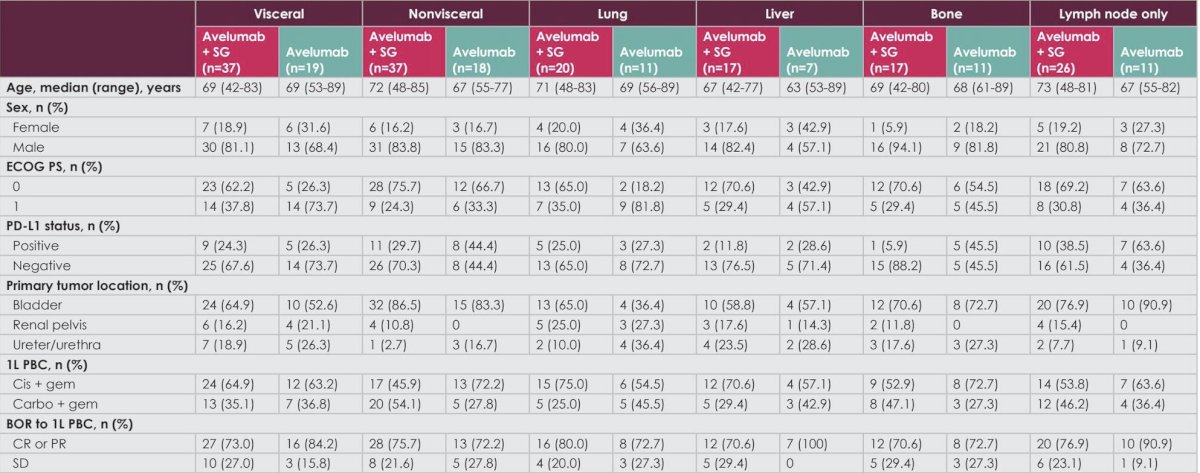
The baseline characteristics are noted in the following table. Across subgroups, the avelumab monotherapy arm had a higher proportion of patients with an ECOG performance status of 1 than the avelumab + sacituzumab govitecan arm:
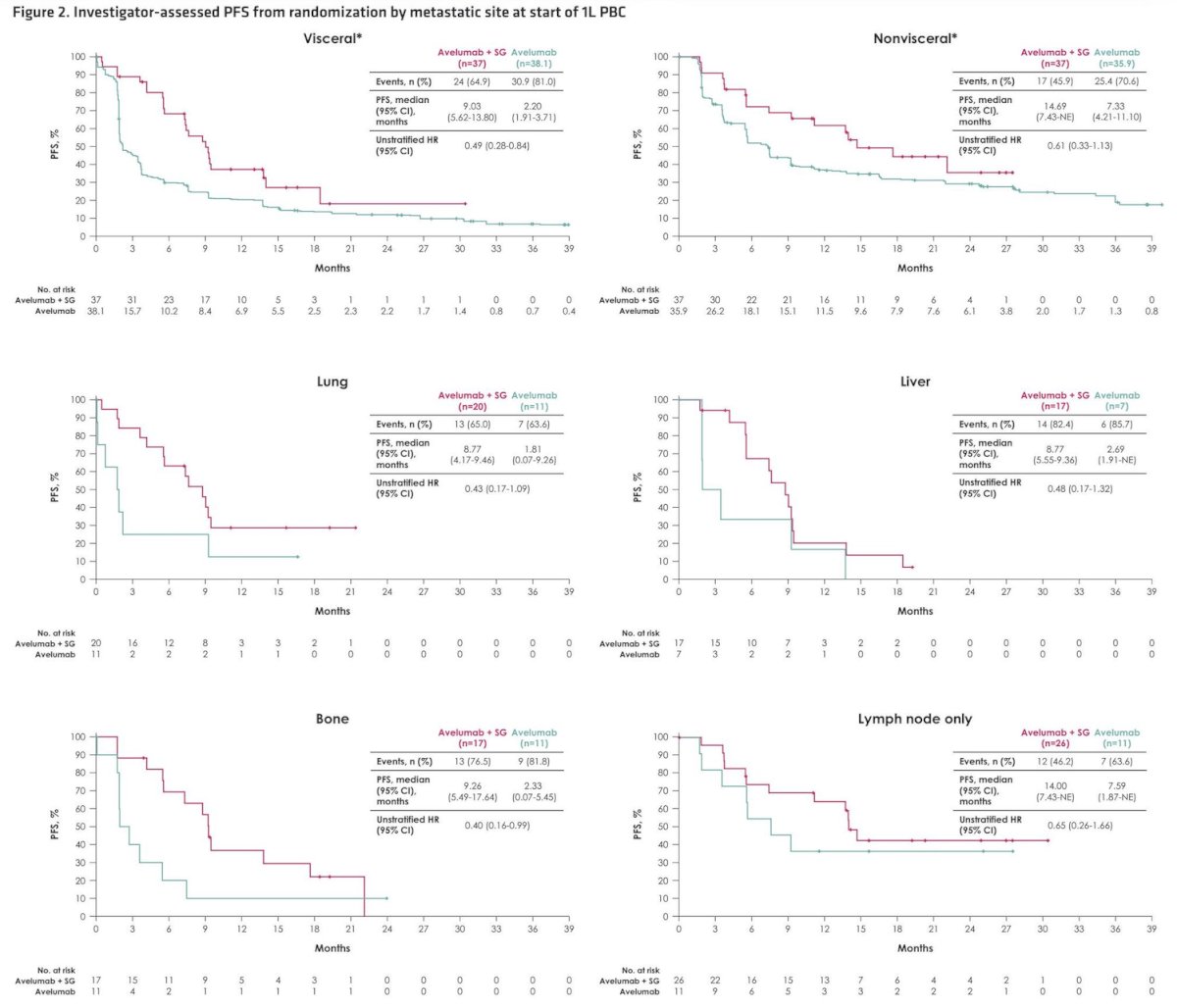
At the data cutoff (April 28, 2025), the median follow-up for progression free survival was 15.7 and 25.1 months in the avelumab monotherapy arm (including extended data). Across all subgroups, progression free survival was prolonged with avelumab + sacituzumab govitecan versus avelumab monotherapy:
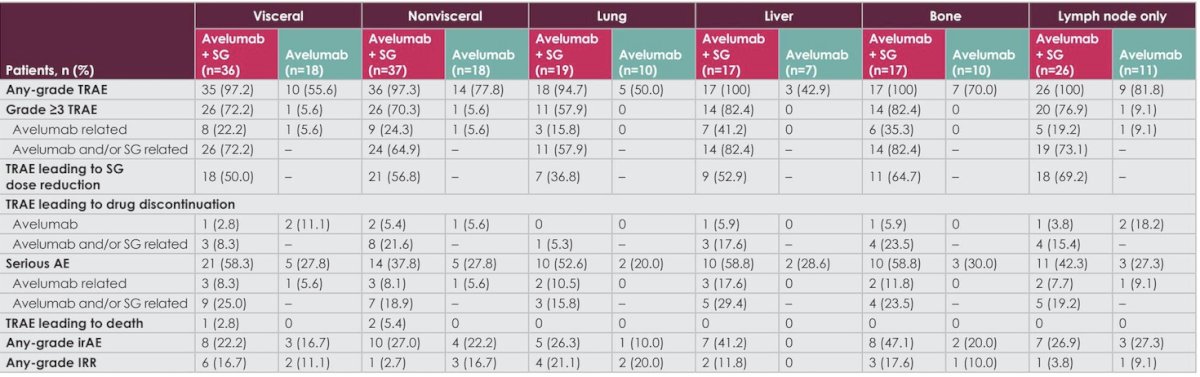
In the avelumab + sacituzumab govitecan and avelumab monotherapy arms, respectively, grade ≥3 treatment related adverse events occurred in 72.2% and 5.6% of patients with visceral metastases, 57.9% and 0% of patients with lung metastases, 82.4% and 0% of patients with liver metastases, 82.4% and 0% of patients with bone metastases, 70.3% and 5.6% of patients with non-visceral metastases, and 76.9% and 9.1% of patients with lymph node–only metastases:
Dr. Grivas concluded his presentation discussing an updated subgroup analyses of JAVELIN Bladder Medley based on metastatic sites assessing avelumab + sacituzumab govitecan versus avelumab monotherapy as first line maintenance treatment for advanced urothelial carcinoma, with the following take home points:
- Consistent with previous interim analysis findings, updated subgroup analyses from the primary analysis of the phase 2 JAVELIN Bladder Medley trial showed that avelumab + sacituzumab govitecan as first line switch maintenance had longer progression free survival versus avelumab monotherapy in patients with advanced urothelial carcinoma following non-progression with first line platinum-based chemotherapy, irrespective of metastatic site at start of first line platinum-based chemotherapy
- The addition of sacituzumab govitecan appeared to provide a greater degree of progression free survival benefit in patients with visceral or bone metastases than those with non-visceral or lymph node–only metastases
- Safety was generally consistent with known profiles of avelumab + sacituzumab govitecan and with results in the overall study population
Presented by: Petros Grivas, MD, PhD, University of Washington, Seattle, WA
Written by: Zachary Klaassen, MD, MSc – Urologic Oncologist, Associate Professor of Urology, Georgia Cancer Center, Wellstar MCG Health, @zklaassen_md on Twitter during the American Society of Clinical Oncology Genitourinary (ASCO) Annual Meeting held in Chicago, IL between May 29th and June 1st, 2026
References:
- Powles T, Park SH, Voog E, et al. Avelumab Maintenance Therapy for Advanced or Metastatic Urothelial Carcinoma. N Engl J Med 2020 Sept 24;383(13):1218-1230.
- Hoffman-Censits J, Tsiatas M, Chang PM, et al. Avelumab plus sacituzumab govitecan versus avelumab monotherapy as first-line maintenance treatment in patients with advanced urothelial carcinoma: JAVELIN Bladder Medley interim analysis. Ann Oncol. 2025 Sep;36(9):1088-1095.