

(UroToday.com) The 2025 ASCO annual meeting featured a urothelial carcinoma trials in progress session and a presentation by Dr. Katie Murray discussing the uTRACT registry, a single-arm, multicenter, prospective, and retrospective registry study to evaluate the real-world use of UGN-101 in participants with upper tract urothelial carcinoma in the United States. Upper tract urothelial carcinoma constitutes 5–10% of primary urothelial carcinomas, affecting two in 100,000 people in the US annually, with a peak incidence occurring in patients 70–90 years of age. Low-grade upper tract urothelial carcinoma represents 40% of the total disease burden. Endoscopically-guided ablation is often used to treat low-grade upper tract urothelial carcinoma, however recurrence is common, and the long-term surveillance risks potential complications in this elderly patient population.
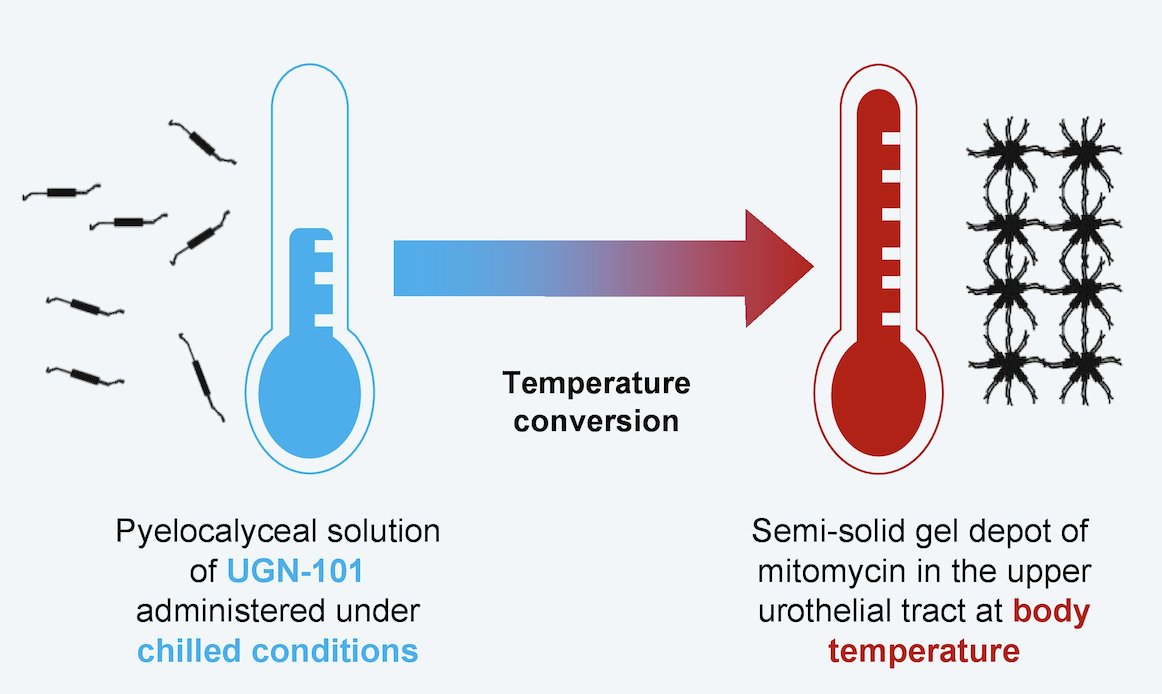
UGN-101 is a reverse thermal hydrogel formulation of mitomycin approved for chemoablative treatment of low-grade upper tract urothelial carcinoma, administered as a liquid in a chilled state, which converts to a gel depot at body temperature, resulting in a dwell time of 4–6 hours:
In the phase 3 OLYMPUS trial, 42 of the 71 low-grade upper tract urothelial carcinoma patients treated with UGN-101 achieved complete response at 3 months [1]. Among the 41 patients followed after complete response, median follow-up was 28.1 months (95% CI, 13.1-57.5), and median duration of response was 47.8 months (95% CI, 13.0-not estimable) [2].
The uTRACT registry (NCT05874921) is evaluating real-world data from patients administered UGN-101, post-FDA approval (April 15, 2020). Approximately 400 patients >18 years old with upper tract urothelial carcinoma who received ≥1 dose of UGN-101 will be enrolled at ~20 sites. Retrospective data will be collected from patients that received UGN-101 after approval as well as prospective data from newly eligible patients. UGN-101 is administered as 6 once weekly pyelocalyceal instillations retrograde via ureteral catheter or antegrade via a nephrostomy tube. Instillation volume is based on volumetric measurements, not to exceed 15 mL (60 mg of mitomycin). For participants with a complete response 3 months after the first dose, once monthly maintenance instillations may be administered (up to 11 additional doses).
Participant history and disease status are collected at baseline (prior to UGN-101 dosing), and dosing information, surveillance endoscopy and imaging results will be captured over a period of 3 years post baseline, at approximately 3, 6, 12, 24, and 36 months after the first instillation. Assessment of response will be based on endoscopic surveillance, imaging, cytology, and/or for-cause biopsy:

Data analysis will be performed on the overall cohort (~400 participants) and the low-grade upper tract urothelial carcinoma cohort (expected to be ~340 participants). Outcomes collected include no evidence of disease at 3-months, duration of response, recurrence free survival, time to recurrence/progression, and adverse events. The uTRACT registry started enrollment in 2023, and as of May 2025, 274 patients have been recruited to date from 22 sites across the US.
Presented by: Katie S. Murray, DO, NYU Langone Health, New York, NY
Written by: Zachary Klaassen, MD, MSc – Urologic Oncologist, Associate Professor of Urology, Georgia Cancer Center, Wellstar MCG Health, @zklaassen_md on Twitter during the American Society of Clinical Oncology (ASCO) 2025 Annual Meeting, Chicago, IL, Fri, May 30 – Tues, Jun 3, 2025.
References:
- Kleinmann N, Matin SF, Pierorazio PM, et al. Primary chemoablation of low-grade upper tract urothelial carcinoma using UGN-101, a mitomycin-containing reverse thermal gel (OLYMPUS): An open-label, single-arm, phase 3 trial. Lancet Oncol 2020 Jun;21(6):776-785.
- Pierorazio PM, Kleinmann N, Shabsigh A, et al. Long-term outcomes of primary chemoablation of low-grade upper tract urothelial carcinoma with UGN-101, a mitomycin reverse thermal gel. J Urol. 2025 Mar;213(3):313-322.