

(UroToday.com) The 2025 American Society of Clinical Oncology (ASCO) Annual Meeting held in Chicago, IL between May 30 and June 3 was host to the Poster Session: Genitourinary Cancer - Prostate, Testicular, and Penile Cancer. Dr. Amy Shaver presented Poster 5024: Use of GIP and GLP-1 receptor agonists in prostate cancer patients.
Dr. Shaver opened his presentation by noting the increasing use of glucagon-like peptide-1 receptor agonists (GLP-1 RAs) and dual glucose-dependent insulinotropic polypeptide (GIP)/GLP-1 receptor agonists (GIP/GLP-1 RAs) in recent years. Given that the GLP-1 receptor is expressed in metastatic prostate cancer (PCa) tissue, there is growing interest in the potential impact of these agents on PCa outcomes. Despite this, no large-scale, real-world analysis has yet evaluated the use of these medications in patients with PCa across a contemporary and diverse cohort.
The investigators presented a national, retrospective cohort study evaluating GLP-1 RA and GIP/GLP-1 RA use among adults with an active diagnosis of PCa using the Epic Cosmos database. This large, deidentified electronic health record (EHR) dataset spans over 293 million patients across 1,633 hospitals and more than 37,900 clinics. The study included patients who initiated a GLP-1 RA or GIP/GLP-1 RA between January 1, 2015, and December 31, 2024. The primary endpoint was the overall percent use and change in use over time of GIP/GLP-1 RA, while secondary endpoints included demographic and clinical factors associated with medication use.
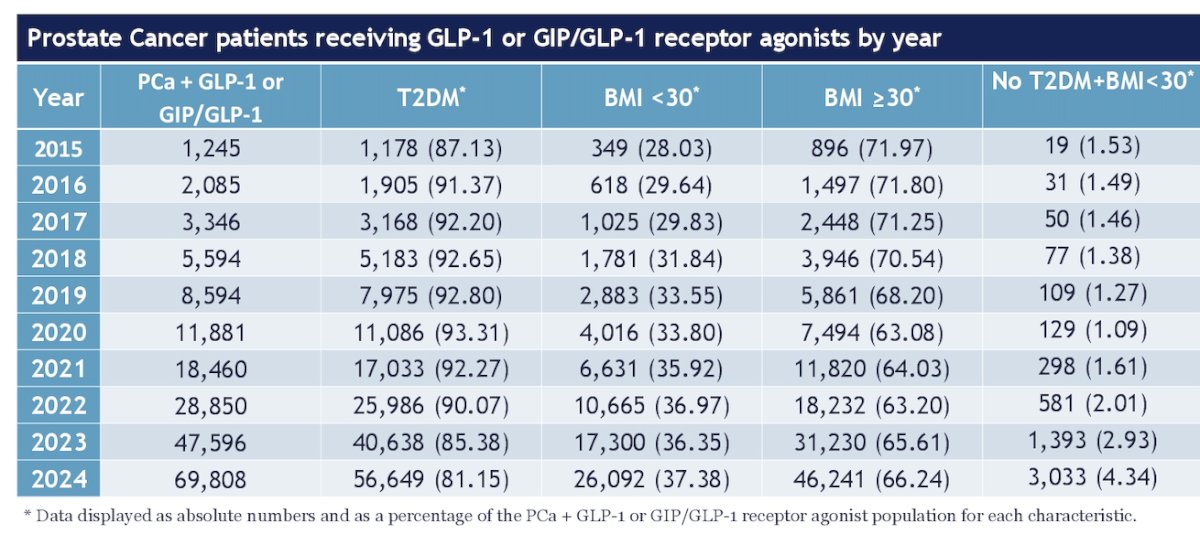
This study included 197,459 PCa patients with a median age of 75 years who received a GLP-1 or GIP/GLP-1 receptor agonist. The proportion of PCa patients using these agents increased markedly over time, rising from 1,245 (0.42%) in 2015 to 69,808 (6.0%) in 2024.
Among PCa patients with type 2 diabetes mellitus, those with a low social vulnerability index (SVI <c25th percentile) were more likely to receive these medications compared to patients with high SVI (≥75th percentile) (OR 1.20, 95% CI 1.16–1.24). Patients aged ≥ 65 years had 59
% lower odds of receiving these medications compared to those under 65 (OR 0.41, 95% CI 0.40–0.42).
Obese patients had significantly higher odds of receiving a GLP-1 RA or GIP/GLP-1 RA than non-obese counterparts (OR 1.88, 95% CI 1.85–1.90), while patients aged ≥65 had lower odds compared to those under 65 (OR 0.41, 95% CI 0.40–0.42).
Additionally, opioid use was more common among type 2 diabetes mellitus PCa patients on GLP-1 RA or GIP/GLP-1 RA (OR 1.14, 95% CI 1.12–1.16). Notably, the proportion of PCa patients receiving these medications without type 2 diabetes mellitus or obesity has grown over time, suggesting expanding use beyond traditional indications as illustrated in the table below.
The investigators concluded that the Epic Cosmos study showed that:
- Use of GLP-1 RA and GIP/GLP-1 RA medications among patients with prostate cancer has significantly increased over the past decade.
- Utilization is influenced by age, obesity status, and social vulnerability index with higher use in younger, obese, and lower-SVI patients.
- A notable association was observed between use of these agents and higher odds of opioid medication receipt.
- These trends highlight the need for ongoing and future research to assess the impact of GLP-1 RA and GIP/GLP-1 RA on PCa progression and long-term outcomes.
Presented by: Amy L Shaver, PhD, PharmD, MPH, Department of Medical Oncology, Thomas Jefferson University. Philadelphia, Pennsylvania, United States
Written by: Julian Chavarriaga, MD – Urologic Oncologist at Cancer Treatment and Research Center (CTIC) via Society of Urologic Oncology (SUO) Fellow at The University of Toronto. @chavarriagaj on Twitter during the American Society of Clinical Oncology (ASCO) 2025 Annual Meeting, Chicago, IL, Fri, May 30 – Tues, Jun 3, 2025.
Related content: Metabolic Drugs and Prostate Cancer: Analyzing GLP-1 Agonist Use in Patients - Amy Shaver