

(UroToday.com) The 2025 American Society of Clinical Oncology (ASCO) Annual Meeting held in Chicago, IL between May 30th and June 3rd, 2025, was host to a prostate, testicular, and penile cancers poster session. Dr. Lisa Horveth presented a study evaluating the association of circulating immune and metabolic markers with clinical outcomes in the phase III ENZAMET trial.
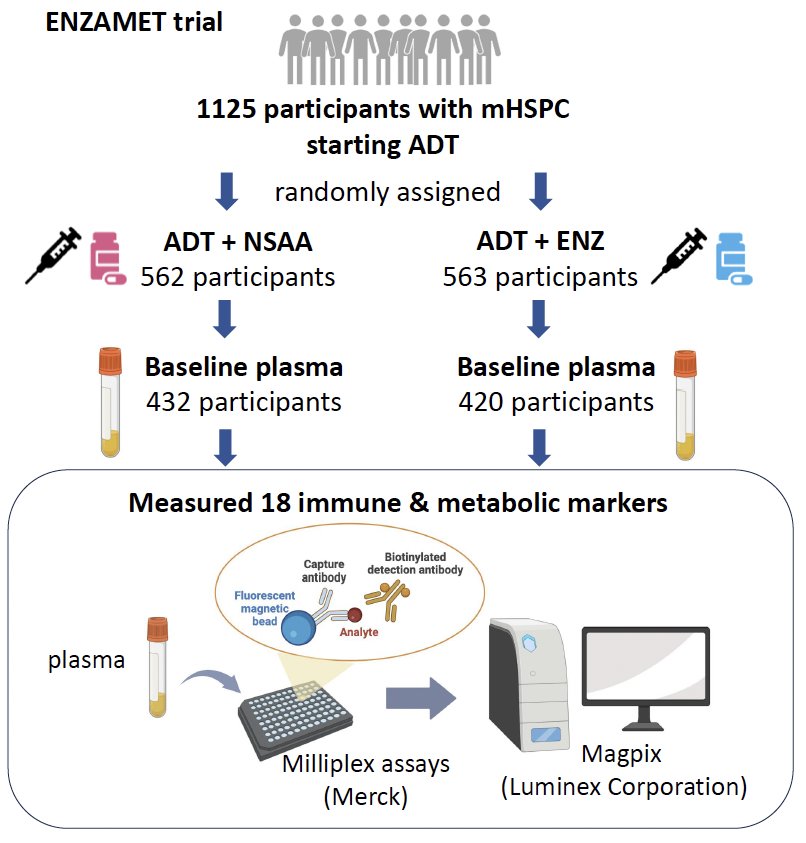
In the ENZAMET trial, 1,125 participants with metastatic hormone sensitive prostate cancer (mHSPC) were randomized to receive androgen deprivation therapy (ADT) + either enzalutamide or a non-steroidal anti-androgen (NSAA). Compared to ADT + NSAA, patients receiving ADT + enzalutamide had improved overall survival (OS) outcomes (HR: 0.70, 95% CI: 0.58–0.84, p<0.001). The 5-year overall survival rates were 67% versus 57%. Notably, however, 11% of mHSPC patients receiving ADT + enzalutamide experienced mortality within two years of initiating therapy, suggesting enzalutamide ‘resistance’.1,2 In the CHAARTED trial, the addition of docetaxel to ADT improved overall survival (HR: 0.61, 95% CI: 0.47–0.80, p<0.001).3,4
There has been increased interest in evaluating circulating immune and metabolic markers as potential prognostic biomarkers in metastatic prostate cancer. Serum IL8, IGFBP1, and the IGF1:IGFPB1 ratio were prognostic for OS in CHAARTED.5,6 Correspondingly, in metastatic castration-resistant prostate cancer (mCRPC), plasma IL8, IL6, YKL40, MIC1, IL17E, IL28A and IL33 were demonstrated to be prognostic of survival outcomes.7
The study objectives were to perform post-hoc analyses of the ENZAMET trial to:
- Validate the prognostic association of circulating IL8, IGFBP1 and IGF1:IGFBP1 ratio in mHSPC
- Assess the association of a panel of inflammation markers and cytokines with clinical outcomes in mHSPC
Baseline plasma levels of IL8, IGF1, IGFBP1, C-reactive protein (CRP), and 14 other cytokines were profiled in 852 participants of ENZAMET using Milliplex antibody assays (Merck). The association of these markers with OS and clinical progression-free survival (cPFS) was assessed using Cox regression analyses.
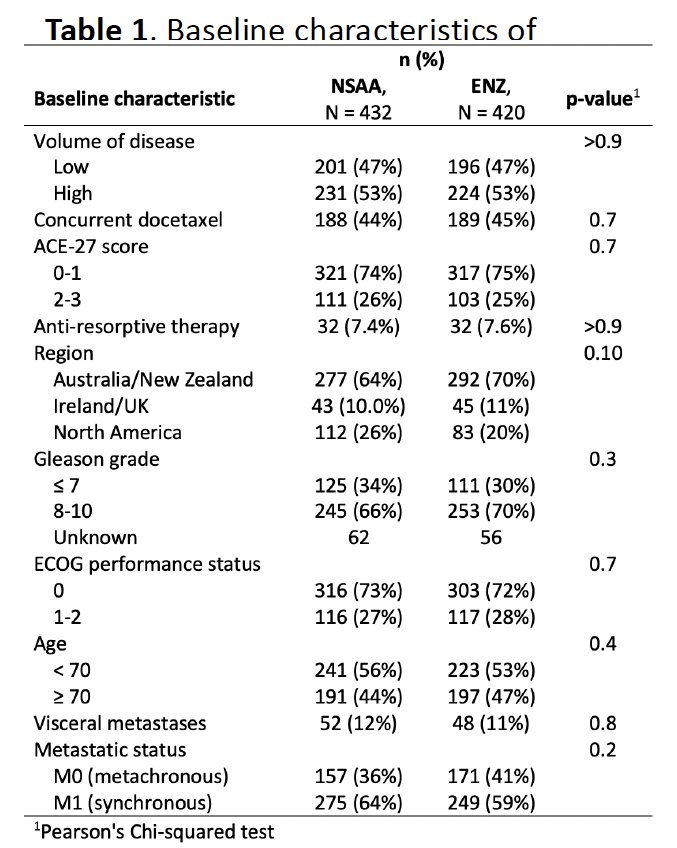
The baseline characteristics are summarized below:
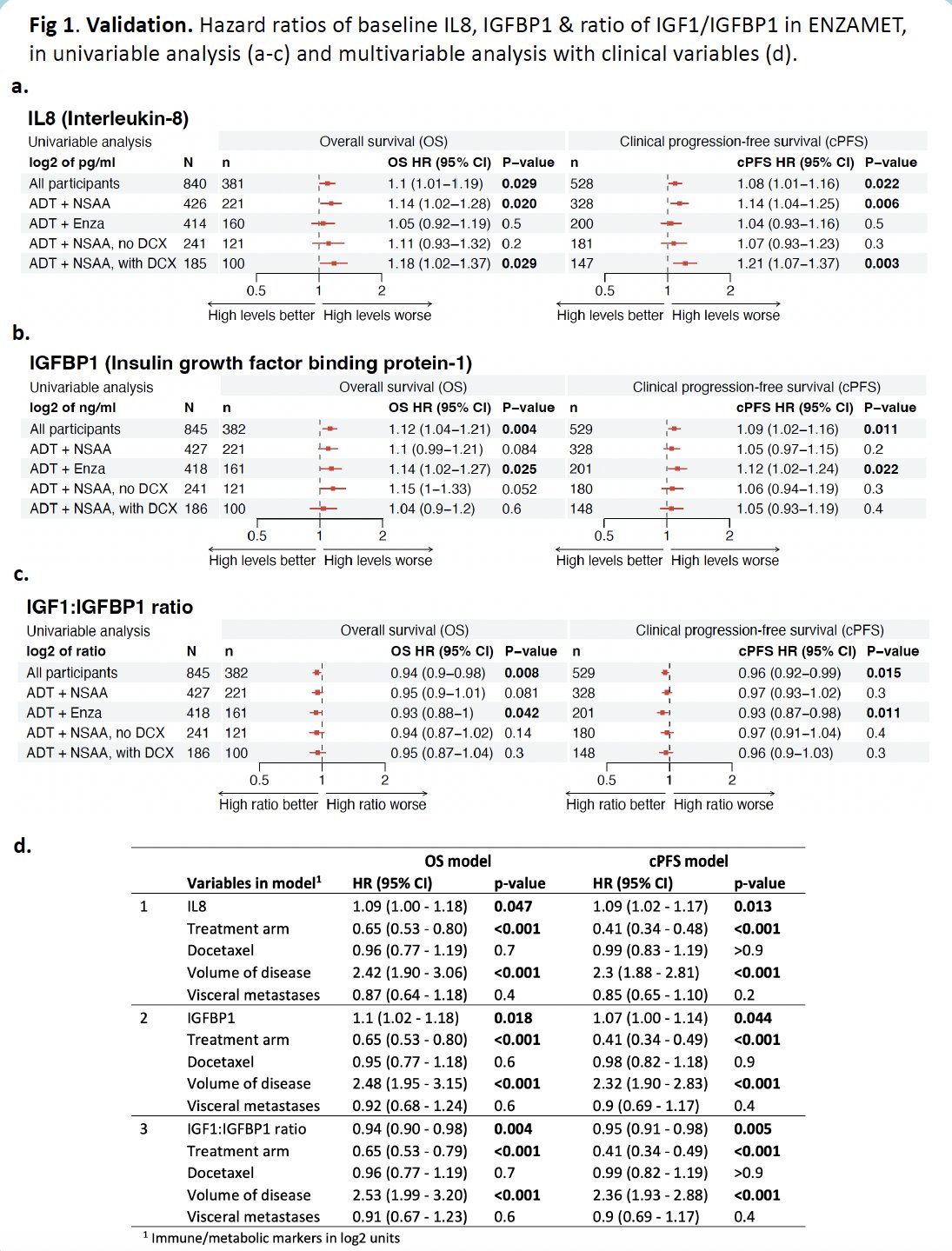
IL8, IGFBP1 and IGF/IGFBP1 were confirmed to be independent prognostic biomarkers in mHSPC patients treated with ADT + enzalutamide or ADT + NSAA (Fig 1).
Some of the exploratory circulating immune markers were also independent prognostic markers.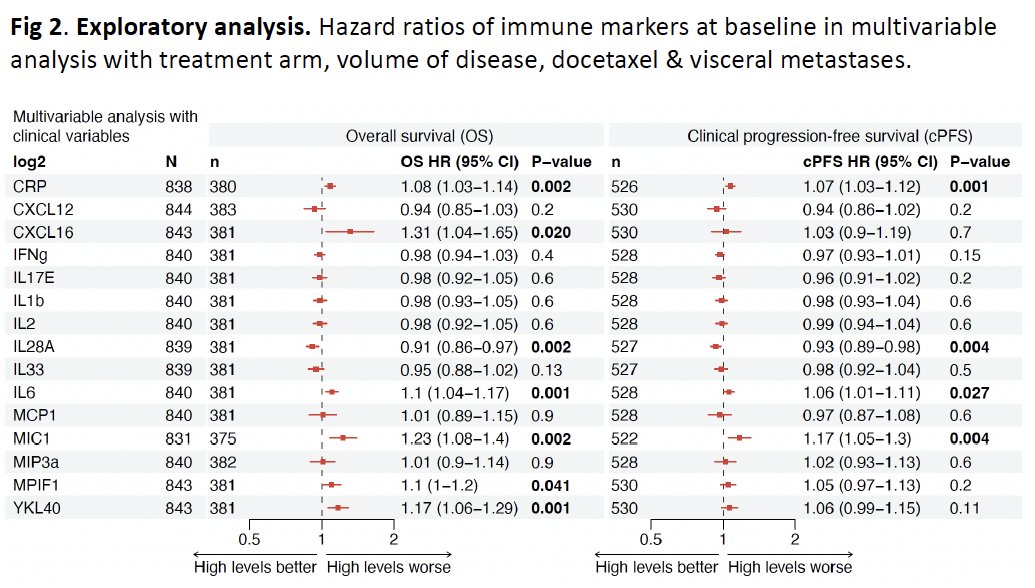
None of the markers were predictive of enzalutamide response (interaction p>0.05).
Dr. Horvath concluded as follows:
- IL8, IGFBP1, and IGF1:IGFBP1 ratio were validated as prognostic biomarkers in mHSPC:
- Higher IL8 and higher IGFBP1 levels were associated with worse OS.
- Higher IGF1:IGFBP1 ratio was associated with better OS.
- Several pro-inflammatory (CRP, CXCL16, IL6, MPIF1), anti-tumour (IL28A), and macrophage-associated (MIC1, YKL40) proteins/cytokines were associated with poorer clinical outcomes in mHSPC.
- None of the markers were predictive of response to enzalutamide.
Presented by: Lisa Horvath, PhD, FRACP, MBBS, Professor, Medical Oncology, Chris O’Brien Lifehouse, University of Sydney, Sydney, Australia
Written by: Rashid K. Sayyid, MD, MSc – Robotic Urologic Oncology Fellow at The University of Southern California, @rksayyid on Twitter during the American Society of Clinical Oncology (ASCO) 2025 Annual Meeting, Chicago, IL, Fri, May 30 – Tues, Jun 3, 2025.
Related content: Exploring IGF-1 Pathway Biomarkers and Outcomes in Metastatic Hormone-Sensitive Prostate Cancer - Lisa Horvath
- Davis ID, Martin AJ, Stockler MR, et al. Enzalutamide with Standard First-Line Therapy in Metastatic Prostate Cancer. N Engl J Med. 2019; 381(2):121-131.
- Sweeney CJ, Martin AJ, Stockler MR, et al. Testosterone suppression plus enzalutamide versus testosterone suppression plus standard antiandrogen therapy for metastatic hormone-sensitive prostate cancer (ENZAMET): An international, open-label, randomized, phase 3 trial. Lancet Oncol. 2023; 24(4):323-334.
- Sweeney CJ, Chen YH, Carducci M, et al. Chemohormonal Therapy in Metastatic Hormone-Sensitive Prostate Cancer. N Engl J Med. 2015; 373(8):737-746.
- Kyriakopoulos CE, Chen YH, Carducci MA, et al. Chemohormonal therapy in metastatic hormone-sensitive prostate cancer: Long-term survival analysis of the randomized phase III E3805 CHAARTED trial. J Clin Oncol. 2018; 36(11):1080-1087.
- Harshman LC, Drake CG, Smith MR, et al. Androgen receptor antagonists in prostate cancer: emerging evidence and evolving treatment landscape. Prostate. 2020; 80:1429.
- Ravi P, Sonpavde G, Yu EY, et al. Androgen receptor pathway inhibitors in prostate cancer: resistance mechanisms and emerging strategies. Endocr Relat Cancer. 2023; 30:e230241.
- Lin C, Yang L, Tanasa B, et al. Androgen receptor signaling in prostate cancer progression and therapy resistance. Cancers (Basel). 2021; 13:4964.