

(UroToday.com) The 2025 American Society of Clinical Oncology (ASCO) Annual Meeting held in Chicago, IL between May 30th and June 3rd, 2025, was host to a prostate, testicular, and penile cancers poster session. Dr. Zahra Sabahi presented a study evaluating the prognostic value of PSMA PET, versus CHAARTED criteria, in an ENZAMET sub-cohort.
The CHAARTED criteria, which are defined based on CT and bone scan findings, are an important prognostic biomarker for mHSPC patients and are used to guide treatment intensification.1 However, clinicians are increasingly using PSMA PET/CT scans in lieu of conventional imaging for staging prostate cancer, and PSMA PET/CT criteria for poor prognostic mHSPC are yet to be defined.
The study objective was to determine features on PSMA PET/CT that correlate with progression-free (PFS) and overall survivals (OS) in the context of CHAARTED criteria using an ENZAMET sub-cohort. This was a retrospective analysis of the randomized, phase III ENZAMET trial study cohort (NCT02446405).2 In this trial, eligible mHPSC patients staged using conventional imaging (i.e., CT and bone scan) were randomized 1:1 to receive testosterone suppression + enzalutamide or a non-steroidal anti-androgen (NSAA). The study investigators included ENZAMET participants who underwent PSMA PET/CT prior to study enrolment for this sub-study. They identified 100 participants (51 enzalutamide; 49 NSAA) who had a 68GaPSMA-11-PET/CT performed prior to enrolment in ENZAMET at Australian trial sites.
The primary and secondary study objectives were as follows:
- Primary: To develop PSMA PET/CT criteria that stratify patients with mHSPC into prognostic groups
- Secondary:
- To compare high and low volume disease on standard imaging to findings on PSMA PET/CT
- Define the quantitative volume of PSMA PET/CT disease that is equivalent to high volume disease on standard imaging.
The baseline characteristics are summarized below. The median patient age was 69 years. Of the 100 patients, 26% had CHAARTED low volume disease and 74% had high volume disease. 46% had synchronous metastases.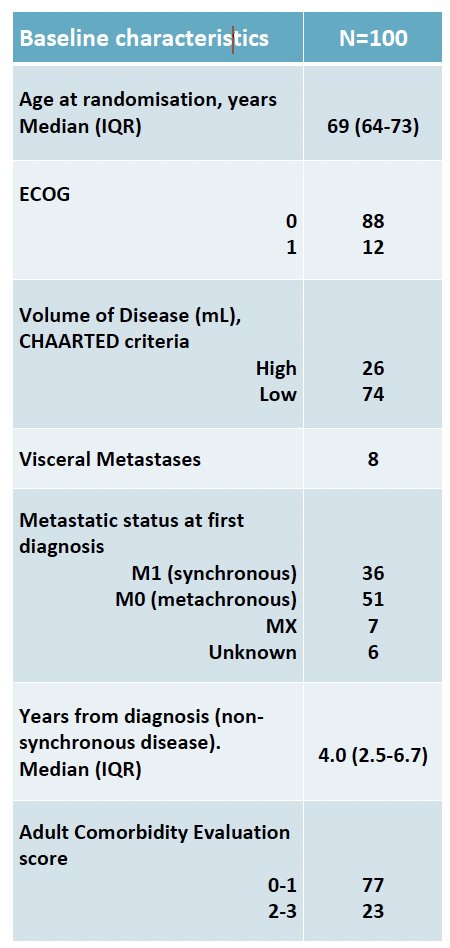
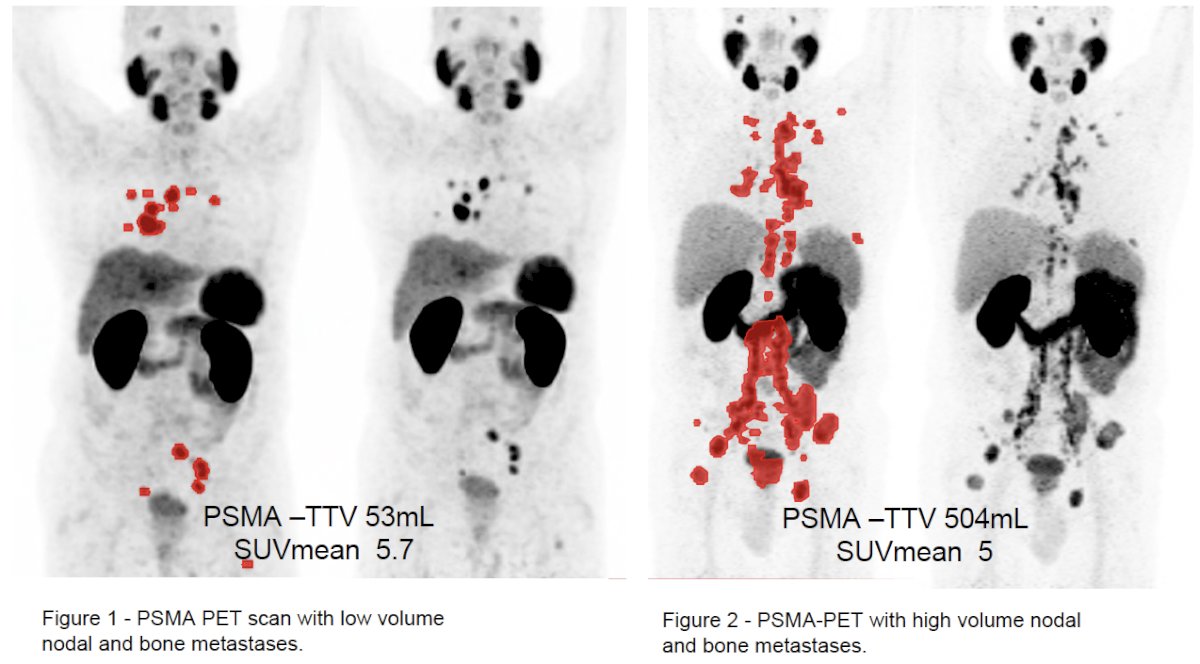
On PSMA PET/CT, 19/100 participants had bone-only disease, 37/100 LN-only disease, 32/100 bone and LN disease, and 6 had visceral involvement. In 54 patients with bone involvement on PSMA-PET/CT, 53 had concordant findings on bone scan.
The median PSMA total tumor volume (PSMA-TTV) in the study cohort was 28 mL (CHAARTED high volume: 61 mL; CHAARTED low volume: 22 mL), with the highest PSMA TTV quartile (Q4) defined at >71mL.
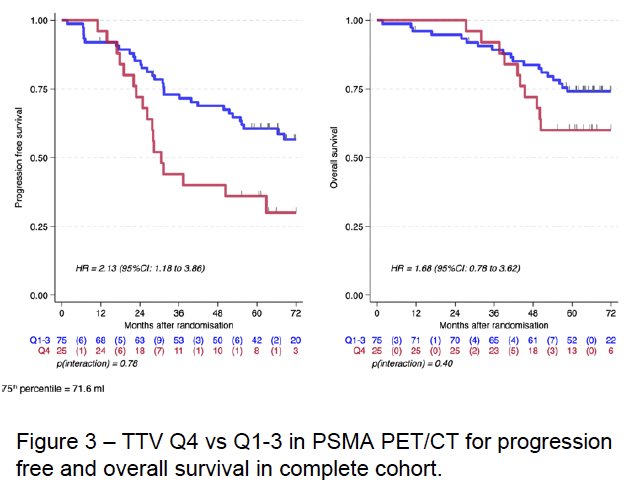
The 5-year PFS for the highest PSMA TTV (i.e., Q4) was 36%, compared to 61% for those with a PSMA TTV in the 1st to 3rd quartiles (HR, per doubling of PSMA TTV: 1.19, 95% CI: 1.03–1.38, p=0.011).
The 5-year OS for the highest PSMA TTV (i.e., Q4) was 60%, compared to 74% for those with a PSMA TTV in the 1st to 3rd quartiles (p=0.18).
Among patients with CHAARTED low volume mHSPC, the highest PSMA TTV quartile (i.e., Q4) was > 63 mL. Among CHAARTED low volume mHSPC, 5-year survival rates for PSMA TTV Q4 versus Q1-3 were as follows:
- PFS: 21% versus 61% (p<0.001)
- OS: 53% versus 74% (p=0.11)

Dr. Sabahi concluded that PSMA-TTV is associated with PFS for mHSPC patients in this ENZAMET sub-cohort, with the highest volume quartile showing significantly shorter PFS, including within the CHAARTED criteria low volume cohort. She argued that further validation of PSMA-TTV as a prognostic biomarker with potential for identifying patients for treatment intensification is warranted in larger mHSPC cohorts.
Presented by: Zahra Sabahi, MD, Nuclear Medicine Physician, St Vincent's Hospital Sydney and Garvan Institute of Medical Research, Sydney, Australia
Written by: Rashid K. Sayyid, MD, MSc – Robotic Urologic Oncology Fellow at The University of Southern California, @rksayyid on Twitter during the American Society of Clinical Oncology (ASCO) 2025 Annual Meeting, Chicago, IL, Fri, May 30 – Tues, Jun 3, 2025.
References:- Sweeney CJ, Chen YH, Carducci M, et al. Chemohormonal Therapy in Metastatic Hormone-Sensitive Prostate Cancer. N Engl J Med. 2015; 373(8):737-746.
- Davis ID, Martin AJ, Stockler MR, et al. Enzalutamide with Standard First-Line Therapy in Metastatic Prostate Cancer. N Engl J Med. 2019; 381(2):121-131.