

(UroToday.com) The 2025 American Society of Clinical Oncology (ASCO) Annual Meeting, held in Chicago, IL, was host to the Poster Session: Genitourinary Cancer - Prostate, Testicular, and Penile Cancer. Dr. Neeraj Agarwal presented the trial in progress Poster TPS5113: Mevrometostat in combination with enzalutamide in patients with metastatic castration-resistant prostate cancer (mCRPC) previously treated with abiraterone acetate: The phase 3, randomized MEVPRO-1 study
Resistance to androgen receptor pathway inhibitors (ARPIs), such as abiraterone and enzalutamide, in metastatic castration-resistant prostate cancer (mCRPC) is frequently driven by mechanisms that sustain AR signaling.1-3 Enhancer of zeste homolog 2 (EZH2), a histone methyltransferase, has been implicated in promoting ARPI resistance through tumor suppressor gene silencing, AR transcriptional activation, and neuroendocrine transdifferentiation.4-6 As such, combining ARPIs with targeted agents like EZH2 inhibitors may help overcome resistance and extend treatment benefit.
Mevrometostat (PF-06821497) is a potent, selective EZH2 inhibitor.7 Enzalutamide, a widely used ARPI, is approved across several prostate cancer settings, including mCRPC, metastatic castration-sensitive prostate cancer (mCSPC), and nonmetastatic CRPC.8 In the absence of standardized treatment sequencing after first-line ARPI failure, real-world practice often involves switching from abiraterone to enzalutamide, especially in patients ineligible for chemotherapy. However, this strategy is often limited by cross-resistance.9,10 Despite this, retrospective data suggest improved PSA responses and a trend toward enhanced overall survival with this switch.12,13
A phase 1/2 dose-expansion study (NCT03460977) evaluating mevrometostat plus enzalutamide demonstrated preliminary efficacy and a manageable safety profile in patients with prior ARPI exposure.14 Notably, Diarrhea, dysgeusia, and anemia were the most common adverse events considered to be related to mevrometostat. The current trial aims to evaluate radiographic progression-free survival (rPFS), overall survival (OS), and safety of mevrometostat plus enzalutamide compared with standard of care in patients with mCRPC previously treated with abiraterone.
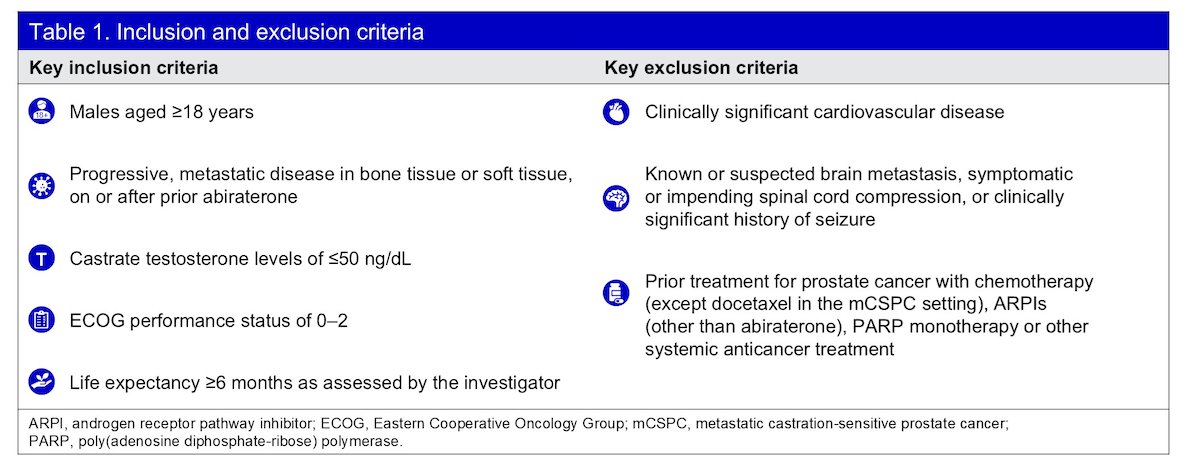
MEVPRO-1 (NCT06551324) is a global, open-label, phase 3 trial enrolling patients with metastatic castration-resistant prostate cancer (mCRPC) who are ≥18 years old and have radiographic disease progression following ≥12 weeks of abiraterone treatment. Eligible participants must have castration-level testosterone (≤50 ng/dL), an ECOG performance status of 0–2, and a life expectancy of at least 6 months. The key inclusion and exclusion criteria are detailed in the table below:
Approximately 600 patients will be randomized 1:1 to receive mevrometostat (875 mg orally twice daily with food) in combination with enzalutamide (160 mg once daily), or physician’s choice of either enzalutamide monotherapy (160 mg once daily) or docetaxel (75 mg/m² intravenously every 21 days). Randomization will be stratified based on prior use of docetaxel in the metastatic castration-sensitive setting, physician’s choice of comparator arm (enzalutamide vs. docetaxel), and the presence of hepatic metastases. The study design is shown below.
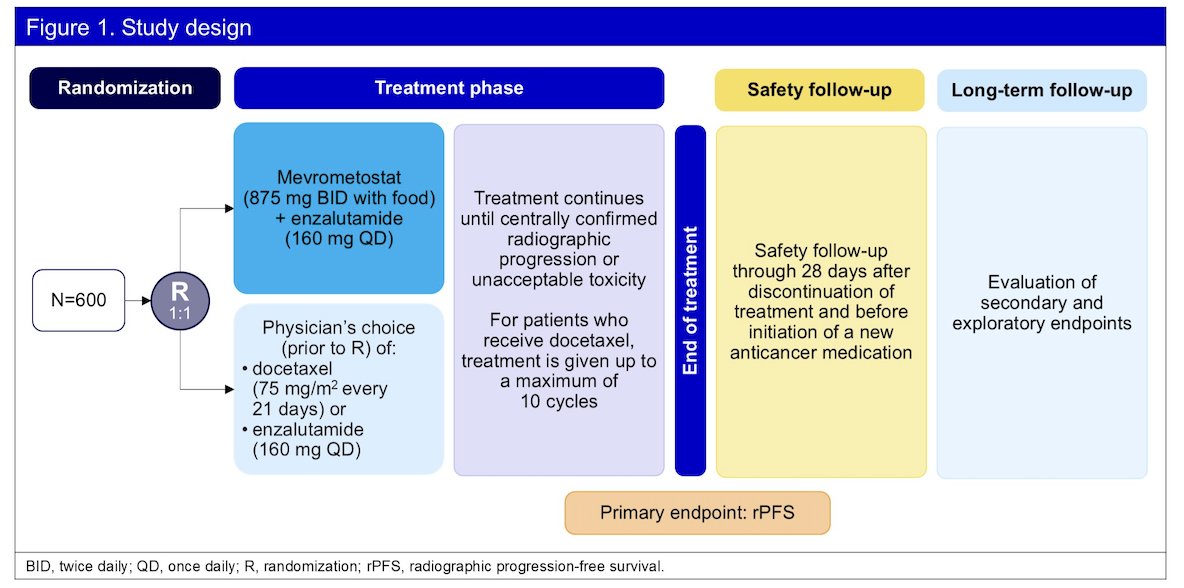
The primary endpoint of the MEVPRO-1 trial is radiographic progression-free survival (rPFS), assessed by blinded independent central review according to RECIST 1.1 criteria for soft tissue and PCWG3 criteria for bone metastases. Other secondary and exploratory endpoints are summarized in the table below:

The investigators reported that time-to-event endpoints will be analyzed using a stratified log-rank test. Hazard ratios (HRs) and 95% confidence intervals (CIs) will be estimated using a stratified Cox proportional hazards model, and Kaplan–Meier curves will be used to summarize survival distributions.
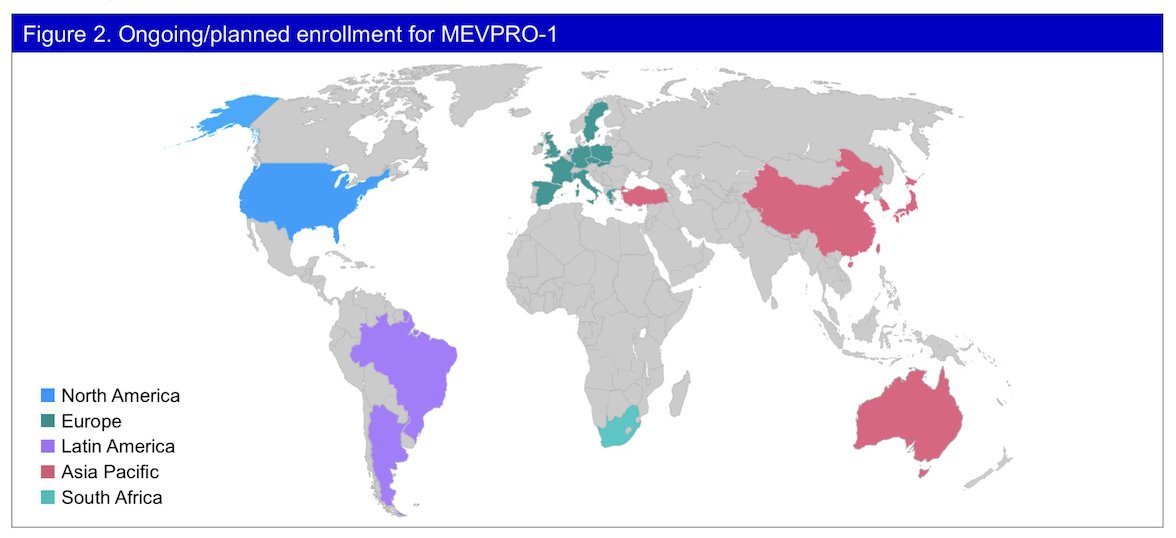
The first patient was enrolled in the study on October 21, 2024. Enrollment for MEVPRO-1 is planned or currently ongoing across multiple global regions, including Asia Pacific, Europe, Latin America, North America, and South Africa. The study is projected to be completed in October 2028.
Presented by: Neeraj Agarwal, MD, FASCO, Huntsman Cancer Institute (NCI-CCC), University of Utah, Utah, United States.
Written by: Julian Chavarriaga, MD – Urologic Oncologist at Cancer Treatment and Research Center (CTIC) via Society of Urologic Oncology (SUO) Fellow at The University of Toronto. @chavarriagaj on Twitter during the American Society of Clinical Oncology (ASCO) 2025 Annual Meeting, Chicago, IL, Fri, May 30 – Tues, Jun 3, 2025
Related content: EZH2 Inhibition in Prostate Cancer: MEVPRO-1 Phase III Trial Update - Neeraj Agarwal
References:
- Armenia J, Wankowicz SAM, Liu D, et al. The long tail of oncogenic drivers in prostate cancer. Nat Genet. 2018;50(5):645-651.
- Quigley DA, Dang HX, Zhao SG, et al. Genomic hallmarks and structural variation in metastatic prostate cancer. Cell. 2018;174(3):758-769.e9.
- Wedge DC, Gundem G, Mitchell T, et al. Sequencing of prostate cancers identifies new cancer genes, routes of progression, and drug targets. Nat Genet. 2018;50(5):682-692.
- Beltran H, Prandi D, Mosquera JM, et al. Divergent clonal evolution of castration-resistant neuroendocrine prostate cancer. Clin Cancer Res. 2019;25(23):6916-6924.
- Ku SY, Rosario S, Wang Y, et al. Rb1 and Trp53 cooperate to suppress prostate cancer lineage plasticity, metastasis, and antiandrogen resistance. Science. 2017;355(6320):78-83.
- Berger A, Brady NJ, Bareja R, et al. N-Myc-mediated reprogramming drives lineage plasticity in advanced prostate cancer. J Clin Invest. 2019;129(9):3924-3940.
- Kung P-P, Snyder LB, Stabile MR, et al. Potent and selective phosphodiesterase 10A inhibitors for the treatment of schizophrenia. J Med Chem. 2018;61(3):650-665.
- Astellas Pharma US Inc. Full prescribing information: XTANDI® (enzalutamide) for oral use. https://www.astellas.us/docs/us/12A005-ENZ-WPI.pdf. Published 2023. Accessed November 6, 2024.
- Gillessen S, Attard G, Beer TM, et al. Management of patients with advanced prostate cancer: The Report of the Advanced Prostate Cancer Consensus Conference APCCC 2017. Eur Urol. 2018;73(2):178-211.
- de Bono JS, Fizazi K, Saad F, et al. Central results from a randomized, phase III trial of abiraterone acetate plus prednisone in patients with metastatic castration-resistant prostate cancer after progression on docetaxel: The COU-AA-301 trial. Eur Urol. 2018;74(1):37-45.
- George DJ, Srinivas S, Armstrong AJ, et al. Personalized oncology through integrating clinical and molecular information in advanced prostate cancer: The PROMOTE Study. Prostate Cancer Prostatic Dis. 2024;27(4):756-764.
- Chung DY, Kim S, Suh YE, et al. Comparative analyses of tumor immunity and immune cell characteristics among molecular subtypes of bladder cancer. Cancers (Basel). 2019;12(1):8.
- Khalaf DJ, Annala M, Taavitsainen S, et al. Phase 2 randomized clinical trial of bipolar androgen therapy for men with metastatic castration-resistant prostate cancer. Lancet Oncol. 2019;20(12):1730-1739.
- Schweizer MT, Gulati R, Montgomery B, et al. Early effects of androgen deprivation therapy and survival in men with localized prostate cancer: Results from the Scandinavian Prostate Cancer Group-4 trial. J Clin Oncol. 2024;42(16_suppl):5061.